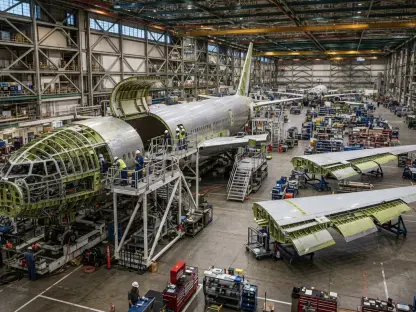
The Fragility of Aerospace Giants and the Power of Niche Suppliers The immense complexity of modern aerospace manufacturing ensures that even a global giant like Boeing remains remarkably vulnerable to the operational stability of its smallest specialized partners. While the industry is often

The Department of Defense recently showcased a swarm of four unmanned ground vehicles at Fort Knox to test how autonomous strike teams might secure the European eastern flank. This demonstration highlights a pivot toward high-technology solutions to address modern geopolitical tensions. By

Providing technical documentation in both English and Russian proved essential for facilitating clear communication between equipment suppliers and local producers. This strategic decision by Shandong Sensitar Industrial Equipment Co., Ltd. during the AGROPRODMASH exhibition in Moscow emphasized

Strategic utilization of weekly lorry shipments from Poland to the Benelux region allows Adelmund Furniture to maintain low shipping costs for its retail clients. This logistical advantage serves as a cornerstone for a company that has successfully transitioned from a traditional furniture agency

While AI can generate watertight 3D solids, translating those digital shapes into mechanical solutions that withstand physical stress remains a challenge. In a groundbreaking exploration of the intersection between artificial intelligence and functional manufacturing, developer Yadullah Abidi

While purchasing teams focus on acquiring a bill of materials, the manufacturing process remains stalled until every manufacturer part number is verified for both availability and technical compatibility. The transition from a digital prototype to a physical assembly represents a high-stakes bridge
1 2 3 4 5 6 7 8 9 10 11 12 13 14 15 16 17 18 19 20 21 22 23 24 25 26 27 28 29 30 31 32 33