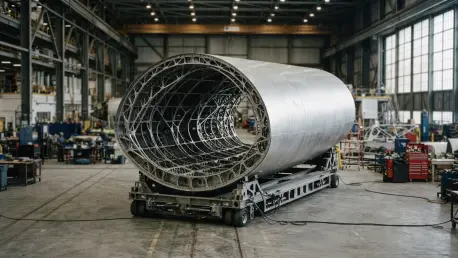

Engineers at the Shenyang Aircraft Design and Research Institute have successfully produced a 16.4-foot integrated structural component for the central fuselage of advanced fighter jets. This achievement marks a significant departure from traditional manufacturing constraints, where large-scale airframe sections typically required dozens of individual parts to be forged, machined, and meticulously joined through intensive labor. By leveraging advanced metal additive manufacturing, the institute is effectively bypassing the need for complex molds and heavy industrial tooling that once slowed the production cycle. This shift toward large-format 3D printing allows for the creation of monolithic structures that distribute stress more efficiently across the airframe. As the global race for air superiority intensifies, this capability provides a clear logistical and performance advantage, enabling faster iteration of prototypes and more resilient production pipelines for current frontline combat platforms.
Structural Innovations in Modern Aviation
Part 1: Consolidating Large Fuselage Components
The primary objective of this shift is to revolutionize airframe construction by reducing structural weight and streamlining the manufacturing pipeline into a more cohesive process. Traditionally, the central fuselage acts as the skeletal core of the aircraft, bearing the brunt of high-G maneuvers and aerodynamic stresses. In previous design generations, this section was assembled from hundreds of separate ribs, spars, and fasteners, each representing a potential point of failure and adding unnecessary bulk. The Shenyang Institute’s new approach eliminates these vulnerabilities by printing the entire 16.4-foot structure as a single piece. This method significantly optimizes material distribution, placing high-density titanium or specialized alloys only where they are most needed. Consequently, the resulting airframe is not only lighter but also possesses a superior strength-to-weight ratio compared to components manufactured through conventional subtractive milling or casting.
Part 2: Overcoming Thermal Challenges in Production
Overcoming the inherent risks of printing such massive metal objects required the development of specialized additive fusion joining techniques that maintain structural integrity. When printing large volumes of metal, thermal stress often leads to warping, cracking, or internal microscopic defects that can compromise the safety of a high-performance aircraft. To mitigate these issues, engineers pioneered a segmented printing strategy that allows for precise control over the cooling rates and grain structures within the metal. These segments are later fused together using proprietary high-energy welding processes that maintain the metallurgical properties of the original print. This breakthrough ensures that the finished component behaves as a truly monolithic unit, capable of withstanding the extreme environmental conditions of supersonic flight. By moving these laboratory innovations into full-scale production, the institute has demonstrated that 3D printing is no longer restricted to small brackets.
Strategic Implementation and Future Utility
Part 3: Material Diversity and Multi-Functional Systems
The application of these additive technologies extends across a broad spectrum of current aviation platforms, including the J-11, J-15, and the J-35 stealth fighter series. To meet the diverse requirements of these different airframes, the Shenyang Institute has successfully deployed 13 distinct metal materials and utilized six specialized printing processes. This versatility allows engineers to select the exact material properties needed for specific environments, from heat-resistant alloys in engine bays to high-fatigue-resistant metals for landing gear. Perhaps the most intricate application is the development of a multifunctional annular heat exchanger integrated within the aircraft’s air intake. This component facilitates efficient heat transfer and air extraction while providing structural support for the intake geometry. Such a design would be nearly impossible to manufacture traditionally, as it requires complex internal flow channels with immense surface areas in a compact volume.
Part 4: Long-Term Outlook for Aerospace Manufacturing
The efforts of the Shenyang Institute effectively transformed additive manufacturing from an experimental tool into a decisive military capability. This transition required a coordinated effort to bridge the gap between academic research and the harsh realities of the assembly line. By proving that 16.4-foot components could meet the rigorous demands of carrier-based aviation and stealth operations, the project successfully validated the reliability of metal 3D printing for critical infrastructure. Moving forward, the focus shifted toward scaling these processes to accommodate the mass production of unmanned aerial systems and high-speed interceptors. Engineers established new protocols for material certification and post-processing heat treatments that significantly shortened the certification timeline for new aircraft designs. These advancements provided a clear blueprint for how modern defense sectors can utilize digital fabrication to maintain a competitive edge in an evolving landscape.