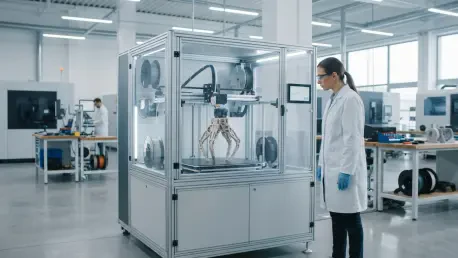

Establishing a resilient and technologically sovereign manufacturing landscape requires the integration of AI-driven design with flexible production infrastructure. As industrial sectors face pressure to shorten product lifecycles, Siemens is pioneering a shift toward autonomous engineering through its collaboration with AGIBOT at the Formnext 2026 exhibition. This initiative showcases an “Agentic AI” workflow, where artificial intelligence actively manages the entire development of task-specific robotic grippers. Unlike previous automation relying on static programming, this approach uses a “Digital Thread” to connect every stage of production. By interpreting user requirements directly, the AI autonomously determines the most efficient mechanical configurations. This marks a departure from traditional human-centric CAD modeling, positioning additive manufacturing as the primary method for translating complex digital concepts into physical tools without the usual delay of manual design iterations.
Autonomous Design: Optimization of Robotic Systems
The technical core of this transition lies in the ability of Agentic AI to function as a high-level orchestrator within the engineering environment. In traditional workflows, an engineer must manually iterate through design variations to find the optimal balance between weight and functionality for a robotic gripper. However, the Agentic AI workflow fundamentally alters this dynamic by taking over the decision-making loop. The system analyzes the specific object the robot needs to manipulate and then proceeds to select suitable gripper types while adapting complex geometries within Siemens’ advanced design software. This process is not limited to simple parameter adjustments; the AI actively interprets the physics of the task to create organic, topology-optimized shapes that would be impossible for a human to draft quickly. This degree of autonomy ensures that the resulting 3D-printed components are perfectly tailored to their unique operational environment without manual overhead.
Beyond the design phase, the integration of simulation and validation protocols ensures that every AI-generated component is ready for the rigors of the factory floor. The workflow incorporates virtual testing environments where the robot interface is validated against real-world mechanical stresses before a single layer of material is deposited. By utilizing Manufacturing Process integration, the system prepares data specifically for industrial 3D printers, ensuring that the transition from digital model to physical object is seamless. This level of preparation is crucial for industrializing additive manufacturing, as it eliminates the trial-and-error phase that often plagues complex part production. Consequently, companies can reduce the resources required for creating complex design variants, allowing for a more agile response to shifting market demands. The result is a manufacturing ecosystem where the bottleneck of engineering time is removed, allowing for rapid iteration of mission-critical components.
Strategic Implementation: The Future of Smart Factories
The evolution of Industry 4.0 is moving toward a more intelligent and adaptive manufacturing ecosystem that prioritizes flexibility over mass production. Siemens is facilitating this shift by upgrading its AM I Navigator tool with sophisticated Industrial AI capabilities to help businesses navigate the complexities of additive adoption. From 2026 to 2028, this tool will be instrumental in helping companies identify and prioritize viable 3D printing applications across their entire production chains. By analyzing existing manufacturing data, the AI can pinpoint specific parts that would benefit from the light-weighting or geometric freedom offered by additive methods. This strategic oversight allows organizations to move beyond experimental 3D printing and toward full-scale industrial implementation. The synergy between Agentic AI and additive manufacturing provides a physical outlet for digital creativity, enabling the creation of individualized designs that remain cost-effective even at very low volumes.
Realizing the full potential of these advancements required a physical infrastructure capable of matching the speed of AI design, which led to the development of the adaptive production cell in Erlangen. In partnership with EOS and AM Solutions, Siemens integrated the entire lifecycle of a part—from printing and automation to post-processing—into a single repeatable industrial process. This collaboration proved that the industrialization of additive manufacturing depended on the seamless merging of printing with downstream processing steps. To move forward, manufacturers should look toward these modular production cells as a blueprint for resilient domestic supply chains. By combining expertise in automation with advanced post-processing, the industry established a framework for technological sovereignty. Decision-makers were encouraged to prioritize the integration of AI-driven design tools with automated hardware. This holistic approach ensured that the digital thread remained unbroken for all industrial challenges.