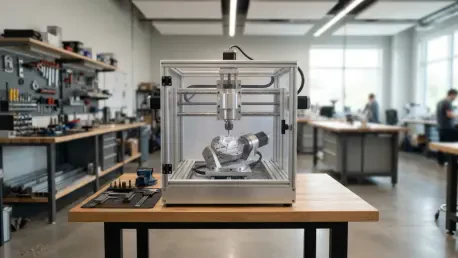

While the standard three-axis work envelope is 265 x 240 x 180 mm, the machine utilizes a specialized cylindrical volume for complex five-axis operations. For hardware designers and engineers, the traditional prototyping cycle often presents a significant bottleneck, characterized by lengthy lead times and external communication hurdles that slow the pace of innovation. Typically, this process involves sending CAD files to professional machine shops and waiting for quotes, only to find design flaws once the physical part finally arrives at the studio. Rownd Precision aims to disrupt this inefficient workflow with the Rownd 5X, a fully enclosed desktop CNC mill designed for simultaneous five-axis machining. By bringing metal-cutting capabilities directly into studios, laboratories, and classrooms, this machine seeks to bridge the gap between digital design and rapid physical iteration. The inclusion of two rotary axes—the A and C axes—located beneath the workpiece on a trunnion-style table, allows for full 360-degree rotation and a tilting range of -45 to +90 degrees. This sophisticated setup effectively eliminates the constant need for manual repositioning between cuts, providing a streamlined path for modern engineers.
Technical Specifications and Machine Architecture
Essential Hardware Components: Metal Milling
To maintain the rigidity necessary for milling non-ferrous metals like aluminum and brass, the Rownd 5X features a single-piece cast aluminum chassis. This sturdy construction minimizes the number of bolted joints that might flex under high-speed cutting stress, ensuring higher precision in a compact desktop format that usually struggles with vibration. The motion system utilizes roller linear guides and ball screws to achieve a positioning repeatability of ±0.02 mm, a specification that rivals much larger industrial equipment. This structural integrity is vital because even minor deviations in a five-axis setup can compound into significant errors at the tool tip. Powering the cutting action is a high-performance 2.2 kW spindle with a variable speed range from 2,000 to 24,000 rpm. This broad range allows the operator to select optimal speeds for various materials, whether clearing out large amounts of aluminum or performing delicate finishing passes with tiny end mills on plastics. To manage the heat generated during these operations and to facilitate efficient chip removal, the machine incorporates a mist cooling system.
Software Integration: Motion Control Systems
The Rownd 5X operates on a customized fork of LinuxCNC, a proven open-source motion control system known for its flexibility and reliability in the professional community. A critical component of this software implementation is the inclusion of Rotational Tool Center Point (RTCP) compensation, which is mandatory for accurate simultaneous five-axis work. Without RTCP, the controller would only track the pivot points of the machine rather than the actual tip of the cutting tool, leading to massive inaccuracies as the part rotates. This feature allows the software to calculate real-time adjustments for the X, Y, and Z axes as the A and C axes tilt and spin, ensuring the tool remains perfectly positioned relative to the part geometry. By automating these complex trigonometric calculations, the machine simplifies the programming requirements for the user, making five-axis milling accessible to those who might not have years of experience with industrial controllers. Users interact with the machine through a 13.3-inch touchscreen interface that handles everything from setup to real-time job monitoring.
Advanced Features and Market Considerations
Comparing the Standard and Pro Models
Rownd offers two distinct tiers to accommodate different production needs: the standard 5X and the 5X Pro, with the latter specifically engineered for those requiring higher levels of automation. The primary distinction between these two versions is the inclusion of an Automatic Tool Changer (ATC) on the Pro model, which fundamentally changes how the machine is utilized in a professional workflow. In the standard model, tool changes are manual, requiring the operator to stop the program, swap the bit, and re-zero the tool length, which can be a time-consuming task during complex jobs. The ATC system on the Pro model features a 10-tool carousel magazine that utilizes ISO20 tool holders, known for their balance and precision at high spindle speeds. With an average tool change time of approximately 12 seconds, the machine can rapidly cycle through different cutters without human intervention, effectively enabling unattended manufacturing for small batches of parts. This automation is a significant force multiplier for small engineering firms where personnel time is always at a premium.
Understanding Logistics: Power and Delivery
Launched through a high-profile Kickstarter campaign, the Rownd 5X has successfully generated significant interest, though prospective backers must carefully consider the logistics and long-term support. The pricing tiers position it as a prosumer or entry-level professional tool, but the projected shipping date is set for June 2027, requiring patience from those looking to upgrade their facilities immediately. It is important to reflect on the manufacturer’s history with its previous desktop CNC lathe, which did eventually reach customers but suffered from several notable delays during its production cycle. Beyond the delivery timeline, users must prepare their physical environments for the machine’s specific electrical and structural requirements. Unlike many consumer-grade 3D printers that use standard 110V wall outlets, the Rownd 5X requires a more robust 208 to 240 Vac power supply with a total draw of approximately 2.8 kW. This level of power consumption may necessitate dedicated electrical work, such as installing a new circuit or a NEMA 6-20 outlet, before the machine can be safely and reliably operated.
Future Perspectives: Desktop Milling Integration
The Rownd 5X is positioned as a bridge for engineers who previously relied on expensive third-party vendors for complex metal parts. For those who adopted this technology, the first logical step involved a thorough audit of their current CAD/CAM workflows to ensure compatibility with five-axis toolpaths. Successful implementation required more than just hardware; it demanded a commitment to learning the nuances of workholding and tool selection for intricate geometries. Organizations that integrated the machine effectively focused on training their design teams to think in five dimensions, ultimately reducing their prototyping lead times by several weeks. As the landscape of localized manufacturing continued to evolve, this desktop mill provided a concrete path toward greater self-sufficiency in hardware development. The transition to in-house five-axis milling allowed for more creative risks during the design phase, as the cost of failure was significantly lowered. Future considerations for users included establishing a rigorous maintenance schedule and procuring high-quality ISO20 tooling to maximize the machine’s output.