
The 26.5 percent reduction in machine footprint offered by newer vertical centers allows for more complex additive manufacturing cells in space-constrained facilities. This spatial efficiency is a cornerstone of the collaborative effort between Mazak Corporation and Oak Ridge National Laboratory, which is redefining the industrial application of metal additive manufacturing. By merging these additive processes with advanced thermomechanical processing and precision machining, the partnership is establishing a robust framework for high-mix, low-volume production. This strategy effectively bridges the historical gap between experimental laboratory prototyping and the rigorous demands of a production-ready workflow. As manufacturers in the energy, defense, and aerospace sectors face increasing pressure to shorten lead times, these converged systems provide a viable pathway to maintain flexibility without sacrificing the speed required for modern commercial markets. The resulting systems allow for components to be fabricated, refined, and inspected in a unified ecosystem that minimizes human intervention.
Technical Advancements
Hybrid Machine Capabilities
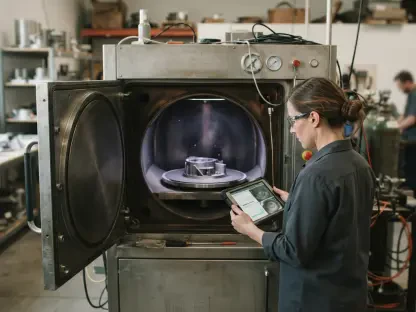
The technical core of this developmental initiative involves a hybrid machine platform that seamlessly integrates laser hot-wire directed energy deposition with precision five-axis machining. By performing these disparate tasks within a single machine envelope, the system enables near-net-shape fabrication alongside in situ feature finishing and the targeted repair of high-value components. The laser hot-wire process utilizes a high-powered laser to establish a stable melt pool on a substrate, into which a pre-heated wire feedstock is introduced under a protective shielding gas. This method is particularly effective because the electrical resistance heating of the wire ensures superior adhesion between layers and creates a highly homogeneous metallurgical structure. Such characteristics are essential for parts operating in high-stress environments, such as turbine components or deep-sea energy infrastructure, where any structural inconsistency could lead to failure. This level of material integrity is difficult to achieve with conventional standalone additive systems.
Modular Ecosystem Convergence
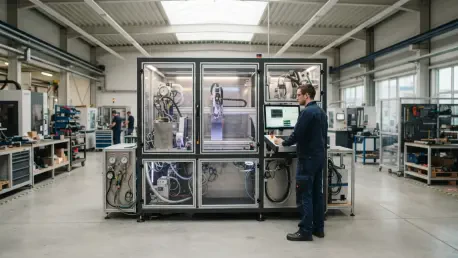
Building upon the success of single-envelope hybrid systems, the partnership recently introduced the Flexible Unified Sustainment Ecosystem to expand the boundaries of convergent manufacturing. This ecosystem utilizes a modular architecture that connects a dedicated wire-arc additive manufacturing unit with an independent five-axis machining center. These distinct units are synchronized through an automated material handling system and sophisticated in-process part probing, resulting in a cohesive manufacturing cell that manages the entire lifecycle of a component. This modularity provides manufacturers with the adaptability needed to grow complex geometries from scratch or modify existing parts with extreme precision. Because the system facilitates coordinated inspection and repair within a single environment, it reduces the logistical overhead typically associated with moving parts between different specialized facilities. This streamlined approach ensures that high quality standards are maintained throughout the build process while maximizing uptime.
Operational Integration
Precision Hardware Specifications
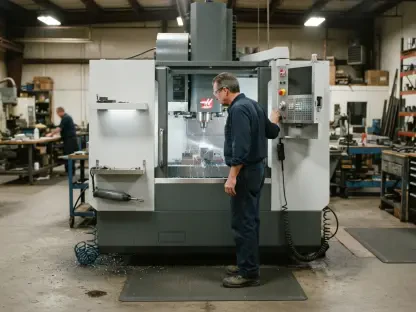
The primary engine driving the subtractive portion of this cell is the Mazak VC-Ez 20X vertical machining center, which is engineered for the high-precision processing of complex geometries. Equipped with a five-axis rotary/tilt trunnion table that leverages roller gear cam technology, this machine provides the accuracy and rigidity necessary for finishing additive-grown parts. The hardware configuration includes substantial axis travels of 31.49 inches in X and 20.08 inches in both Y and Z directions, providing a generous working volume for a variety of industrial applications. Rapid traverse rates of 1,260 inches per minute ensure that cycle times remain competitive even when handling intricate toolpaths. Despite its expansive internal capabilities, the machine maintains a remarkably compact footprint of approximately 105.9 square feet. This design choice is vital for modern factories that must integrate additive, subtractive, and metrology equipment within a limited physical area, allowing for higher density and more output per square foot.
Control Systems and Industrial Impact
Efficient management of these advanced manufacturing cells is achieved through the MAZATROL SmoothEz5 control system, which supports both traditional EIA/G-code and intuitive conversational programming. This dual-path control logic allows operators to make rapid adjustments on the factory floor, ensuring that the transition from digital model to physical part is as seamless as possible. To further enhance productivity, the system integrates with the PALLETECH automation solution, a pre-engineered palletized system that can be scaled as production volumes increase. This level of automation is currently proving invaluable at national laboratories such as Ames and ORNL, where researchers are investigating the sustainment of legacy industrial equipment. By utilizing these multitasking platforms to repair obsolete parts that are no longer in active production, the defense sector is successfully enhancing supply-chain resilience and reducing the total cost of ownership for critical infrastructure. The focus remains on creating a scalable path from small batches to high-volume output.
Strategic Pathways: Achieving Industrial Resilience
The collaboration between Mazak and ORNL demonstrated that the convergence of additive and subtractive disciplines was the most effective way to address modern supply chain vulnerabilities. By integrating deposition, machining, and automated inspection into a unified workflow, these organizations successfully shortened the time-to-market for complex industrial components. Manufacturers who seek to remain competitive should prioritize the adoption of modular ecosystems like FUSE to handle the increasing demand for customized, low-volume production. Investing in multitasking hardware and standardized automation protocols will likely be the definitive step toward achieving long-term sustainability in high-precision sectors. As these technologies matured, they provided a clear blueprint for shifting away from standalone prototyping tools toward fully integrated production platforms. Future efforts must now focus on expanding material compatibility and refining real-time process monitoring to further solidify the reliability of these convergent systems as they enter broader use.