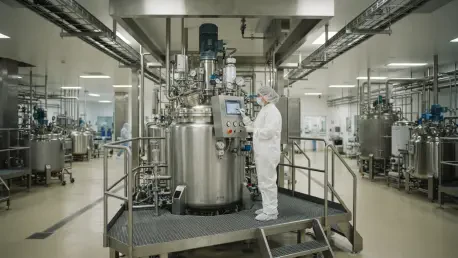

The biopharmaceutical industry is currently undergoing a foundational transformation as it pivots from a historical focus on massive production volumes toward an era defined by extreme molecular complexity and manufacturing agility. This shift is not merely a change in technical preferences but a fundamental reordering of how medicine is conceived, developed, and delivered to global markets. As biologics increasingly target orphan diseases and niche patient populations with high precision, traditional production methods have proven insufficient. Consequently, the reliance on advanced partnerships with contract development and manufacturing organizations (CDMOs) has evolved from a simple tactical necessity into a core strategic mandate. Today, the choice of a partner determines whether a molecule remains a laboratory success or becomes a viable commercial therapy capable of reaching the clinic with speed and safety.
This analysis explores the systemic transition from legacy manufacturing paradigms to highly integrated development models that prioritize long-term commercial success over short-term milestones. It examines how the rise of complex modalities has necessitated a new breed of technological innovation and why manufacturing resilience is now considered a vital component of a drug’s value proposition. Furthermore, the discussion highlights the critical role of technological connectivity in ensuring that the global supply chain remains robust in the face of market volatility and regulatory shifts. By moving away from transactional relationships and toward deeply integrated architectures, the industry is setting a new standard for how life-saving therapies are brought to the global stage.
The Evolution of Biologics Manufacturing and Market Growth
Market Shifts Toward Specialized and Complex Modalities
The pharmaceutical landscape was once dominated by “blockbuster” monoclonal antibodies (mAbs) designed for broad patient populations, necessitating massive stainless-steel facilities. However, the current pipeline reflects a significant pivot toward more specialized and sophisticated modalities, such as bispecific antibodies, antibody-drug conjugates (ADCs), and fusion proteins. These complex molecules offer enhanced therapeutic efficacy but present substantial hurdles in terms of molecular stability and manufacturing consistency. Unlike conventional mAbs, which follow relatively standardized production pathways, these next-generation therapies often require bespoke processes to handle unique impurity profiles and assembly challenges. This complexity has triggered a surge in demand for CDMOs that possess the specific technical expertise required to manage these intricate development cycles.
Moreover, the industry is seeing a move toward precision medicine, where therapies are tailored to smaller, targeted patient groups rather than the “one-size-fits-all” approach of the past. This demographic shift means that the massive, 20,000-liter bioreactor runs that defined the early 2000s are becoming less common for newer assets. Instead, there is a growing need for higher-titer processes and intensified manufacturing that can produce high-quality biologics in smaller quantities. The growth of the CDMO sector is largely driven by this need for flexibility, as sponsors seek partners who can provide the technical sophistication to produce these specialized modalities without the overhead of maintaining their own large-scale infrastructure.
Real-World Applications of Agile Manufacturing Models
The adoption of single-use technologies (SUT) has been a primary driver in enabling the flexibility required for modern biologics. Unlike traditional fixed-piping facilities, single-use systems allow for rapid changeovers between different product runs, significantly reducing the risk of cross-contamination and the time required for cleaning validation. This agility is essential for companies navigating the transition from 2026 toward 2030, as they must respond to fluctuating market demands and regional supply needs. Organizations are increasingly utilizing these modular footprints to create a distributed manufacturing network that can be scaled up or down with minimal lead time. This transition toward “footprint flexibility” ensures that capital is not tied up in idle capacity during periods of low demand.
Beyond physical hardware, the concept of “designing for commercialization” has become a cornerstone of agile manufacturing. This approach involves making critical process decisions during early-stage development that are specifically aimed at preventing late-stage failures during scale-up. Case studies across the industry demonstrate that early attention to cell line stability, impurity separation, and analytical characterization can save millions of dollars in remediation costs. Integrated platforms, such as those utilized by market leaders like WuXi Biologics, have bridged the gap between the lab and the clinic by providing a seamless data flow from initial molecular design to final commercial production. These platforms ensure that the process developed at the bench is robust enough to withstand the rigors of global commercial supply.
Industry Perspectives on Strategic CDMO Integration
Expert opinions across the biopharmaceutical sector suggest that manufacturing resilience is no longer a feature that can be retrofitted onto a program; it must be built into the process architecture from day one. In a volatile global environment, waiting until a product is on the verge of launch to consider supply redundancy is a high-risk strategy that often leads to regulatory delays. Experts emphasize that the most successful programs are those where the sponsor and the CDMO operate as a single, unified team. This level of integration allows for the proactive identification of potential bottlenecks in the supply chain, ensuring that the path from clinical trials to the market remains unobstructed. Resilience is viewed as a foundational quality, much like safety or efficacy, that must be nurtured throughout the entire lifecycle of the drug.
This collaborative approach creates a “force multiplier” effect, where the combination of high-quality standards, rapid speed-to-market, and advanced technological capabilities yields a result greater than the sum of its parts. Professional observers note that when a single provider manages the transition from development to commercialization, the typical frictions associated with technology transfer are minimized. This synergy is particularly valuable for smaller biotech firms that lack the internal resources to manage multiple vendors. By consolidating operations under a single umbrella, these firms can leverage the CDMO’s extensive experience and specialized tools to accelerate their timelines. The value proposition of a CDMO has thus shifted from providing mere “slots and scale” to acting as the primary architects of the commercialization pathway.
Future Outlook for Biologics Commercialization and Partnerships
As the industry moves forward, the focus on proactive dual-site planning and “qualified supply optionality” will become standard practice. The uncertainty of global logistics has taught sponsors that having a secondary manufacturing site is not just a backup plan but a competitive necessity. By establishing dual production locations early in the development phase, companies can ensure that their therapies remain available to patients regardless of regional disruptions. This strategy relies heavily on the CDMO’s ability to maintain identical quality systems and analytical protocols across different geographic locations. The result is a more resilient supply chain that can absorb shocks and adapt to changing regulatory requirements in different international markets.
Technological advancements such as digital twins and continuous processing are set to further revolutionize the economic landscape of biologics. Digital twins—virtual replicas of the manufacturing process—allow engineers to simulate production runs and optimize parameters in a digital environment before any physical material is used. This capability, combined with continuous manufacturing techniques, has the potential to significantly lower the cost of goods (COGS) and increase overall yield. However, the transition toward these advanced technologies presents challenges in maintaining regulatory alignment across different jurisdictions. As therapies become more personalized and processes more automated, the need for a globalized approach to regulatory standards becomes even more critical to ensure that innovations can be implemented without unnecessary administrative delays.
Summary of Key Commercialization Trends
The transition from capacity-driven to expertise-driven partnerships represented a fundamental change in how the biopharmaceutical industry approached the delivery of modern medicine. It became clear that physical infrastructure was only as valuable as the technical intelligence used to manage it. The shift toward complex modalities like ADCs and bispecifics demanded a level of scientific depth that transcended traditional manufacturing services. Consequently, the most successful organizations were those that prioritized early intervention, ensuring that every molecular design choice was informed by a long-term commercialization strategy. This foresight allowed for the creation of robust processes that were capable of scaling seamlessly while maintaining the highest standards of quality and patient safety.
Integrated technology platforms proved to be the primary drivers of both economic and clinical success in this new landscape. By connecting data points from initial discovery through to commercial production, these systems eliminated the silos that previously slowed down drug development. The industry also recognized that supply chain resilience was a non-negotiable requirement in an increasingly interconnected and unpredictable world. Strategic investments in dual-site readiness and digital monitoring provided the security needed to navigate complex global markets. Ultimately, these evolving partnerships ensured that life-saving biologics reached patients with unprecedented speed, proving that the synergy between innovative sponsors and specialized CDMOs was the most effective way to meet the healthcare challenges of the era. Future strategies focused on the continued adoption of digital integration and sustainable practices to maintain this momentum in the global pharmaceutical market.