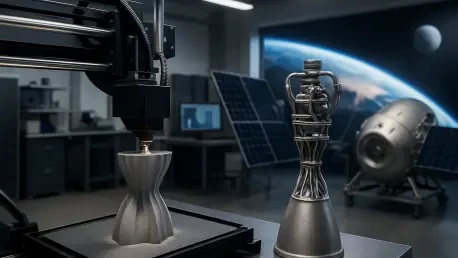

The successful on-orbit deployment of a satellite payload from a mechanism built almost entirely with 3D printing signals a fundamental shift in how humanity engineers systems for the final frontier. Additive Manufacturing (AM) represents a significant advancement in the aerospace and space exploration sector. This review will explore the evolution of the technology, its key features, performance metrics, and the impact it has had on various applications, from satellite components to propulsion systems. The purpose of this review is to provide a thorough understanding of the technology, its current capabilities, and its potential future development for space-based systems.
An Overview of Additive Manufacturing in the Space Sector
At its core, Additive Manufacturing, often called 3D printing, builds objects layer-by-layer from a digital model. This process stands in stark contrast to traditional subtractive methods, where material is carved away from a solid block. For space applications, where every gram counts, this difference is transformative. The ability to deposit material only where it is needed allows for the creation of lightweight, intricate structures that are impossible to produce conventionally.
This layer-by-layer approach unlocks unprecedented design freedom, enabling engineers to consolidate multiple components into a single, complex part. Reducing part count not only simplifies assembly and lowers the risk of failure at joints but also significantly cuts down on overall mass. These weight reductions translate directly into lower launch costs and create opportunities for more capable and ambitious missions.
Key AM Technologies and Space-Grade Materials
Metal Additive Manufacturing Processes
Metal AM processes are the workhorses for creating mission-critical space hardware. Technologies like Laser Powder Bed Fusion (LPBF) and Electron Beam Melting (EBM) precisely melt and fuse layers of fine metal powder to build robust components. Meanwhile, Directed Energy Deposition (DED) can be used to add features to existing parts or create larger structures.
These processes utilize space-grade alloys renowned for their strength-to-weight ratios and resilience in extreme environments. Titanium alloys such as Ti-6Al-4V are favored for their low density and high strength, while nickel-based superalloys like Inconel are essential for high-temperature applications in rocket engines. High-strength aluminum alloys also play a crucial role in developing lightweight structural elements.
Polymer and Composite Additive Manufacturing
Beyond metals, high-performance polymers and composites are gaining traction for a wide array of space applications. Materials like PEEK and PEI (ULTEM) offer excellent thermal stability and chemical resistance, making them ideal for non-structural components, electronic enclosures, and internal brackets.
The advent of continuous fiber-reinforced composite printing further expands the material palette. By embedding fibers like carbon or fiberglass into a polymer matrix, AM can produce parts with tailored strength and stiffness properties. This capability is particularly valuable for rapidly fabricating custom tools, jigs, and fixtures needed during assembly, significantly accelerating ground-based operations.
Current Innovations and Evolving Trends
The cutting edge of AM in space is moving toward creating monolithic, functionally integrated systems. A prime example is JPL’s Additive Compliant Canister (JACC), a deployable mechanism where the canister, hinges, and springs are integrated into a single printed assembly, reducing the part count by a factor of three. This approach minimizes assembly complexity and potential points of failure.
In tandem with component integration, there is a significant push toward large-scale AM for producing primary structural elements of spacecraft and launch vehicles. Moreover, the development of in-space manufacturing platforms is a rapidly evolving trend. These systems aim to fabricate parts on-orbit, heralding a new era of mission flexibility and responsiveness.
Real-World Applications in Space Missions
Propulsion Systems and Rocket Engines
AM has revolutionized the production of rocket engine components. Intricate parts like fuel injectors and combustion chambers, which once required assembling dozens of individual pieces, are now printed as single units. This allows for the integration of complex internal cooling channels and optimized geometries that boost engine performance and efficiency. Consequently, development lead times for new launch vehicles have been drastically reduced.
Satellite Components and Deployable Systems
The technology is equally impactful in satellite manufacturing. AM is routinely used to create lightweight yet strong support brackets, antenna arrays, and other structural components. The successful on-orbit deployment of the JACC from the Proteus Space M1 satellite serves as a powerful case study. This compact, low-mass system validated the reliability of additively manufactured mechanisms, proving their readiness for creating advanced deployable systems for future missions.
In-Space Manufacturing and Maintenance
One of the most forward-looking applications is in-space manufacturing. The ability to print tools, spare parts, and even habitats on demand is strategically vital for long-duration human exploration. This capability would reduce missions’ dependency on costly and time-consuming resupply from Earth, increasing autonomy and enabling sustainable operations on the Moon, Mars, and beyond.
Technical Challenges and Developmental Hurdles
Despite its successes, the widespread adoption of AM for space faces considerable obstacles. The rigorous qualification and certification process for mission-critical parts remains a primary hurdle, requiring extensive testing to ensure consistency and reliability.
Technical challenges also persist, including variability in material properties between builds and the need for complex post-processing steps like heat treatment and surface finishing. Furthermore, operating AM systems reliably in a microgravity environment presents unique difficulties related to material handling and thermal management that must be overcome for in-space manufacturing to reach its full potential.
Future Outlook and Long-Term Vision
The trajectory for AM in the space sector points toward even more sophisticated capabilities. Future breakthroughs are anticipated in multi-material printing, which would allow for the fabrication of components with integrated electronics and varying material properties. The synergy of AM with autonomous robotic systems promises to enable the construction of large-scale orbital infrastructure with minimal human intervention.
Perhaps the most transformative vision involves leveraging in-situ resource utilization (ISRU) to create structures from extraterrestrial materials like lunar or Martian regolith. This capability is seen as a cornerstone for establishing a sustainable, long-term human presence beyond Earth, fundamentally changing the economics and logistics of deep-space colonization.
Conclusion
The review demonstrated that Additive Manufacturing is a disruptive technology fundamentally changing how space hardware is designed, built, and deployed. Its capacity for creating lightweight, complex, and functionally integrated components has already yielded significant improvements in performance and cost-efficiency for propulsion systems and satellites. While challenges in qualification and in-space operation remained, the ongoing innovation in materials, processes, and applications positioned AM as a critical enabler for the next generation of affordable, capable, and sustainable space exploration.