
The modern automobile contains more lines of code than a commercial airliner, a complex reality that has pushed traditional manufacturing timelines to their absolute breaking point. As vehicles transform into rolling data centers, the industry faces a critical question: how can innovation accelerate when physical prototypes and siloed development teams create crippling delays? The answer lies not in faster machinery, but in a radical shift toward a virtual-first approach where cars are fully built, integrated, and tested in a digital realm long before the first piece of metal is ever cut. This pivot toward comprehensive digital twins is becoming the key to unlocking speed and agility in a software-driven market.
The New Assembly Line Isn’t Made of Steel It’s Made of Code
As modern vehicles become increasingly defined by their software capabilities, the traditional, physical-first approach to car manufacturing has hit a wall. In this new paradigm, the assembly line of the future is not a sprawling factory floor but a sophisticated digital environment. The core challenge is that the value and function of a car are now dictated by software, which must seamlessly integrate with complex electronics from numerous suppliers.
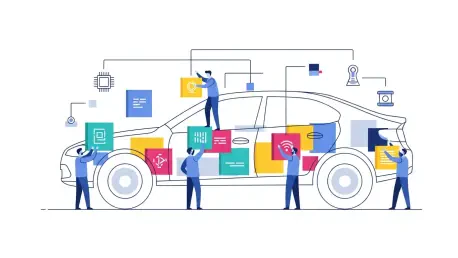
What if the entire vehicle—from its chips and sensors to its chassis and infotainment systems—could be built and validated in a virtual world first? This is the central premise behind the move to digital twins. Such a platform allows engineers to test every interaction, update, and feature in a simulated environment that perfectly mirrors the real-world hardware. This transition moves the most time-consuming and expensive integration tasks from the physical world into the flexible and fast-paced domain of code.
Why the Automotive Industry Is Stuck in the Slow Lane
The seismic shift toward the Software-Defined Vehicle (SDV) is the primary driver of current development challenges. A car’s identity, from its performance characteristics to its user experience, is now written in software. This change means that innovation is no longer limited to mechanical enhancements but extends to continuous software updates for features like autonomous driving and in-car connectivity, creating immense pressure on traditional development cycles.
This pressure creates a significant integration impasse. Automakers must weave together a complex tapestry of hardware and software from dozens of different suppliers, each with its own development process. This fragmented ecosystem leads to a critical bottleneck where teams wait for physical components to become available before they can even begin testing how their software interacts with the larger system. Consequently, delays from one supplier can cascade through the entire project, pushing timelines back by months.
Furthermore, the reliance on traditional prototyping is both financially and temporally exhaustive. Building physical models for every significant software update or hardware change is an unsustainable practice. The time and resources wasted on creating and testing these tangible prototypes for validation represent a major impediment to rapid innovation, keeping the industry in a perpetual slow lane while consumer demand for advanced features accelerates.
PAVE360 A Virtual Car on Demand
To break this gridlock, solutions like Siemens’ PAVE360 offer a full-system digital twin—a pre-integrated, off-the-shelf virtual replica of a vehicle’s complete electronic and software architecture. This moves far beyond simple component simulations. It provides a holistic, functional model of the entire car in the cloud, effectively offering a virtual car on demand for every engineer involved in the project.
This system works by providing a centralized, cloud-based environment that mirrors real vehicle hardware, granting all teams simultaneous access. This accessibility enables parallel development and testing of advanced features such as Advanced Driver-Assistance Systems (ADAS), Autonomous Driving (AD), and In-Vehicle Infotainment (IVI). Developers no longer need to wait for physical hardware to arrive. Instead, they can begin coding, integrating, and validating their work immediately, drastically shortening the feedback loop and accelerating project kickoff with customizable virtual reference designs.
The Evidence From Theoretical to Tangible Speed
The promise of this technology is not merely theoretical. Research from Siemens highlights the potential to slash critical software development and validation cycles from months to days. By leveraging a ready-made digital twin environment, companies can bypass the lengthy process of building their own virtual testbeds from scratch, allowing them to focus directly on innovation and problem-solving.
This dramatic acceleration is achieved by breaking down the traditional silos that have long plagued the automotive industry. A unified digital platform fosters unprecedented collaboration between disparate hardware, software, and validation teams. Everyone works on the same virtual model, ensuring that integration issues are identified and resolved early in the process rather than late in the physical prototyping stage. This positions the technology as a direct solution to a major industry bottleneck, empowering companies to innovate with greater speed and confidence.
The New Blueprint for Automotive Development
This new approach is best encapsulated by the “Shift-Left” strategy, a practical framework that reorders the entire vehicle design process. The first step is to prioritize virtual development. Engineers write, integrate, and test software on the digital twin long before physical hardware is manufactured or even finalized. This allows for early bug detection and feature validation at a fraction of the cost of traditional methods.
The framework continues with continuous cloud-based validation, where thousands of tests can be run simultaneously in the virtual environment. This parallel processing power allows for comprehensive testing of countless scenarios, ensuring software robustness at scale. Finally, the validated digital twin is connected to physical components in a Hardware-in-the-Loop (HIL) setup for final, real-world verification. This step ensures that the software, already proven in the digital realm, performs flawlessly with the actual hardware, bridging the gap between the virtual and physical worlds.
The adoption of this virtual-first development model ultimately provided the agility and speed the industry desperately needed. It transformed the automotive development cycle from a linear, hardware-constrained process into a dynamic, software-driven ecosystem, proving that the fastest cars were not built on an assembly line, but in the cloud.