
The Indian auto component industry, a formidable force in global supply chains, now confronts a defining moment of strategic re-evaluation as headwinds from its largest export market, the United States, threaten to stall its impressive growth trajectory. Faced with stagnant demand and tariff-related uncertainties across the Atlantic, the sector is embarking on a comprehensive transformation. This pivot is not merely a reactive measure but a calculated, multi-pronged strategy designed to build long-term resilience. By actively diversifying export destinations, pursuing landmark free trade agreements, harnessing the power of a booming domestic market, and embracing the profound technological shift toward electric and software-defined vehicles, the industry is charting a new course to navigate the complexities of the modern automotive landscape and secure its future relevance. This period of challenge has become a catalyst for innovation and a deeper introspection into the sector’s operational and strategic foundations.
The American Anchor and Its Drag
Grappling with a Stagnant U.S. Market
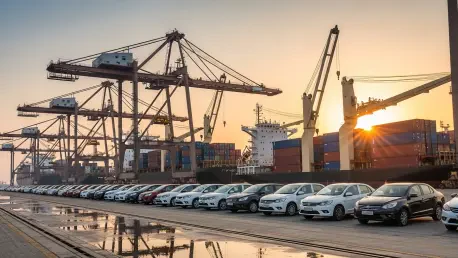
The industry’s most pressing concern revolves around its relationship with the U.S. market, which has historically served as its primary growth engine. In the first half of the 2026 fiscal year, exports to the United States remained nearly flat, holding at approximately $3.64 billion. This stagnation was a primary factor in a significant shift in the sector’s trade balance, pushing it from a surplus in the previous year into a deficit. According to data from the Automotive Component Manufacturers Association of India (ACMA), while total exports reached $12.2 billion, they were eclipsed by imports amounting to $12.3 billion. A major contributor to this constrained growth has been the impact of U.S. tariffs, which have specifically restricted the export of raw materials, thereby placing a ceiling on the sector’s potential in this crucial market. This situation underscores the vulnerability that comes with heavy reliance on a single economic partner, prompting a strategic rethink across the industry.
Compounding the issue of flat exports is a substantial volume of imports, particularly from Asia, which accounted for a staggering $8.31 billion of the total. The exponential rise in components sourced from China has become an especially prominent feature of the industry’s evolving trade dynamics, adding another layer of complexity to the trade deficit problem. Looking ahead, the forecast for the U.S. market offers little optimism. ACMA does not anticipate any meaningful recovery in the second half of the fiscal year and notes that visibility for the next financial year is also severely limited. Further exacerbating the uncertainty, several new manufacturing programs that Indian suppliers had anticipated being awarded have been indefinitely put on hold, leaving many businesses in a precarious position and reinforcing the urgent need for strategic diversification away from North American dependence.
The Diversification Imperative
In direct response to the persistent headwinds from North America, export diversification has rapidly emerged as the cornerstone of the industry’s resilience strategy. This strategic pivot is viewed not as a short-term remedy but as a fundamental, long-term necessity for sustainable growth. ACMA President Vikrampati Singhania emphasized that while the U.S. market remains too large to be ignored, the positive growth trends observed in other international regions—including Europe, Asia, and Africa—are expected to provide a crucial and much-needed cushion against the potential negative impacts of the American slowdown. This proactive approach reflects a broader industry consensus that reducing dependency on any single market is essential for building a more robust and adaptable business model capable of weathering global economic fluctuations and geopolitical uncertainties.
The sentiment for this strategic shift is universally strong among industry leaders. Sriram Viji, President-Designate of ACMA, described the current situation as an “eye-opener” and labeled the concerted push for diversification as a “no-regret move,” underscoring the deep-seated belief that this is the correct path forward. This perspective highlights a collective realization that the previous model of over-reliance on one primary market carried inherent risks that are no longer tenable in the current global climate. Consequently, Indian component makers are reportedly actively pursuing and expanding their business engagements in these non-U.S. markets. This involves not just seeking new customers but also adapting products and strategies to meet the unique demands and regulatory environments of diverse regions, thereby creating a more balanced and resilient export portfolio for the future.
Charting a New Course Through Policy and Domestic Power
A Game Changing European Free Trade Agreement
A significant potential catalyst for future growth and deeper integration into global supply chains is the ongoing negotiation of a free trade agreement (FTA) between India and the European Union. Industry leaders view this as a potential “game changer” with benefits that extend far beyond simple tariff reductions. The successful implementation of an FTA is expected to address critical non-tariff barriers, such as complex and often costly certification and homologation processes that can hinder market access. Sriram Viji noted that India and Europe already share “fairly synergistic norms” in these areas, which could facilitate a much smoother trade and integration process once a formal agreement is in place. This alignment is seen as a key advantage that could unlock substantial opportunities for Indian manufacturers to compete more effectively on the European stage.
Beyond the direct flow of goods, a comprehensive FTA is anticipated to encourage a significant increase in European investment into India. This influx of capital would be instrumental in enabling Indian manufacturers to access advanced automotive technologies, which are crucial for staying competitive in a rapidly evolving industry. Greater investment would also significantly strengthen localization efforts, allowing for the domestic production of more sophisticated components and reducing reliance on imports. By fostering a more technologically advanced and self-sufficient domestic ecosystem, the FTA would not only boost exports to Europe but also enhance the overall capabilities and competitiveness of the entire Indian auto component sector, positioning it for long-term, sustainable growth in the global marketplace.
Leaning on a Robust Domestic Market
While international strategies are being actively reshaped, the industry is also leaning heavily on the remarkable strength and dynamism of its domestic market. This rapidly increasing domestic demand has played a critical role in offsetting the export-related challenges and providing a stable foundation for growth. Auto production within India has remained strong, supported by a confluence of positive factors that have sustained momentum across various vehicle segments. This internal resilience has been a crucial buffer, allowing component manufacturers to continue operations and invest in future capabilities even as their primary export channel faced significant disruption. The health of the domestic market has, therefore, become as important to the industry’s strategy as its international ambitions.
The vibrancy of the domestic market is fueled by several key drivers. A steady stream of new vehicle launches from both domestic and international automakers has kept consumer interest high and stimulated consistent demand for new parts and technologies. Furthermore, a government-led focus on infrastructure development has created sustained demand for commercial vehicles, from trucks to buses, which in turn props up a significant portion of the component sector. Finally, the rationalization of the Goods and Services Tax (GST) on auto components has created a more favorable and predictable business environment. This tax reform has helped streamline operations and reduce costs for manufacturers, contributing to the overall health and dynamism of the domestic automotive ecosystem.
Navigating the Technological Revolution
The Electric Vehicle Transition
The future trajectory of the industry is also being profoundly shaped by major technological shifts, most notably the transition to electric vehicles (EVs). While the pace of adoption may be slower than some of the more optimistic projections from a few years ago, it remains a positive and steadily growing trend. In the first half of the 2026 fiscal year, EVs accounted for approximately 5% of the auto component industry’s activity, and all indicators suggest that this share is expected to rise consistently in the coming years. This gradual but certain shift represents a significant new frontier for component manufacturers, creating demand for an entirely new range of products, from battery components and thermal management systems to electric motors and power electronics.
India’s supportive policy environment has been a key enabler of this transition. The government’s multi-fuel strategy, which supports the adoption of EVs alongside other clean energy solutions like flex fuels, ethanol blending, and biofuels, provides a stable and predictable framework for this long-term industrial change. Specific government initiatives, such as the Production Linked Incentive (PLI) scheme and PM E-DRIVE, have provided targeted support for electric mobility, particularly in accelerating the electrification of the bus and three-wheeler segments. However, it is worth noting that the direct benefits of these incentives have, to date, been concentrated among a relatively small group of six to seven established auto component manufacturers, highlighting the need for broader participation to fully realize the potential of this technological evolution.
Fortifying for an Unpredictable Future
Beyond the immediate focus on electrification, the industry recognized that the most significant long-term driver of growth would be the rapid shift toward software-defined vehicles (SDVs), advanced electronics, and integrated digital systems. There was a unanimous agreement among industry leaders that the auto components of tomorrow would be increasingly defined by their electronic and software content. This convergence of hardware and software presented a substantial opportunity for Indian manufacturers to innovate and capture new value in the evolving automotive ecosystem. To capitalize on this shift and manage the complex and uncertain global environment, the industry proactively invested in key operational areas to build resilience. These included a focus on digitization to improve efficiency, the implementation of rigorous cost optimization measures, and the strengthening of supply chain management systems. Despite these proactive measures, several potential headwinds remained on the horizon. Persistent geopolitical challenges that could disrupt supply chains, the ongoing issue of increasing freight costs, potential shortages in the availability of critical materials like rare earth magnets, and the inherent volatility of raw material prices were all identified as critical risks that required continuous monitoring and strategic planning.