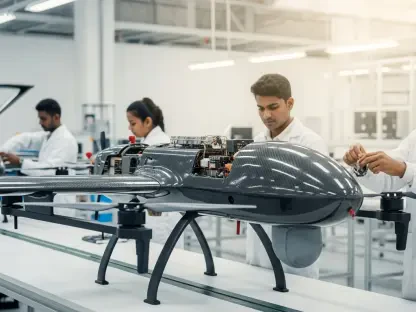

The persistent hum of ground-level traffic may soon be joined by the whisper of electric rotors as Eve Air Mobility’s full-scale prototype successfully lifted off the ground, turning a futuristic vision into a tangible reality. The company has officially conducted the inaugural test flight of its uncrewed electric vertical take-off and landing (eVTOL) aircraft in Gavião Peixoto, Brazil. This event signifies the formal start of the company’s flight test campaign, a pivotal milestone on the journey toward commercializing advanced Urban Air Mobility (UAM) solutions.
The Dawn of a New Era in Urban Transit
The question of how to navigate increasingly congested cities is prompting a revolutionary shift in transportation, moving from crowded streets to the open sky. For decades, the concept of a “flying taxi” was confined to science fiction, but this successful flight demonstrates that the technology is rapidly maturing. This development is not just about a new type of aircraft but about fundamentally rethinking how people move within metropolitan areas.
A Milestone for Urban Air Mobility
Within the broader context of the burgeoning UAM industry, a successful first flight of a full-scale prototype serves as a critical benchmark. This single event provides tangible proof of concept, boosting confidence among investors, regulators, and the public. It transforms theoretical designs into a physical reality, signaling that the industry is moving beyond simulations and toward certifiable, operational vehicles.
The development of eVTOLs directly addresses some of the most pressing challenges of modern urban life. By offering a clean, quiet, and efficient alternative to ground-based transport, these aircraft present a viable solution to chronic traffic congestion and the environmental impact of fossil fuels. This flight represents a concrete step toward building a more sustainable and accessible transportation ecosystem for the future.
A Technical Look Inside the Landmark Hover Test
The primary achievement of the initial hover flight was the successful validation of the aircraft’s core systems and their seamless integration. This crucial test confirmed that the fundamental blueprint of the vehicle is sound, providing the essential data needed to proceed with further development. It was a foundational success that underpins the entire program.
During the test, engineers closely scrutinized several key components. The aircraft’s fifth-generation fly-by-wire system, its eight fixed-pitch lifter rotors, the complex control laws governing its stability, and the overall energy management system were all pushed to perform. The positive results from these evaluations give the product a clear go-ahead to advance toward greater maturity.
A significant outcome was the close alignment between the prototype’s real-world performance and the predictions from sophisticated computer models. The aircraft’s dynamic response and noise footprint behaved exactly as simulated, confirming the integrity and accuracy of the design and engineering work completed to date.
The Official Flight Test Campaign Begins
This maiden flight should be viewed not as a final accomplishment but as the official starting point of a disciplined and rigorous testing campaign. The data gathered from this initial hover provides the baseline for a multi-stage program designed to systematically push the aircraft’s capabilities and ensure its safety and reliability under a wide range of conditions.
Eve Air Mobility is taking a methodical approach to product maturity, with an unwavering focus on achieving unparalleled reliability and efficiency. This strategy prioritizes safety and performance over speed to market, ensuring that the final commercial product meets the highest standards of the aviation industry before it carries its first passengers.
The Roadmap to Commercial Skies
The path forward involves a series of progressively more complex flight tests designed to expand the aircraft’s flight envelope. The company will conduct numerous additional flights over the coming months, with the primary goal of achieving a full transition from vertical lift to wing-borne flight by 2026. This phase is critical to proving the vehicle’s efficiency for longer-distance urban travel.
To support this extensive testing and prepare for the certification process, Eve will manufacture a fleet of six conforming prototypes. These aircraft will be built to the exact specifications of the final commercial model and will undergo thousands of hours of flight and ground testing to satisfy regulatory requirements.
The company is actively collaborating with Brazil’s Civil Aviation Agency (ANAC), its primary certifying authority, as well as international bodies like the FAA in the United States and EASA in Europe. This concurrent certification process is designed to streamline regulatory approval, targeting the start of deliveries and entry into service by 2027. This successful hover test in Brazil thus represented a foundational step, confirming the viability of Eve’s design and initiating a clear path toward redefining urban transportation.