
The grueling world of endurance racing demands a relentless pursuit of speed that extends far beyond the asphalt and deep into the high-tech laboratories of automotive manufacturing. In a sport where a millisecond of aerodynamic drag can negate hours of driving excellence, the traditional multi-week wait for heavy tooling has become an unacceptable liability. The strategic partnership between Duqueine Automotive and Caracol AM has effectively shattered this bottleneck, proving that robotic large-format additive manufacturing (LFAM) can produce structural tooling for a Le Mans Prototype 3 (LMP3) car in less than a day.
The 16-Hour Breakthrough in Endurance Racing Engineering
At the highest levels of motorsport, the production of a 300-kilogram engine cover cure tool used to take weeks; now, it takes less than a day. This shift marks a departure from slow, subtractive manufacturing toward a reactive, high-output ecosystem that matches the frantic pace of the racing season. By leveraging robotic precision, engineers can now bypass the constraints of traditional mold-making, moving from a digital design to a physical tool with unprecedented velocity.
The ability to generate a 660-pound component in just 16 hours allows teams to react to track data in real time. This agility ensures that the development cycle remains fluid, allowing for rapid adjustments that were previously impossible due to the rigid timelines of conventional casting or milling. This transformation has turned the manufacturing department into a high-speed extension of the pit crew.
Bridging the Gap Between Prototyping and Track Performance
Endurance racing serves as the ultimate laboratory for automotive innovation, but the industry often struggles with the bottleneck of tooling production. Conventional molds for carbon fiber components are expensive, produce significant material waste, and require long lead times that hinder mid-season aerodynamic adjustments. By integrating the Heron AM platform, engineers can now print carbon fiber-reinforced polycarbonate molds directly, allowing the Duqueine D09 and its twin-turbo V6 engine to benefit from rapid structural updates.
This transition addresses the critical need for operational agility in a sport where the ability to test and refine a component between race weekends can determine a podium finish. Instead of waiting for external suppliers, teams maintain control over their intellectual property and production schedules. This internal capability fosters a culture of continuous experimentation, where every race provides data that can be materialized into hardware by Monday morning.
Engineering the Duqueine D09 with Heron AM Technology
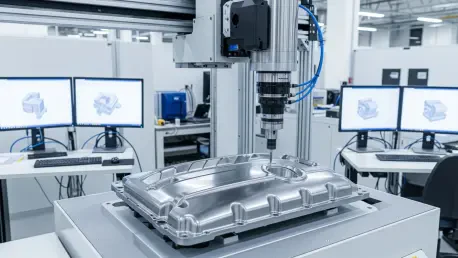
The technical heart of this advancement lies in the Heron 400 system, a robotic platform designed to handle the complexities of large-scale composite printing. Using a high-flow extruder and a 12mm nozzle, the system deposits reinforced polymers with precision, creating molds that are 20% lighter than their traditional counterparts. This workflow is managed by Eidos Builder software, which optimizes printing strategies to ensure thermal stability during the curing process.
Once the initial 3D print is complete, CNC post-processing is used to achieve the micron-level surface tolerances required for high-performance aerodynamic parts, such as the D09 engine cover. This hybrid approach combines the additive speed of the robot with the subtractive precision of traditional machining. The result is a tool that possesses the thermal resistance needed for autoclave environments while maintaining the surface finish of a mirror.
Quantifiable Gains in Production Efficiency and Sustainability
The collaboration has yielded data that underscores the transformative impact of LFAM on the manufacturing pipeline. Over a recent six-month period, the system produced 60 separate molds and masters, demonstrating a level of reliability previously unseen in large-format printing. Key performance indicators include a 50% reduction in lead times, allowing for overnight tool production, and a 50% decrease in material waste by utilizing near-net-shape printing.
Furthermore, the model provides significant logistics savings through a decentralized manufacturing framework. By placing delivery centers near championship venues, the team facilitated real-time performance tuning without the carbon footprint of international shipping. This sustainable approach reduces the environmental impact of the sport while simultaneously lowering the overhead costs associated with inventory management and specialized shipping containers.
Implementing a Decentralized LFAM Framework for High-Performance Teams
To replicate the success of the Duqueine-Caracol partnership, racing teams and aerospace manufacturers must adopt a specific strategic framework for additive integration. Point-of-use manufacturing hubs should be established near testing facilities to minimize transportation delays and allow for trackside engineering feedback. Utilizing carbon fiber-reinforced polycarbonates ensures that tools can withstand the high pressures and temperatures of autoclave curing, which is essential for structural integrity.
Moreover, the integration of specialized slicing and simulation software helped predict thermal deformation before the print began, reducing the need for multiple iterations. Hybrid workflows that combine additive speed with CNC finishing ensured that every part met the strict FIA technical regulations. These advancements suggested that the future of competitive engineering lies in the seamless merger of digital design and localized, high-speed robotic production.