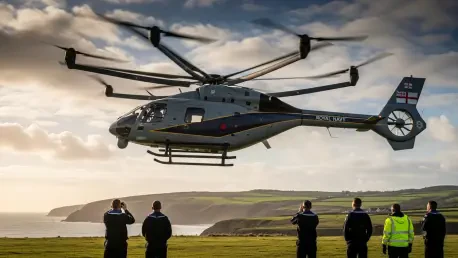

A full-sized military helicopter ascended into the skies over Cornwall’s Predannack airfield, but its cockpit was conspicuously empty, marking a profound and historic milestone for the United Kingdom’s naval aviation capabilities. The successful maiden flight of Proteus, the Royal Navy’s first truly autonomous helicopter, signals a strategic pivot toward a future where uncrewed systems will operate alongside human crews, fundamentally redefining maritime security and warfare. This event is far more than a technological demonstration; it represents the dawn of a new era in naval power projection and the tangible beginning of the nation’s “New Hybrid Navy.”
When the Cockpit is Empty: A New Dawn for Naval Aviation
The successful launch of the Proteus platform ushers in a fundamental change in how the Royal Navy conceptualizes its air power. Moving beyond smaller, remotely piloted drones, Proteus introduces a full-scale asset capable of complex missions without direct human intervention. This leap heralds a future where persistent surveillance and hazardous tasks can be delegated to autonomous systems, preserving crewed helicopters for high-stakes tactical operations. The integration of such platforms is central to creating a more resilient, versatile, and effective naval force.
This technological advancement directly supports the vision of a “hybrid air wing,” where human-machine teaming becomes the standard. In this model, autonomous helicopters like Proteus will work in concert with traditional crewed aircraft such as the Merlin or Wildcat. This synergy allows the Royal Navy to extend its operational reach, increase its presence in contested waters, and multiply its effectiveness without a proportional increase in personnel, creating a powerful force multiplier for future maritime challenges.
The Strategic Imperative of Securing the North Atlantic
The development of Proteus is not an isolated project but a direct response to evolving geopolitical pressures, particularly in the North Atlantic. The UK’s “Atlantic Bastion” strategy aims to reassert naval dominance and enhance anti-submarine warfare capabilities in this critical maritime corridor. The ability of autonomous platforms to conduct long-endurance patrols makes them ideal for tracking increasingly sophisticated underwater threats, providing the persistent “eyes and ears” needed to secure vital sea lanes.
This strategic modernization embodies the core concept of the “New Hybrid Navy,” a force structure that seamlessly blends crewed and uncrewed systems. Proteus is a cornerstone of this vision, designed to extend the fleet’s sensor network and provide commanders with greater situational awareness. By integrating autonomous assets, the Royal Navy aims to create a layered defense that is more adaptable and potent, ensuring its ability to counter threats across multiple domains.
Inside Proteus: The Technology Powering the Revolution
Developed by Leonardo at its historic Yeovil facility, the Proteus platform is the culmination of a £60 million technology demonstrator program. This significant investment underscores a commitment to bolstering the UK’s sovereign defense industry and maintaining a technological edge in military aviation. The project leverages decades of helicopter manufacturing expertise to produce a platform that is not only advanced but also purpose-built for the rigors of naval operations.
What sets Proteus apart from existing drones is its sophisticated operational autonomy. Rather than relying on constant human piloting, the helicopter is equipped with a cutting-edge sensor suite and advanced software that enable it to perceive and interpret its environment. This system allows Proteus to process vast amounts of data in real time, make informed decisions, and execute mission objectives independently, representing a true leap beyond simple remote control. The successful flight at the Predannack drone hub was a critical validation of this complex technology, proving its viability for future deployment.
A Leap Forward with Official and Expert Validation
The Proteus program directly fulfills key commitments laid out in the nation’s Strategic Defense Review, which called for greater investment in autonomous systems to meet future security challenges. The successful flight serves as powerful evidence that large-scale uncrewed platforms are not just a future concept but a present-day reality, reinforcing the strategic viability of the UK’s defense modernization plans.
Defense analysts and senior naval commanders have noted the disruptive potential of this new capability. The introduction of autonomous helicopters is seen as a game-changer for naval aviation, offering unprecedented flexibility in mission planning and execution. Experts suggest that platforms like Proteus will redefine tactical doctrine, allowing for more aggressive reconnaissance and anti-submarine patrols while reducing the risk to human personnel in contested environments.
Charting the Course for Proteus and the Fleet
With its initial flight successfully completed, the Proteus program will now transition from a technology demonstrator to a tactical asset in development. Its projected roles within the Royal Navy are diverse and critical, ranging from persistent intelligence, surveillance, and reconnaissance (ISR) to the complex task of hunting for enemy submarines. Its endurance and autonomy make it an ideal platform for covering vast areas of the ocean, a crucial capability in modern anti-submarine warfare.
The next phase involves an intensive integration roadmap designed to weave Proteus seamlessly into existing naval operations. This process will include extensive trials to refine its autonomous systems, followed by ship-based integration to ensure it can operate effectively from the flight decks of the Royal Navy’s warships. Concurrently, new doctrines and training programs will be developed to prepare sailors and aviators for a future of commanding hybrid air crews, marking a new chapter in naval warfare.