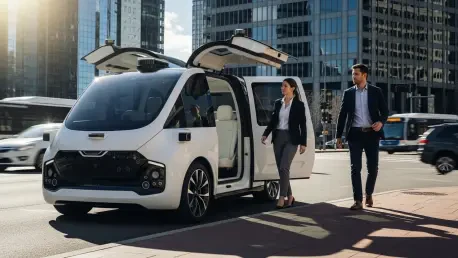

The long-promised future of autonomous urban transportation is no longer a distant vision, as 2025 marks the year robotaxis transition from controlled experiments to commercially viable services on city streets around the world. A powerful convergence of maturing artificial intelligence, advanced sensor technology, and increasingly supportive regulatory frameworks is fueling an intense global competition. This high-stakes race features established technology giants, legacy automakers, and nimble ride-hailing platforms, all vying for supremacy in a sector poised to fundamentally redefine personal mobility and the economic landscape of our cities. The overarching trend is a decisive pivot from research and development to real-world deployment, as leading companies aggressively secure operational permits, launch new fleets, and scale their services across continents, signaling a new era in how we move.
A New Map of Global Competition
The international landscape is being rapidly redrawn by ambitious players, with Chinese firm WeRide emerging as a formidable force in global expansion. The company is at the forefront of launching fully driverless services, making significant inroads in the Middle East with its operations in Abu Dhabi, a region that has proven to be a receptive early-adopter market. Further extending its reach, WeRide secured critical permits in November to begin operating in the Zurich region of Switzerland, signaling a major entry into the competitive European theater with passenger services planned imminently. This strategic push is part of a broader industry trend of deploying Level 4 autonomous vehicles, capable of operating without human intervention within specific geofenced areas. In Asia, WeRide’s collaborative model is showcased through its partnership with ride-hailing leader Grab in Singapore, where it is testing its fleet with plans to significantly expand test runs by year-end, proving that local alliances are a powerful catalyst for adoption.
In the United States, Waymo continues to hold its position as the clear operational frontrunner, having leveraged its significant head start to build a robust and scalable service. The Alphabet subsidiary now conducts hundreds of thousands of paid passenger trips every week across seven American cities, a scale of operation that remains unmatched. This extensive real-world experience provides Waymo with an enormous repository of data and a proven track record of reliability, setting an exceptionally high benchmark for safety and commercial viability. This established presence presents a formidable barrier to entry for competitors who are still in the process of validating their technology and business models, solidifying Waymo’s influence in shaping industry standards and public perception in one of the world’s most critical autonomous vehicle markets.
Meanwhile, Tesla is making aggressive moves to disrupt the existing hierarchy with a bold and vertically integrated strategy. The company is preparing for the launch of unsupervised Full Self-Driving (FSD) pilot programs in Austin, Texas, scheduled for late 2025 or early 2026. A central pillar of this strategy is the development of the Cybercab, a purpose-built robotaxi engineered from the ground up for full autonomy, which is slated to enter production by the end of the year. This approach of creating a dedicated vehicle, rather than retrofitting existing models, aims to optimize for cost, efficiency, and passenger experience. This vision has captured the imagination of investors and analysts, with firms like Ark Invest projecting that the robotaxi business could become a colossal value driver for Tesla, potentially accounting for a majority of its enterprise value by 2029.
China’s domestic robotaxi market is defined by its astonishing pace of scaling, led by national champions like Baidu with its Apollo Go service. Facilitated by strong state-backed initiatives and a favorable regulatory climate, driverless services are proliferating across dozens of Chinese cities, giving the nation an undeniable lead in the sheer volume of operational deployments. This domestic dominance is now being leveraged for international influence. Baidu is actively pursuing strategic partnerships abroad, most notably a collaboration with ride-hailing platforms Uber and Lyft for trials in the United Kingdom scheduled for 2026. This move positions the UK as a key European testing ground and signals Baidu’s ambition to transform from a regional leader into a global autonomous technology powerhouse, challenging the established players from the West.
Rather than committing billions to developing their own autonomous driving systems from scratch, ride-hailing giants like Uber and Lyft are pursuing a more pragmatic, partnership-based model. Their strategy focuses on what they do best: managing vast transportation networks and a massive user base. By integrating autonomous vehicle services from specialized technology firms, they aim to create a seamless, hybrid ecosystem where customers can summon either a human-driven car or a robotaxi from the same app. This is evident in Uber’s collaboration with WeRide for services in Abu Dhabi and its joint efforts with Baidu for upcoming trials in the UK. This trend points toward an industry future built on integrated platforms, combining sophisticated autonomous driving software with the extensive reach and logistical expertise of established ride-hailing networks to accelerate the path to mass adoption.
Overcoming Hurdles on the Road to Autonomy
Despite the accelerating pace of deployment, the journey toward a fully autonomous future is laden with significant technological and operational challenges. The core of the issue lies in ensuring that the incredibly complex systems responsible for sensor fusion, AI-based decision-making, and real-time environmental mapping can perform flawlessly in the chaotic and unpredictable conditions of real-world urban environments. A critical incident that brought this vulnerability into sharp focus involved a power outage in San Francisco, which caused a fleet of Waymo vehicles to stall and create significant traffic gridlock. This event served as a stark reminder of the reliance of autonomous systems on stable infrastructure and ignited crucial industry-wide discussions about the necessity for more robust contingency planning, fail-safe mechanisms, and resilient remote monitoring capabilities, especially in preparation for crises like natural disasters.
Safety remains the paramount concern and the ultimate determinant of both regulatory approval and public trust. To this end, autonomous vehicle companies are bolstering their case with compelling safety data that highlights the shortcomings of human drivers. Waymo, for instance, reports a crash rate of just one incident per 7.44 million miles driven, a figure that dramatically surpasses the safety record of humans, who average one crash approximately every 700,000 miles. While these statistics present a powerful argument for accelerating deployment, they have yet to fully overcome public skepticism. Widespread concerns persist regarding the complex issues of liability in the event of an accident and the deeply ethical programming required for an AI to navigate difficult dilemma situations on the road, where it might be forced to make a choice between two unavoidable negative outcomes.
The regulatory environment acts as a critical gatekeeper, shaping the pace and direction of robotaxi expansion across the globe. A global patchwork of regulations is emerging, with different regions adopting distinct approaches. China’s state-backed model, for example, prioritizes rapid, large-scale deployment to gain a strategic advantage. In contrast, Western markets in the United States and Europe tend to emphasize more stringent safety certifications and a more gradual, phased rollout process. This fragmented regulatory landscape creates a complex and competitive environment for companies seeking to operate internationally. Furthermore, the successful integration of robotaxis into the urban fabric requires significant investment in infrastructure adaptation, including upgrades to roads, traffic signals, and the deployment of advanced communication networks to support Vehicle-to-Everything (V2X) interactions.
The Reshaping of Urban Landscapes
The economic transformations heralded by the robotaxi boom were profound, promising to fundamentally restructure the transportation sector. For ride-hailing services, the elimination of driver salaries, which have always constituted a major operational expense, unlocked the potential for dramatically increased profitability and significantly lower per-ride costs. This development, in turn, suggested that fares for consumers could fall, making on-demand transportation more accessible and potentially creating trillions of dollars in new market value. The optimism surrounding this future was consistently reflected in financial markets, where positive news about robotaxi development often led to surges in the stock prices of key players. However, this economic shift also brought with it the certainty of significant social disruption, as the displacement of millions of traditional drivers from the workforce became a major societal concern.
Finally, the widespread adoption of these services hinged on delivering a consistently safe, reliable, and seamless user experience. The pivot to electric fleets, a standard for major players, offered the potential to significantly reduce urban carbon emissions and improve air quality, though this environmental benefit was counterbalanced by the substantial energy demands of the data centers required to operate the sophisticated AI models. Broader public acceptance was also found to depend on addressing critical issues of data privacy and cybersecurity, particularly concerning the use of in-car surveillance and the secure handling of personal location data. In response, regulators began developing new frameworks aimed at governing these areas, a necessary step in building the public trust required for this technology to become a truly ubiquitous part of modern urban life.