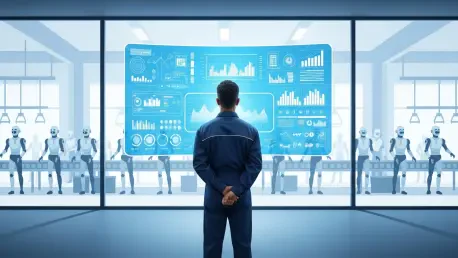

The very foundation of modern manufacturing, a blueprint designed for human hands and limitations for over a century, is rapidly becoming an architecture of obsolescence. A fundamental paradigm shift is underway, driven not by the simple integration of new tools but by the arrival of a new workforce: humanoid robots. This transition to a “robot-first” environment is no longer a distant theoretical concept; it is an immediate competitive imperative fueled by staggering advances in robotics and a dramatic, impending collapse in their operational costs. Success in this new era will not be achieved by incrementally augmenting human labor but by decisively rebuilding the factory itself for its new, tireless inhabitants. The speed and conviction with which organizations embrace this change will determine their relevance, and ultimately their survival, in the next industrial age.
The Economic Imperative for Change
The Unstoppable Economics of Humanoid Robots
The economic argument for a robotic workforce has become overwhelmingly compelling, shifting the conversation from “if” to “when.” Today’s sophisticated bipedal robots are already capable of operating for up to 20 hours per day, totaling approximately 7,000 hours annually—a workload that far surpasses the capacity of any human employee. However, the most critical driver of this disruption is not just capability but cost. A humanoid robot that currently costs the equivalent of $10 per hour is projected to see that figure plummet to just $1 per hour within the next decade, and to less than 25 cents per hour shortly thereafter. When a competitor can access labor at a fraction of a dollar while traditional labor costs remain in the $25-$35 per hour range, the fundamental mathematics of business are irrevocably broken for those who fail to adapt. The competitive landscape will be redrawn with brutal efficiency, rendering entire business models obsolete.
This transformation mirrors the swift, society-altering disruption caused by the automobile a century ago. Citing historical analysis, it is worth noting that between 1907 and 1922, horses transitioned from being the dominant mode of personal transportation to a marginal one, a change driven by superior efficiency and declining costs. The displacement of manual human labor by humanoid robots is poised to follow a similar, accelerated trajectory. This is not a gradual evolution but a tidal wave of economic inevitability that will sweep away businesses anchored to outdated labor models. The logic of the market will favor automation on a scale never before seen, making resistance to this change a financially untenable position. Companies that hesitate will find themselves on the wrong side of a historic economic divide, unable to compete on price, productivity, or efficiency.
The Global Race to Robot-First Dominance
This trend is not a distant forecast but an active global strategy being pursued with immense resources and national determination. China, for instance, has clearly recognized this impending shift and is aggressively positioning itself for global dominance in this new manufacturing paradigm. The nation has reportedly invested over $13.8 billion with the explicit goal of leading the humanoid robotics sector. This strategy is not about retrofitting existing facilities but about a far more radical and effective approach: building new “dark factories” from the ground up, specifically designed for a robotic workforce. These facilities operate without conventional lighting, climate control systems for human comfort, or the extensive safety infrastructure required to protect human workers, allowing for unparalleled efficiency and radically lower operational expenditures.
With a projected global market of 59 million humanoid robot units by 2050, China’s proactive strategy serves as a stark warning and a powerful call to action for American manufacturing. The race to build this future is already underway, and the competitive advantages are compounding. By designing and constructing factories optimized for robotic density, three-dimensional workflows, and non-stop operation, early adopters are creating a structural lead that will be incredibly difficult for others to overcome. This is more than a technological arms race; it is a fundamental competition over the physical infrastructure of the next generation of industry. Waiting for the technology to mature before investing in the necessary infrastructure is a strategy for obsolescence, as competitors will have already built the very foundation of future production.
Reimagining the Factory Floor
The Obsolescence of Human-Centric Design
For centuries, industrial facilities have been meticulously designed around the needs, comforts, and limitations of the human body, inadvertently creating what can now be seen as an architecture of obsolescence. Essential features for a human workforce, such as adequate lighting, comfortable temperatures, ergonomic workstations, and extensive safety protocols, become significant economic liabilities in a robot-first world. Industry analysis estimates that a staggering 30-40% of factory floor space is not dedicated to direct production but is instead consumed by human-centric needs like walkways, break rooms, and clearance zones. Furthermore, complex safety systems designed to prevent human injury can add as much as 8-12% to operational costs. These design principles, once necessary, are now sunk costs that directly impede the efficiency and productivity required to compete in a hyper-automated future.
This outdated model represents a profound misallocation of resources in the context of an automated workforce. The energy expended on heating, cooling, and illuminating vast spaces for biological comfort rather than optimal machine performance is a continuous drain on operational budgets. The physical space dedicated to separating humans from machinery is valuable real estate that could be used for revenue-generating production. In a future where robots are the primary workforce, every square foot dedicated to a walkway and every dollar spent on a traditional safety cage is a tangible competitive disadvantage. As global competitors begin to shed these legacy costs by building machine-native environments, companies still operating within the human-centric framework will be burdened by structural inefficiencies that make it impossible to compete on a level playing field.
The Blueprint for the 2030s Factory
The factory of the near future will be a fundamentally different environment, meticulously optimized for machine performance rather than human accommodation. Traditional lighting systems will be eliminated entirely, potentially replaced by sensor-friendly wavelengths invisible to the human eye, slashing energy consumption. Temperature and humidity will no longer be set for comfort but will be precisely controlled to maximize equipment longevity, enhance manufacturing precision, and minimize material degradation. This environmental optimization alone could reduce a facility’s operating costs by an astonishing 40-60%, providing an immediate and substantial competitive advantage before a single product is even made. The factory ceases to be a human habitat and becomes a high-performance instrument of production.
Freed from the constraints of human mobility and safety, the physical layout of production will be completely reimagined. Robots will operate in dense, vertical arrays, utilizing three-dimensional space to maximize throughput per square foot and eliminating the need for ground-level walkways and safety barriers. The factory itself will become a dynamic, living entity. Automated systems and robotic workers will reconfigure production lines in real-time, responding instantly to changing demand signals from the market. In this model, robots will effectively rebuild their own workstations as needed, enabling mass customization on an unprecedented industrial scale. Communication will be seamless and instantaneous, with robots receiving instructions through embedded networks, rendering human-readable displays and control panels obsolete and creating a frictionless flow of data and action.
The Evolving Role of Human Capital
Shifting from Manual Labor to Strategic Oversight
Addressing the inevitable concern of mass job displacement requires reframing the robot revolution as an evolution of human work, not its wholesale elimination. History is replete with examples of technological advancements making specific job roles obsolete while simultaneously creating new, higher-value ones. The roles most immediately primed for automation are the “3D” jobs—those that are dark, dangerous, and dirty. These are tasks performed in hazardous environments, involving toxic materials, or requiring repetitive, physically damaging motions that compromise human health and safety. Transitioning these responsibilities to robots is not a threat to the workforce but an elevation of the human condition in the workplace, freeing people from labor that is inherently ill-suited to them.
This shift allows human workers to move away from physically demanding and risk-prone labor and toward roles that leverage uniquely human capabilities: strategic thinking, creative problem-solving, complex decision-making, and innovation. The manufacturing floor of the future will require a new class of high-skilled professionals, including robot wranglers who maintain and deploy fleets of machines, system architects who design and optimize automated workflows, and AI/ML engineers who refine the intelligence driving the entire operation. A critical challenge for business leaders is the urgent need to invest in their workforce now to prepare for this transition. These new roles require months or even years of specialized training to master, and companies that proactively build a pipeline of skilled talent will possess a decisive advantage in the years to come.
The Paradox of Human Value in an Automated World
The impending era of hyper-automation introduced a compelling paradox that redefined the nature of work. As the cost of robotic labor plummeted toward zero, the strategic value of skilled human oversight and creative management increased dramatically. It was discovered that the true competitive differentiator was not simply the deployment of robots but the intelligent orchestration of these automated systems. The capacity for innovation, complex problem-solving, and strategic foresight—abilities that remained squarely in the human domain—became the most valuable assets a company could possess. The focus shifted from managing human labor to managing technological systems, a far more complex and value-additive endeavor that required a completely new skill set.
Ultimately, the transformation had revealed that America’s strength in innovation was its greatest asset. The most successful enterprises had been those that leaned into this paradox, investing as much in upskilling their human workforce as they did in their robotic infrastructure. A single, highly skilled human operator, capable of managing and optimizing a vast, interconnected robotic ecosystem, was found to oversee production levels that once required an entire factory of manual laborers. This elevation of the human role—from a cog in the machine to the architect of the entire system—had not only ensured continued relevance but had also unlocked unprecedented levels of productivity and creativity, defining the new frontier of global manufacturing.