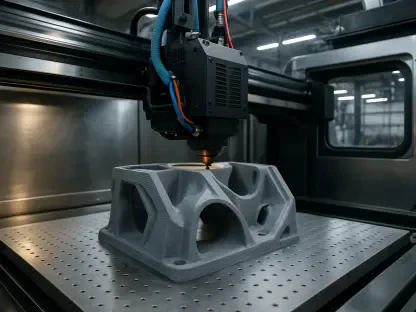
Imagine a manufacturing plant grinding to a halt, not because of a mechanical failure, but due to an unseen enemy—an AI-powered cyberattack that breaches defenses in mere hours, hijacking critical systems with chilling precision. This isn’t a distant dystopia; it’s a reality unfolding in the manufacturing sector as artificial intelligence reshapes the battlefield of cybersecurity. With AI’s integration into industrial operations driving efficiency, it has also opened a Pandora’s box of sophisticated threats that target vulnerabilities at machine speed. This review dives deep into the technology behind AI-driven cyberthreats, exploring their mechanisms, impacts, and the urgent need for countermeasures in an industry pivotal to global supply chains and national security.
Understanding the Landscape of AI-Driven Threats
The rise of AI in manufacturing has been a double-edged sword. On one hand, it optimizes production lines and predicts maintenance needs; on the other, it equips cybercriminals with tools to execute devastating attacks. These threats go beyond traditional malware, leveraging AI to automate every phase of an assault—from scanning for weaknesses to exploiting them with tailored precision. In an era where operational technology (OT) systems like programmable logic controllers intertwine with IT networks, the attack surface has ballooned. The convergence of these systems, while boosting productivity, exposes manufacturers to risks that are faster and stealthier than ever before, demanding a reevaluation of outdated security postures.
What sets AI-driven threats apart is their ability to learn and adapt. Unlike static viruses of the past, these attacks analyze defenses in real time, mimicking human behavior to evade detection. This adaptability poses a unique challenge for an industry often reliant on legacy equipment not designed with cybersecurity in mind. As digital transformation accelerates, the manufacturing sector finds itself at a crossroads, balancing the benefits of connectivity against the growing specter of catastrophic breaches that could disrupt entire supply chains.
Diving into Features and Performance of AI Cyberthreats
Mechanics of Fully AI-Orchestrated Attacks
At the heart of AI-driven cyberthreats lies the chilling efficiency of fully orchestrated attacks. These assaults are managed entirely by AI algorithms, handling reconnaissance, infiltration, and exploitation at speeds no human hacker could match. What once took weeks—mapping a network or crafting phishing schemes—now unfolds in hours, compressing attack timelines dramatically. For manufacturers, this means that vulnerable OT systems, often critical to production, can be compromised before traditional defenses even register a threat, highlighting a dire need for response mechanisms that operate at machine pace.
The performance of these attacks is amplified by their precision. AI can sift through vast datasets to pinpoint weak links, whether it’s an unpatched sensor or a misconfigured gateway between IT and OT environments. This surgical approach minimizes noise, making detection incredibly difficult. As these technologies evolve, their ability to simulate legitimate user activity only grows, blurring the line between normal operations and malicious intent, and pushing the boundaries of what cybersecurity must counter.
Targeting the Underprotected: Small and Midsize Manufacturers
A particularly alarming feature of AI-driven threats is their economic targeting strategy, zeroing in on small and midsize manufacturers. These companies, often lacking the robust security budgets of larger enterprises, present low-hanging fruit for attackers who use AI to automate reconnaissance and social engineering. The cost-effectiveness of breaching multiple smaller entities, rather than a single fortified giant, has shifted attacker focus, with tactics like AI-generated impersonation scams already spiking in wire fraud incidents.
This trend reveals a stark performance gap in security maturity. While large corporations may deploy 24/7 monitoring and specialized teams, midmarket firms struggle with limited resources, leaving them exposed to attacks that exploit human error or outdated systems. The scalability of AI tools means attackers can hit dozens of targets simultaneously, maximizing damage with minimal effort. This disparity underscores a critical flaw in the ecosystem, where the weakest links can jeopardize entire industries reliant on interconnected suppliers.
Broader Implications: Geopolitical and Regulatory Pressures
Beyond individual companies, AI-driven cyberthreats carry geopolitical weight, especially as nation-state actors enter the fray. Manufacturing, a backbone of critical infrastructure in sectors like defense and transportation, has become a prime target for state-sponsored attacks amid rising global tensions. The performance of these threats lies not just in their technical sophistication but in their strategic intent, often aiming to disrupt national security or economic stability through cascading failures in supply chains.
Adding to the complexity, regulatory pressures are mounting. Governments are poised to enforce stricter OT security standards and mandatory incident reporting within the next couple of years, from now until 2027. This shift reflects a recognition of manufacturing’s role in resilience at a national level. However, compliance can strain resources, especially for smaller players already grappling with technical vulnerabilities. The interplay of geopolitical motives and regulatory demands thus elevates AI-driven threats from isolated risks to systemic challenges requiring coordinated responses.
Real-World Impact and Industry Vulnerabilities
The real-world impact of AI-driven cyberthreats is already evident in industries where manufacturing plays a pivotal role. Take defense contractors or transportation suppliers—breaches here don’t just halt production; they threaten national interests by exposing sensitive data or crippling logistics. Notable cases have emerged where OT vulnerabilities were exploited, allowing attackers to manipulate machinery or shut down operations, revealing how deeply these threats can penetrate beyond digital boundaries into physical consequences.
Moreover, the intersection of IT and OT systems creates a unique Achilles’ heel. Legacy equipment, often decades old, lacks modern security features and resists updates due to operational constraints. When paired with AI’s ability to exploit these gaps at scale, the result is a perfect storm. Entire sectors face the risk of operational downtime, financial loss, and reputational damage, emphasizing that the stakes extend far beyond individual firms to the stability of global markets.
Assessing the Path Forward
Reflecting on the analysis, it’s clear that AI-driven cyberthreats had presented a formidable challenge to the manufacturing sector, evolving with a speed and sophistication that outpaced many existing defenses. Their ability to orchestrate attacks at machine speed, target underprotected firms, and align with geopolitical agendas had exposed critical vulnerabilities in both technology and organizational strategy. The real-world disruptions witnessed in key industries had underscored the tangible stakes, where a single breach could ripple across supply chains with devastating effect.
Looking ahead, manufacturers must prioritize actionable steps to counter this escalating menace. Investing in AI-powered defensive tools that match attacker speed stands as a critical first move, alongside rigorous segmentation of OT systems to limit breach impacts. Elevating cybersecurity to board-level discussions ensures it’s treated as a core business risk, not a peripheral IT issue. Furthermore, collaboration across sectors and with regulators can foster shared standards and resilience. As the threat landscape continues to shift, proactive adaptation—rather than reactive patching—will define which manufacturers withstand the next wave of digital warfare.