
As a leading expert in manufacturing and production management, Kwame Zaire has dedicated his career to the intersection of material science and industrial scalability. With a deep focus on predictive maintenance and quality control, he has become a pivotal figure in transitioning sustainable technologies from the laboratory to the factory floor. This discussion explores a revolutionary breakthrough in bio-based packaging that began with an accidental discovery involving beetle aesthetics and evolved into a high-performance, compostable alternative to traditional petroleum-based plastics.
The following conversation delves into the molecular engineering of chitin and cellulose, the mechanical challenges of roll-to-roll manufacturing, and the economic shifts required to replace single-use plastics with renewable materials.
Since the initial transition from studying beetle aesthetics to measuring oxygen transmission, what specific testing protocols did the team use to confirm these films outperformed standard plastics? Could you walk through the moment you realized the material’s density provided such a superior barrier?
The testing protocols were rigorous, focusing primarily on oxygen transmission rate (OTR) measurements conducted under controlled atmospheric conditions. Initially, the team expected a porous structure suitable for pigments, but instead, the chitin nanofibers self-assembled into an incredibly dense, transparent matrix. When we ran the OTR tests, the data showed that this natural carbohydrate allowed less oxygen to pass through than many of the high-performance plastics currently dominating the packaging market. It was a stunning revelation in 2014 because it proved that bio-polymers didn’t have to be “weaker” versions of synthetics. The physical sensation of handling those first films—seeing how thin yet structurally sound they were—really solidified our shift from studying aesthetics to engineering a functional barrier.
Given that chitin and cellulose possess opposite electric charges, how do these properties facilitate the spray-coating process on a molecular level? What are the mechanical steps required to ensure these layers bond into a dense interface rather than remaining separate or porous?
The magic happens through electrostatic attraction, where the positive charge of the chitin and the negative charge of the cellulose create a long-range pull that zips the layers together. In a spray-coating setup, we deposit a fine mist of chitin first, followed immediately by the cellulose nanomaterials, allowing them to find their molecular “fit” in real-time. Mechanically, this requires precise control over the spray pressure and the distance from the substrate to ensure the droplets don’t bead up but rather spread into a uniform film. By managing the deposition rate, we force the materials to create a dense interface that eliminates the gaps or pores that would otherwise allow gases to leak through.
Moisture sensitivity often causes bio-based films to swell and lose their effectiveness. How did the introduction of citric acid and carboxymethylcellulose create the necessary chemical cross-links to solve this? Please describe the resulting impact on the film’s performance in high-humidity environments.
Moisture has historically been the “Achilles’ heel” of bio-polymers because water molecules wedge themselves between the chains, causing the material to swell and lose its barrier properties. To solve this, we introduced citric acid to act as a bridge, creating chemical cross-links—essentially permanent junctions—between the molecules of carboxymethylcellulose. This chemical architecture was a breakthrough we finalized in 2024, as it significantly reduced the film’s ability to take up water. Even when we pushed the environment to 80% humidity, the film maintained its integrity and continued to match or outperform traditional plastic packaging.
Moving from laboratory-scale casting to industrial roll-to-roll coating presents significant logistical hurdles. What modifications are necessary for existing manufacturing lines to handle these natural polymers, and what metrics determine if a specific substrate is suitable for this type of continuous application?
The transition to roll-to-roll manufacturing requires a shift in how we manage drying times and tension control on the production line. Because we are working with aqueous suspensions of chitin and cellulose, the drying ovens must be calibrated to remove moisture without causing the bio-film to become brittle or warp. We look for substrates like paper or other biodegradable plastics that have high surface energy, ensuring the coating adheres perfectly during the continuous winding process. The primary metrics for success are coating thickness uniformity and adhesion strength, as any peeling at industrial speeds would lead to catastrophic material waste.
Purified chitin is currently a niche material used primarily in specialized medical fields. How must the supply chain for food waste and mushroom-derived chitin evolve to meet global packaging demands, and what specific economic trade-offs do manufacturers face when switching from petroleum-based plastics?
Currently, the supply chain is highly fragmented because chitin is mostly a byproduct of the seafood industry, used for high-value items like wound dressings or water filters. To meet the massive volume required for food packaging, we need to industrialize the extraction of chitin from mushroom farming and crustacean food waste on a much larger scale. Manufacturers face a higher upfront cost for these raw materials compared to the mature, subsidized petroleum-based plastics market. However, the trade-off is becoming more attractive as governments implement bans on single-use plastics and carbon taxes begin to penalize non-biodegradable waste.
Beyond the technical specifications of oxygen and moisture resistance, how do these films behave during the composting process? Could you provide a step-by-step breakdown of how the material degrades in a natural environment compared to the lifecycle of a traditional multi-layer plastic laminate?
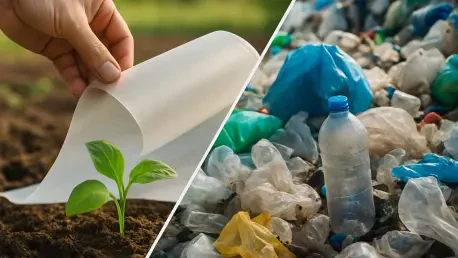
Unlike traditional laminates that consist of inseparable layers of foil and plastic—which essentially live forever in a landfill—our films are designed to be recognized by natural microbes. Once the film enters a composting environment, moisture and soil bacteria begin breaking the citric acid cross-links and consuming the carbohydrate chains of the cellulose and chitin. Within a matter of weeks, the material returns to the earth as organic matter, whereas a standard plastic laminate would take hundreds of years to break into harmful microplastics. It is a closed-loop cycle where the packaging effectively becomes food for the next generation of plants or fungi.
What is your forecast for the future of bio-based packaging?
I believe we are on the cusp of a total transformation where “plastic” will no longer be synonymous with petroleum. Over the next decade, as we refine roll-to-roll techniques and stabilize global supply chains for chitin, these bio-based films will move from niche experimental products to the standard for dry goods and fresh produce. The convergence of high-performance barrier properties—like those we’ve seen in our October 2025 results—and increasing regulatory pressure will make sustainable packaging the only logical choice for global brands. Eventually, we won’t just be mimicking nature’s designs, like the beetle’s shell; we will be fully integrating our industrial systems into the planet’s natural lifecycle.