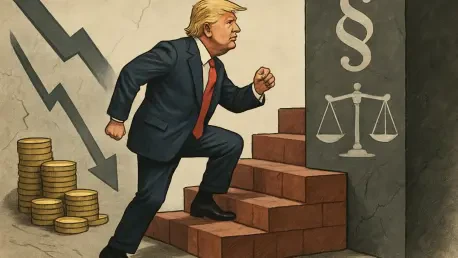

A massive judicial pivot has left the federal government scrambling to navigate a fiscal labyrinth after the Supreme Court dismantled a cornerstone of the nation’s current trade policy. This legal earthquake involves a ruling that the International Emergency Economic Powers Act did not provide the necessary authority for the administration’s previously enacted, wide-ranging tariffs. By effectively pulling the plug on these measures, the court has created a logistical nightmare that requires the government to process roughly $175 billion in refunds to various importers. Rather than retreating from its protectionist stance, the administration is now searching for alternative legal channels to maintain its trade objectives while addressing this significant revenue gap.
The fallout from this judicial decision has forced a complete re-evaluation of how the executive branch interacts with global markets. Policymakers are no longer relying on the broad, emergency-based justifications that failed under legal scrutiny; instead, they are shifting their strategy toward more targeted, established statutes. This move is not just a change in paperwork but a fundamental restructuring of the American economic strategy, as the government attempts to stabilize a budget that suddenly faces a multibillion-dollar deficit. The urgency of the situation is compounded by the need to find a sustainable way to protect domestic industries without triggering further legal defeats or immediate domestic price shocks.
A $175 Billion Judicial Collision and the Quest for New Revenue
The recent Supreme Court decision has essentially stripped the executive branch of its most potent trade weapon, leaving a void where a comprehensive protectionist policy once stood. This ruling highlighted the limitations of using emergency acts for long-term economic restructuring, a strategy that the court found exceeded the statutory intent of the law. As a result, the administration must now account for the $175 billion that must be returned to businesses, a task that complicates the federal budget and creates uncertainty for fiscal planning. This situation has sparked an intense search for new revenue streams that can withstand the same level of judicial oversight that toppled the previous regime.
To fill this fiscal hole, trade officials are increasingly looking toward a more diverse set of authorities that focus on specific trade practices rather than general national emergencies. This transition involves a complex balancing act, as the administration tries to satisfy the demands of domestic labor groups while avoiding further interventions from the judiciary. The quest for new revenue is now inextricably linked to the legality of the tools used to collect it, making the choice of statutory authority the most important decision for trade representatives. This shift marks a departure from the “shock and awe” approach of past years toward a more methodical and legally insulated strategy.
Why the Move Toward Section 301 Represents a Critical Turning Point
Transitioning from broad emergency powers to the specific mechanisms found in Section 301 of the Trade Act of 1974 is a defining moment for modern commerce. This shift is significant because Section 301 was designed specifically to address unfair trade practices, making it a much more resilient tool in the face of courtroom challenges compared to the overstretched emergency acts of the past. By grounding policy in a statute that has historically survived legal testing, the administration is signaling its intent to remain aggressive in trade negotiations while minimizing the risk of another embarrassing and costly defeat.
This policy evolution is also a primary driver of the current national economic narrative, influencing everything from high-level diplomatic relations with the European Union to the price of basic consumer goods. As the United States grapples with volatile energy prices and international instability, the use of Section 301 allows for a more surgical approach to trade, targeting specific sectors like electronics and automotive parts. This strategic pivot ensures that the trade agenda remains a central pillar of the administration’s platform, even as it adapts to the realities of a more skeptical judicial environment.
The New Protectionist Toolkit: Investigating Excess Capacity and National Security
In the wake of the IEEPA invalidation, the administration is deploying a refined toolkit that utilizes Sections 301, 122, and 232 to achieve its goals. Section 122 provides a quick-strike capability, allowing for immediate levies of up to 15% to address balance-of-payment issues, though its 150-day duration serves as a built-in expiration date. To establish a more permanent defensive perimeter, officials have launched an expansive Section 301 investigation into 16 different trading partners. This inquiry focuses heavily on “excess capacity,” particularly regarding the overproduction of goods in China that threatens to flood global markets and undermine American manufacturers.
Furthermore, the definition of national security is being broadened under Section 232 to include much more than just the traditional steel and aluminum sectors. Current trade strategies frame automotive parts and pharmaceutical supply chains as critical infrastructure, making them eligible for protective tariffs under the guise of national defense. This holistic approach to trade security seeks to insulate the American economy from foreign dependencies that could be exploited during times of global conflict. By weaving together these different statutes, the administration is attempting to create a layered defense that protects domestic jobs while navigating the constraints of international law.
Evaluating the High Cost of Trade Wars Through Data and Expert Analysis
Despite the promise of industrial renewal, the economic cost of these protectionist measures is becoming increasingly apparent through recent data. Analysis from the Joint Economic Committee suggests that the current tariff trajectory will impose a significant financial burden on the average American household, reaching an estimated $2,512 by the end of the 2026 fiscal year. This represents a sharp increase in the cost of living, as the “double-hit” effect takes hold. Importers typically pass along the majority of tariff costs to consumers, and domestic producers often follow suit by raising their own prices in the absence of cheaper foreign competition.
Trade specialists at firms like King & Spalding have noted that the sheer scale of the ongoing investigations is without precedent in the history of American trade policy. The gamble is high-stakes; the administration is betting that these measures will eventually force trading partners to the table and lead to better terms for U.S. workers. However, the immediate reality for many families is one of decreased purchasing power. This tension between long-term industrial goals and short-term financial strain remains a central point of debate, as experts monitor whether the domestic manufacturing gains will be enough to offset the rising prices seen across the retail landscape.
A Framework for Monitoring Economic Stability Amidst Policy Shifts
Successfully navigating this volatile period required a constant monitoring of the interaction between trade levies and broader market signals. Stakeholders had to pay close attention to the 150-day countdown associated with Section 122 tariffs to determine if legislative extensions would be granted. Simultaneously, analyzing the “pass-through” rates of costs in critical sectors provided a real-time look at how trade policy was influencing inflation. This framework allowed observers to weigh the promised benefits of increased domestic investment against the very real pressure of rising energy and commodity costs.
Ultimately, the administration sought to bridge the gap between protectionist ideals and the harsh realities of global trade law. The transition toward investigation-heavy frameworks provided a more stable foundation for policy, even as it increased the direct costs for many Americans. Moving forward, the focus shifted toward whether these calculated trade barriers would actually foster a more resilient industrial base or if the financial burden on consumers would become too heavy to sustain. The lessons learned during this period of legal and economic upheaval provided a roadmap for how future administrations might handle the delicate balance of national interest and international cooperation.