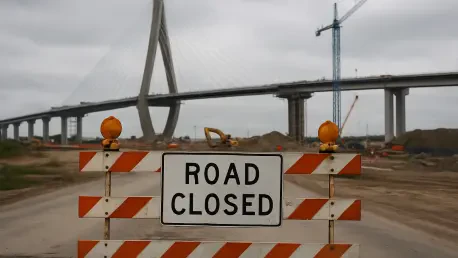

A multi-billion dollar feat of engineering designed to be the longest cable-stayed bridge in North America and a vital new artery for U.S.-Canada trade now faces an unprecedented political roadblock just as it nears completion. The Gordie Howe International Bridge, a project years in the making and fully funded by the Canadian government, has become the latest flashpoint in the escalating trade tensions between the two nations, after President Donald Trump issued a startling threat to prevent its opening. In a move that sent shockwaves through the automotive industry and local Michigan communities, the president demanded a complete renegotiation of the project’s terms, including at least 50% U.S. ownership, casting a long shadow of uncertainty over a critical piece of infrastructure. The threat, issued ahead of a contentious review of the United States-Mexico-Canada trade agreement, pits federal economic nationalism against years of established international cooperation and bipartisan state-level support, raising fundamental questions about the future of one of the world’s most significant trade relationships.
A Standoff over Steel and Sovereignty
The core of the administration’s surprising opposition was articulated in a social media post where President Trump outlined his demands for the nearly finished Gordie Howe International Bridge. Citing complaints that the United States would get “nothing” from the arrangement and that Canada did not use American steel in the bridge’s construction, the president called for a radical restructuring of the project’s ownership. The demand for at least 50% U.S. ownership, along with other unspecified conditions, represents a sharp pivot from the long-standing agreement governing the project. This stance is being viewed by many analysts as a strategic maneuver tied to the broader context of a deteriorating trade relationship with Canada during his second term. The timing of the threat, just before a scheduled review of the United States-Mexico-Canada Agreement (USMCA), suggests it is a high-stakes bargaining chip in a much larger economic negotiation, using a vital infrastructure project as leverage in a contentious international dispute.
However, the president’s claims stand in stark contrast to the documented history and foundational agreements of the bridge project. The Gordie Howe International Bridge was conceived and executed under an arrangement where the Canadian government agreed to finance the entire multi-billion dollar construction cost, including the customs plazas on both the U.S. and Canadian sides. This agreement was finalized during the tenure of former Michigan Republican Governor Rick Snyder as a pragmatic solution to alleviate crippling traffic congestion on the existing Ambassador Bridge without placing a financial burden on Michigan taxpayers. Furthermore, the assertion that the United States would receive no benefit is directly contradicted by the project’s governance structure. Upon completion, the bridge is set to be operated under a joint public-private partnership agreement between Michigan and Canada, with toll revenues first repaying Canada’s initial investment before being shared. This collaborative framework was designed to ensure mutual benefit and was the product of years of bipartisan and international negotiation.
A Unified Front in Michigan
The presidential threat has been met with swift and unified condemnation from a bipartisan chorus of Michigan’s political leaders, who have championed the bridge as a generational investment in the state’s economic future. From the governor’s office to the state’s congressional delegation, officials have forcefully pushed back against the administration’s narrative, emphasizing the project’s critical importance. Describing the bridge as a “huge boon” for Michigan’s economy, they highlight its role as the busiest trade crossing in North America, a crucial link for the integrated auto industry, and a generator of thousands of local jobs. Representative Elissa Slotkin characterized the president’s threat as a self-defeating move that would harm American workers and businesses, attributing the sudden opposition to “spite” rather than a coherent economic strategy. Similarly, Representative Shri Thanedar labeled the move as detrimental to American interests, underscoring the broad consensus within the state that obstructing the bridge’s opening would be an act of economic self-sabotage.
The intense local opposition is rooted in the tangible economic realities of the U.S.-Canada trade relationship, which is most acutely felt at the Detroit-Windsor border crossing. This single corridor facilitates a significant portion of all trade between the two countries, with the automotive sector being particularly dependent on the seamless flow of parts and finished vehicles. The Gordie Howe International Bridge was specifically designed to provide much-needed redundancy and capacity to this vital commercial artery, which has long been strained by reliance on the aging, privately owned Ambassador Bridge. For Michigan, the new bridge represents more than just concrete and steel; it is a guarantee of future economic competitiveness, supply chain security, and sustained growth in its cornerstone industry. This on-the-ground reality has created a stark disconnect between the federal administration’s political posturing and the unwavering bipartisan support for the project within the state, where leaders have expressed firm determination to see it through to completion.
The Bridge’s Unwavering Trajectory
The confrontation over the Gordie Howe International Bridge ultimately highlighted the profound resilience of long-term, cross-border infrastructure projects against sudden political pressures. Despite the severity of the presidential threat, the mechanism by which the White House could have legally blocked the opening of a customs plaza on U.S. soil for a bridge built under a ratified international agreement remained ambiguous. This lack of a clear legal pathway, combined with the unified and forceful opposition from Michigan’s entire political establishment, effectively rendered the threat toothless. State officials, confident in the legally binding nature of the agreements negotiated by a previous administration, stood firm in their assertion that the bridge “is going to open one way or another.” This episode served as a crucial test case, demonstrating that deeply integrated economic partnerships and state-level commitments, once codified, could withstand even the most direct challenges from the executive branch, ensuring that a vital economic link forged through years of cooperation would not be severed by a last-minute political gambit.