
Recent trade tariffs have served as a powerful market-wide stress test, fundamentally recalibrating the competitive dynamics within the U.S. manufacturing sector and moving the conversation far beyond the predictable narratives of cost spikes and supply chain disruptions. These economic policies have acted as a clarifying agent, exposing the deep-seated vulnerabilities of businesses architected around intricate global supply chains while simultaneously amplifying the inherent strategic advantages of companies committed to domestic production. The result has been a seismic shift in corporate priorities, where the long-standing “lowest bid wins” procurement model is steadily being supplanted by a more cautious, forward-thinking paradigm. In an era increasingly defined by global volatility and geopolitical uncertainty, the central question for American businesses has evolved from simply “What does it cost?” to the more critical and sophisticated inquiry, “What is the risk?”. This pivot signals a mature understanding that true long-term value lies not in marginal cost savings but in operational resilience and supply chain stability.
The New Calculus of Procurement and Logistics
For decades, cost remained the undisputed king of procurement decisions, but the instability injected into the market by tariffs has irrevocably altered this calculus. Manufacturers heavily dependent on foreign components and overseas suppliers were immediately thrust into a reactive state, compelled to pass on unpredictable and often repeated price increases to their customers throughout the year. This created a level of volatility that is particularly disruptive for large-scale institutional buyers, such as airports, school districts, and corporate facility managers, who operate on long-term budgets and multi-year procurement cycles. The constant pricing reassessments complicate their financial planning and introduce a degree of uncertainty they are increasingly unwilling to accept. Conversely, domestic manufacturers with established, localized supply chains were largely insulated from these shocks. Because their core cost structure remained stable, they could offer something far more valuable than a marginal discount: price consistency. This predictability has emerged as a potent competitive advantage, as buyers now demonstrate a clear preference for vendors who can guarantee cost stability.
The strategic importance of logistics and lead times has also been thrust back into the spotlight, drawing parallels to the supply chain nightmares of the recent past that saw container ships idling offshore and global commerce grinding to a halt. Tariffs have added another significant layer of risk to global logistics, highlighting how long, complex supply chains are inherently vulnerable to a host of potential disruptions, including international port congestion, sudden policy changes, and escalating geopolitical tensions. Domestic manufacturing offers a direct and effective countermeasure to these vulnerabilities. By sourcing and producing goods within the United States, companies can dramatically shorten their lead times, a critical operational benefit for many clients. This proximity to the end market significantly reduces transportation costs, eliminates the risk of overseas bottlenecks, and enables far greater agility in production. For high-traffic facilities that require rapid replacement of essential equipment, the ability to secure products quickly is not a luxury but a necessity for uninterrupted operations.
The Strategic Value of a Domestic Footprint
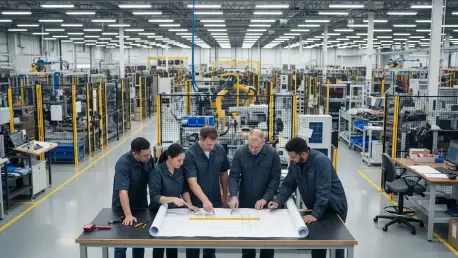
The conversation around the American workforce has been reframed, moving beyond patriotic sentiment to a discussion of tangible business strategy. Companies that have consistently invested in a stable, experienced domestic workforce have gained an unexpected but significant advantage in the form of human capital that mitigates risk and drives innovation. When tariff-affected competitors are forced to pivot quickly away from established offshore suppliers, they often face significant quality control risks associated with new, unvetted partners. In contrast, a seasoned domestic team ensures a consistent standard of quality, protecting brand reputation and customer trust. Furthermore, the strategic value of “proximity” cannot be overstated. When engineering, sourcing, assembly, and quality control teams are located in the same facility or region, the innovation cycle is dramatically accelerated. Problems can be identified and solved in a matter of hours or days when teams are “down the hall, not across the ocean,” fostering a responsive and efficient operational ecosystem that allows for faster product development and continuous improvement.
This new economic environment has powerfully validated the foresight of companies that committed to U.S. manufacturing long before it became a reactive trend. A crucial distinction has emerged between two corporate responses to tariffs. One group of companies is now exploring reshoring and developing domestic supply chains purely as a short-term fix because the tariffs forced their hand. Their strategy is one of necessity rather than conviction. The other group consists of manufacturers who have been quietly and deliberately building their domestic production capabilities for decades. For these companies, the decision to manufacture in the U.S. was a long-term strategic bet on the belief that a domestic foundation would ultimately build a stronger, more resilient business. The recent wave of tariffs did not change their philosophy; it powerfully validated it. These companies are now reaping the rewards of their long-term vision, gaining market share by being able to respond to market disruptions with the simple and powerful message: “We are unaffected.”
Redefining Competitive Advantage for the Future
The market advantages currently enjoyed by domestic manufacturers were not a temporary phenomenon, as the forces reshaping global trade showed every sign of becoming permanent features of the economic landscape. An examination of the industry’s trajectory revealed that procurement practices were set to evolve permanently. Just as sustainability criteria became a standard part of Requests for Proposals (RFPs) over the past decade, procurement teams were increasingly expected to filter potential vendors based on their tariff exposure and the transparency of their domestic sourcing. This shift underscored a fundamental re-prioritization where supply chain resilience became a critical business imperative. It was clear that manufacturers with deep roots in the U.S. would possess a structural competitive advantage, as their business models were fundamentally less vulnerable to global economic and political shocks. While the trend of reshoring was likely to continue, it was a complex, costly, and friction-filled process, presenting significant hurdles for companies attempting a rapid pivot to domestic production. In the end, the analysis demonstrated that tariffs had acted as a powerful clarifying agent, starkly revealing which companies were built on resilient, long-term strategies and which were structured on fragile, cost-optimized global supply chains.