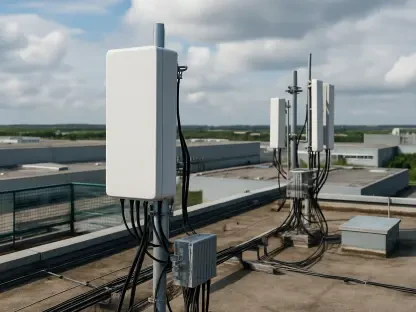

The same multi-gigabit speeds that promise to power autonomous cities and remote surgery are also creating attack vectors that can materialize and vanish in the blink of an eye, forcing a fundamental reckoning with how digital infrastructure is secured. The fifth-generation wireless standard, or 5G, has moved from a future-facing concept to a present-day reality, underpinning a new wave of technological innovation. Its arrival signals more than just faster downloads; it represents a paradigm shift in connectivity that is redefining industries and daily life. However, this transformative power carries with it a set of inherent security challenges that are directly proportional to its performance advantages. As enterprises and governments accelerate their adoption of 5G, they must confront an uncomfortable truth: the very architecture that enables unprecedented progress also creates unparalleled vulnerabilities.
The Dawn of the Hyper-Connected ErUnderstanding 5G’s Transformative Power
The fifth-generation wireless revolution is built on three foundational pillars: enhanced mobile broadband (eMBB) delivering multi-gigabit speeds, ultra-reliable low-latency communications (URLLC) enabling near-instantaneous response times, and massive machine-type communications (mMTC) supporting up to a million connected devices per square kilometer. This trifecta of capabilities moves cellular technology beyond a consumer-centric service into the realm of critical infrastructure, serving as the connective tissue for the next industrial revolution.
Across key sectors, 5G’s significance is already profound. In manufacturing, it powers smart factories with wirelessly connected robotics and predictive maintenance sensors. In healthcare, it enables remote diagnostics and telesurgery, where latency is a matter of life and death. For civic infrastructure, 5G is the backbone of smart cities, managing everything from traffic flow to energy grids. Meanwhile, in logistics and transportation, it is the key enabler for autonomous vehicles and drone delivery systems that rely on constant, real-time data exchange.
This ecosystem is driven by a diverse range of market players. Network providers like AT&T, Verizon, and T-Mobile are rapidly deploying the physical infrastructure, while hardware manufacturers such as Ericsson, Nokia, and Samsung provide the radio access network (RAN) and core network components. Underpinning it all are technology firms like Qualcomm and Intel, which design the modems and chipsets that allow billions of devices to connect to these advanced networks, creating a complex and interdependent global market.
The Accelerating Adoption: Trends and Market Projections
From Smart Cities to Autonomous Factories: How 5G is Reshaping Industries
The primary market driver for 5G adoption is the insatiable demand for real-time data processing. Industries are no longer just collecting data; they are acting on it instantaneously. This need for immediacy, coupled with the explosion of IoT deployments, makes 5G an essential enabling technology. Legacy wireless standards simply cannot offer the combination of bandwidth, latency, and device density required to manage a fleet of autonomous trucks or a city-wide network of environmental sensors.
Consequently, both enterprise and consumer behaviors are shifting. The rise of edge computing, which processes data closer to its source rather than in a centralized cloud, is a direct result of 5G’s low latency. This allows for more responsive applications and reduces data transit costs. For consumers, enhanced mobile broadband is making fixed wireless access a viable alternative to traditional cable internet, while paving the way for immersive augmented and virtual reality experiences. These shifts are fostering entirely new business models, from on-demand private 5G networks for enterprise campuses to subscription services for cloud-based gaming that rely on a lag-free connection.
The Exponential Growth Curve: Projecting 5G’s Market Dominance
Market data reveals an industry in a state of exponential growth. Since the initial rollouts, 5G network coverage has expanded dramatically across North America, Europe, and Asia, with subscriber numbers climbing into the billions. Device adoption has kept pace, as nearly all new smartphones and a growing number of industrial IoT devices are now 5G-enabled, creating a self-reinforcing cycle of demand and investment.
Economic forecasts reflect this momentum, projecting that the global 5G market will continue its double-digit annual growth through the end of the decade. Performance indicators, such as capital expenditure by network operators and revenue from 5G-enabled services, consistently outperform initial estimates. Looking forward, the technology’s impact is expected to deepen, becoming fully integrated into critical national infrastructure and driving trillions of dollars in economic activity by the early 2030s.
The High-Speed Paradox: When Unprecedented Velocity Creates Unseen Vulnerabilities
The Shrinking Window for Defense: How Speed Fuels Rapid Attacks
The multi-gigabit speeds of 5G create a security paradox by dramatically compressing attack timelines. In this high-velocity environment, threat actors can execute “burst-mode” data theft, exfiltrating terabytes of sensitive information in minutes or even seconds—a task that would have taken hours or days on previous networks. This speed also facilitates rapid lateral movement, allowing an intruder who breaches a single endpoint to quickly pivot and compromise an entire network before detection systems can even register the initial anomaly.
This acceleration renders many traditional security tools obsolete. Deep packet inspection (DPI), for instance, which scrutinizes the content of data packets for malicious signatures, cannot operate at the line speed of 5G without creating a significant performance bottleneck. Security teams are faced with a stark choice: either slow down the network to inspect traffic, thereby negating the primary benefit of 5G, or allow traffic to pass with minimal inspection, creating a massive blind spot. For malicious actors, 5G’s speed is a potent force multiplier, enabling them to execute campaigns with a velocity that outpaces human-led incident response.
A Widening Attack Surface: The Architectural Risks of 5G
Beyond speed, the very architecture of 5G introduces new security complexities that expand the potential attack surface. Network slicing, a feature that allows operators to create multiple virtual networks on a single physical infrastructure, is a prime example. While it offers unprecedented flexibility, a misconfiguration in the policies that isolate these slices could allow a threat to bleed from a low-security slice (e.g., guest Wi-Fi) into a high-security one (e.g., critical operational controls).
Furthermore, the shift toward distributed edge computing decentralizes the network, moving processing power away from a fortified central core and out to thousands of edge nodes. This complicates centralized security monitoring and creates more points of potential entry for attackers. Compounding this challenge is the proliferation of millions of unsupervised IoT endpoints, from smart meters to industrial sensors. Many of these devices lack robust built-in security features, making them easy targets for compromise and potent gateways for launching larger attacks across the 5G network.
Governing the Unseen Threat: The Race to Regulate 5G Security
In response to these emerging risks, a new regulatory landscape is taking shape. Government agencies, including the Cybersecurity and Infrastructure Security Agency (CISA) and the National Security Agency (NSA), have issued formal guidance highlighting the strategic threats posed by 5G. These bodies are actively collaborating with industry partners to develop a more resilient and defensible network architecture, recognizing that 5G is now a component of critical national infrastructure.
This has led to the development of new security standards and compliance frameworks designed specifically for the 5G environment. Standards bodies like the 3rd Generation Partnership Project (3GPP) have integrated enhanced security features into the core specifications of 5G, including stronger encryption and more robust subscriber identity protection. Simultaneously, industry-specific regulations are emerging to govern the use of 5G in sectors like finance and healthcare, mandating stringent security controls. These evolving regulations are placing new responsibilities on network operators, device manufacturers, and enterprise adopters, who must now demonstrate compliance to ensure the integrity and security of their 5G deployments.
Forging a New Defense Paradigm: Securing the Future of Connectivity
Shifting from Inspection to Intelligence: The Rise of AI and Behavioral Analytics
To secure networks operating at 5G speeds, security strategies must shift from deep packet inspection to broader intelligence gathering. Modern detection now focuses on analyzing traffic patterns and behavioral anomalies rather than trying to scrutinize the content of every packet. This approach leverages machine learning and artificial intelligence to establish a baseline of normal network behavior, allowing systems to automatically flag deviations that may indicate a compromise.
The success of this paradigm depends on real-time telemetry and highly scalable security data pipelines. By collecting and correlating metadata from network flows, endpoints, and applications at line speed, security platforms can identify sophisticated threats without introducing latency. This move toward behavioral analytics allows security teams to gain visibility even into encrypted traffic, identifying threats based on their communication patterns rather than their payload, a critical capability in a world where encryption is ubiquitous.
Fighting Fire with Fire: The Critical Need for Automated Incident Response
With attack timelines shrinking from days to minutes, manual incident response is no longer viable. The modern security imperative is to fight fire with fire, using automation to contain threats at machine speed. This means moving from human-driven analysis and containment to automated workflows that can reduce attacker dwell time to near zero.
Effective methods include dynamic slice isolation, where a compromised network slice is automatically quarantined to prevent a threat from spreading. Automated policy enforcement can instantly block malicious IP addresses or revoke user credentials upon detecting suspicious activity. To ensure these automated defenses are effective, they must be continuously validated. Integrating real-time threat intelligence feeds and conducting continuous red team testing allows organizations to proactively identify weaknesses and refine their automated response playbooks before a real attack occurs.
Balancing Speed and Security: A Verdict on the 5G Dilemma
The analysis presented confirmed that 5G’s defining feature—its unprecedented speed—is a dual-edged sword that mandates a fundamental modernization of cybersecurity. The very attributes that drive innovation and efficiency also equip adversaries with the means to execute faster, more damaging attacks. This created a high-speed paradox where legacy security models, built for slower networks, were rendered insufficient, leaving organizations exposed.
The investigation into 5G’s architectural shifts, such as network slicing and edge computing, revealed a significantly expanded and more complex attack surface. This decentralization complicated oversight and introduced new vectors for compromise. It became clear that harnessing 5G’s transformative benefits requires a parallel and equally ambitious investment in a new defense paradigm. For security leaders, the path forward involves embracing a Zero-Trust architecture, where no user or device is trusted by default. This approach, combined with a commitment to automated, intelligence-driven defense systems, provides the strategic framework needed to manage the inherent risks of a hyper-connected world.