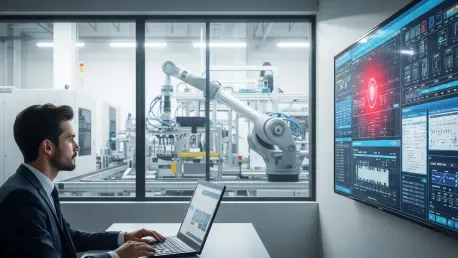

While the digital alarms in manufacturing boardrooms have been ringing loudest for the ever-present threat of ransomware, a more insidious and politically charged danger has quietly moved from the periphery to the factory floor. For years, the sector has rightly focused its defenses on financially motivated criminals who lock down systems for profit, a threat that made manufacturing the most targeted industry globally. However, this intense focus has cultivated a significant blind spot: the evolution of hacktivism from a digital nuisance into a potent weapon for causing tangible, physical disruption. The common perception of a hacktivist as a lone actor defacing a website is dangerously obsolete. Today, they are organized, politically aligned, and increasingly capable of turning a production line into a geopolitical statement.
Manufacturing in the Crosshairs: Understanding the Modern Threat Landscape
The manufacturing sector serves as the backbone of national economies and a critical node in global supply chains, making its stability a matter of strategic importance. Any disruption, however brief, can create cascading effects that impact everything from consumer goods availability to national defense readiness. This inherent criticality makes the industry an attractive target for adversaries seeking to exert pressure or create chaos without engaging in conventional conflict. Its role is not just economic; it is a symbol of a nation’s industrial strength and self-sufficiency.
This sector’s vulnerability has been amplified by its rapid digital transformation. The convergence of Information Technology (IT) and Operational Technology (OT) has unlocked immense efficiencies, connecting corporate networks to the sensitive Industrial Control Systems (ICS) that manage physical processes. This integration, while beneficial for productivity, has erased the traditional “air gap” that once isolated factory floor operations from the outside digital world. Consequently, a single vulnerability in an IT system can now provide a direct pathway to manipulating the machinery that defines a manufacturer’s core function.
Historically, the industry’s cybersecurity posture has been shaped almost exclusively by the threat of financially motivated attacks. Ransomware gangs have demonstrated their ability to halt production for days or weeks, costing companies millions in lost revenue and recovery efforts. This clear and present danger has driven security investments and incident response planning. Yet, this singular focus on extortion has left many organizations unprepared for an adversary with a different goal: not to make money, but to make a point by causing operational failure, spoiling materials, or creating a public safety incident.
The Rising Tide: Hacktivism’s Evolution and Future Trajectory
From Digital Graffiti to Physical Disruption: The Changing Face of Hacktivism
The very definition of hacktivism is undergoing a radical transformation. What was once characterized by low-level digital protests like website defacements and Distributed Denial-of-Service (DDoS) attacks has morphed into a far more dangerous pursuit. Modern hacktivist collectives are no longer content with virtual spray paint; they are actively targeting the Industrial Control Systems at the heart of manufacturing. Their objective has shifted from reputational harm to operational destruction, aiming to halt production lines, manipulate sensitive physical processes, and generate highly visible, real-world consequences.
This evolution is intrinsically linked to the current geopolitical climate, where hacktivism has become a tool of statecraft. Many groups operate in a “gray zone,” advancing a nation’s strategic interests without official attribution. Whether acting autonomously in alignment with a government’s narrative or receiving indirect state support, these collectives provide plausible deniability for disruptive cyber campaigns. As international conflicts escalate, this form of asymmetric warfare becomes an accessible and effective outlet for retaliation, allowing nations to strike at an adversary’s industrial base with limited risk of direct military reprisal.
In pursuit of these new objectives, hacktivist tactics have become more sophisticated and tailored to the unique weaknesses of industrial environments. They understand that manufacturing operations are constrained by the need for continuous uptime and the difficulty of patching legacy systems. Attackers are now exploiting these operational realities, using known but unpatched vulnerabilities in controllers and Human-Machine Interfaces (HMIs) to gain access and cause disruption that is both impactful and difficult to recover from quickly.
Forecasting the Fault Lines: Attack Vectors and Key Threat Actors
Analysis indicates with high confidence that manufacturers will face escalating attacks through exposed ICS and OT systems. Primary entry points will not only be industrial-specific hardware but also common remote access tools like Virtual Network Computing (VNC), which are often used by third-party vendors for maintenance. Attackers are expected to leverage publicly available proof-of-concept exploits and automated scanning tools to efficiently identify and compromise vulnerable systems, creating significant ripple effects across the sector.
The threat landscape is populated by a growing and increasingly fragmented array of politically motivated actors. Pro-Russia collectives such as Infrastructure Destruction Squad and Z-Alliance have demonstrated a clear intent to move beyond service disruption, claiming intrusions where they manipulated temperature controls and chemical settings in facilities across the U.S., Europe, and Turkey. Similarly, pro-Iran aligned groups like Handala Hack and Cyber Toufan have targeted manufacturing and aerospace organizations with wiper malware, designed not for extortion but for the permanent destruction of critical systems.
Beyond these prominent examples lies a broad ecosystem of other disruptive groups, including NoName057(16), Server Killers, and Dark Storm Team, who conduct campaigns tied to specific geopolitical events. While any single one of these groups may lack the sophistication of a top-tier ransomware syndicate, their cumulative activity presents a persistent and meaningful risk. The sheer volume and diversity of these actors, from CyberArmyofRussia_Reborn to Sijjil Cyber and UserSec, ensure a continuous barrage of attacks against industrial targets.
A Perfect Storm of Vulnerabilities: Why Manufacturing Is an Easy Target
Securing OT environments presents a unique and formidable set of challenges that hacktivists are perfectly positioned to exploit. Unlike IT systems, which can often be patched and rebooted with minimal disruption, OT assets like programmable logic controllers (PLCs) may run on legacy software for decades. Patching these systems is a complex and high-stakes endeavor, frequently requiring planned downtime, extensive validation, and coordination across engineering teams. This operational reality means that known vulnerabilities can remain exposed for months or even years, offering a wide window of opportunity for attackers.
The relentless drive toward digital integration has further compounded these risks. The convergence of IT and OT networks has dramatically expanded the attack surface, creating new and often poorly secured pathways from the corporate network directly to the factory floor. A compromised email account or a vulnerable web server can become the initial foothold for an attacker to pivot into the OT environment and gain control of critical production assets. This interconnectedness, designed for efficiency, has inadvertently built a digital bridge for adversaries to cross.
Furthermore, a deep-seated organizational culture prioritizing uptime and production availability above all else often creates systemic weaknesses. Security measures that could introduce even a minor risk of operational interruption are frequently resisted or delayed. This mindset, while understandable from a production standpoint, is a critical vulnerability. Hacktivists, whose goal is precisely to cause that interruption, can leverage this cultural bias, knowing that defenses may be less robust in the very systems that control physical operations.
Beyond Compliance: Rethinking Security Frameworks for a Politicized Threat
Existing regulatory and compliance standards, while essential, often fall short of addressing the specific threat posed by politically motivated operational disruption. Many frameworks are designed around data protection or preventing large-scale network outages, which may not align with the objectives of a hacktivist. An attacker who can briefly manipulate a chemical mixture or cause a short-term shutdown of a single production line can achieve their goal of creating public impact without triggering many traditional compliance-focused security alerts.
This new class of adversary requires a fundamental adaptation of security frameworks for critical infrastructure. The “hit-and-run” tactics employed by hacktivists, where success is measured by even a brief but visible disruption, demand a shift in defensive thinking. Security models must move beyond preventing prolonged network compromise and focus on preventing any unauthorized interaction with production systems. This includes a greater emphasis on network segmentation, access control hardening, and continuous monitoring of OT environments for anomalous behavior.
Consequently, manufacturers must develop incident response plans tailored to adversaries who prioritize public spectacle over financial gain. These plans must account for attacks that arrive without a ransom note or a negotiation channel. The focus must be on rapid containment, operational recovery, and managing public communications, as hacktivists will often publicize their “success” immediately through social media or other channels. This requires close coordination between security, operations, and corporate communications teams, a collaboration not always emphasized in traditional incident response planning.
The Geopolitical Battlefield in the Factory: What’s Next for Manufacturing Security?
There is a direct and undeniable correlation between rising global tensions and the increased frequency and severity of hacktivist campaigns against industrial targets. As diplomatic or military conflicts unfold, the factory floor becomes a new battlefield. Sanctions, political declarations, or military actions are now routinely followed by retaliatory cyberattacks against the industrial base of the perceived aggressor. This pattern transforms manufacturing facilities from purely economic entities into symbolic and strategic targets in international disputes.
This trend is giving rise to more destructive and dangerous attack methods. Emerging tactics include the deployment of wiper malware, which is designed solely to erase data and render systems inoperable, causing maximum disruption with no possibility of recovery. More alarmingly, threat actors have demonstrated the capability and intent to directly manipulate physical processes. This includes altering temperature settings, changing chemical formulas, or disabling safety controls, moving beyond digital disruption into the realm of potential physical damage and safety risks.
The future paradigm for manufacturing security will be one where cyber-physical attacks are a standard component of international conflict. This reality necessitates a fundamental shift in defensive strategy from a reactive, IT-centric model to a proactive, resilience-focused approach that integrates OT security into its core. Manufacturers must operate under the assumption that they are not just targets for criminals seeking money but also for politically motivated actors seeking to advance a geopolitical agenda by disrupting the physical world.
Closing the Blind Spot: A Strategic Blueprint for Resilience
The perception of hacktivism as a low-level nuisance is a dangerously outdated view that the manufacturing industry can no longer afford to hold. In an increasingly unstable world, these politically motivated actors represent a direct and growing threat to production, safety, and business continuity. Their goals are different from those of cybercriminals, and defending against them requires a different mindset—one that prioritizes the integrity of physical processes as much as the security of digital data.
A resilient defense demands a strategic and proactive approach. Manufacturers must harden symbolic and externally visible systems, such as production dashboards, as these are prime targets for attackers seeking public attention. Protecting process integrity through robust change detection is critical, ensuring that any unauthorized alteration to operational parameters is treated as a security incident. Most importantly, operations teams—the plant managers and engineers on the front lines—must be trained and empowered to recognize and escalate unusual system behavior as a potential cyberattack.
Ultimately, closing this blind spot requires integrating the threat of politically motivated disruption into core risk management and business continuity strategies. This is no longer a hypothetical scenario or a problem for another industry. The geopolitical battlefield has expanded to the factory floor, and preparing for this new reality has become an urgent and unavoidable necessity for every manufacturer.