
The familiar yellow machinery often seen on civilian construction projects is now undergoing a profound transformation, being rigorously adapted for the demanding and unpredictable environments of modern military operations. This evolution from a commercial workhorse to a combat-ready asset is exemplified by the burgeoning relationship between British equipment manufacturer JCB and the United States Department of Defense. A series of high-value contracts, culminating in a landmark $205 million agreement, highlights a strategic shift in military procurement, where proven commercial technology is being rapidly tailored for the battlefield. This partnership underscores the critical need for versatile, reliable, and adaptable engineering equipment in an era of increasingly diverse global missions for the U.S. Marine Corps.
From Construction Sites to Combat Arenas
The alliance between a commercial equipment giant and an elite military force may seem unusual, but it represents a pragmatic approach to modern defense logistics. JCB, a company synonymous with excavators and loaders on civilian job sites, has systematically cultivated a robust defense division, proving that its core engineering principles of durability and performance translate effectively to military contexts. The U.S. Department of Defense, in turn, has recognized the value of leveraging established, globally supported commercial platforms rather than developing bespoke systems from scratch, which can be costly and time-consuming.
This strengthening partnership is not an overnight development but the result of a deliberate strategy. By demonstrating the adaptability of its vehicles through smaller, successful contracts, JCB built the credibility necessary to secure larger, more critical roles. The U.S. Marine Corps, tasked with operating in some of the planet’s most austere locations, found a willing and capable partner in a manufacturer whose equipment is already proven to withstand harsh conditions worldwide, paving the way for a more integrated and efficient procurement model.
The Modern Marine Corps and its Need for New Machinery
The U.S. Marine Corps is actively modernizing its engineering and logistical capabilities to meet the demands of a complex global landscape. The nature of modern conflict and humanitarian response requires forces that can deploy rapidly and operate self-sufficiently anywhere from remote coastlines to urban disaster zones. This operational doctrine necessitates equipment that is not only powerful but also highly mobile, versatile, and capable of functioning in extreme environmental conditions.
The JCB contracts directly address this strategic imperative. Whether clearing debris after a natural disaster, establishing forward operating bases, or engineering beachheads during amphibious assaults, the Marines require robust machinery that can perform multiple roles. The Tractor, Rubber Tired, Articulated-Steering Multi-Purpose (TRAM) program, under which the largest JCB contract falls, is specifically designed to replace aging equipment with a new generation of adaptable vehicles, ensuring the Corps remains a responsive and effective force in any scenario.
Anatomy of the Multi-Million Dollar Overhaul
At the heart of this equipment modernization is the substantial $205 million agreement for JCB to supply 535 militarized 437HT wheeled loaders. These vehicles are far from standard-issue; they are specifically modified tool carriers designed for the rigors of military deployment. Key upgrades include comprehensive waterproofing, allowing the loaders to wade through water up to 1.5 meters deep, a critical capability for amphibious operations. Additionally, secondary roof hatches provide an emergency egress route for the crew, while specialized trackway dispensers enable the rapid deployment of temporary roadways over soft ground, essential for beach landings and disaster relief efforts.
This landmark deal builds upon a solid foundation of recent procurements, indicating a pattern of trust and satisfaction. It was preceded by a $45 million order for militarized versions of the iconic JCB 4CX backhoe loader and a separate $39 million contract for multi-terrain loaders based on the JCB Teleskid platform. Together, these agreements represent a comprehensive overhaul of the Marine Corps’ light to medium engineering fleet, replacing older assets with a standardized, modern, and highly capable family of vehicles. Test machines for the 437HT program are now undergoing evaluation, with full-scale production scheduled to commence in 2027.
JCB’s Military Off-The-Shelf Blueprint
JCB’s success in the defense sector is built on its “Military Off-The-Shelf” (MOTS) strategy. This approach focuses on taking commercially proven, reliable vehicles and rapidly adapting them for defense applications, significantly reducing development time and costs compared to creating new systems from the ground up. This method allows the military to benefit from mature technologies and established global supply chains while still acquiring equipment tailored to its specific needs.
The standard militarization package applied to JCB’s vehicles is extensive. It begins with a durable military paint finish and includes practical interior modifications like rifle brackets for crew weapons. The electrical systems are upgraded to include 24V sockets and blackout lighting for covert operations, while NATO-standard tow pintles ensure interoperability with other military vehicles. Advanced features like Integrated Vehicle Surveillance Systems (IVSS) are also incorporated, providing enhanced situational awareness. This MOTS blueprint extends across JCB’s defense portfolio, which includes everything from armored telescopic handlers (Loadalls) to innovative single-arm “PowerBoom” skid steer loaders.
Enhancing Capabilities on the Modern Battlefield
The introduction of this new fleet of JCB equipment provides a significant tactical advantage for Marine Corps engineering and logistics units. The versatility of these multi-purpose machines streamlines deployment, as a single vehicle can perform tasks that might have previously required multiple specialized assets. This reduces the logistical footprint of a deployed force, simplifying maintenance, training, and transportation, which in turn enhances operational speed and flexibility in the field.
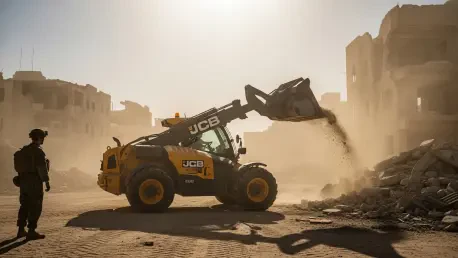
These vehicles are designed for a wide spectrum of mission scenarios, from combat engineering tasks like building fortifications and clearing obstacles to supporting logistical operations by moving cargo and supplies. Furthermore, the dual-use nature of this equipment is a critical benefit. The same wheeled loader used to clear a path for an assault force can be just as effective in a humanitarian aid mission, clearing rubble to rescue civilians or rebuilding infrastructure after a hurricane. This adaptability ensures the U.S. Marine Corps is better equipped to handle both its combat and its humanitarian responsibilities around the globe.
This series of contracts solidified a strategic partnership that enhanced the operational readiness of the U.S. Marine Corps. By embracing a “Military Off-The-Shelf” approach, both the manufacturer and the military branch created a model of efficient and effective procurement. The successful integration of this versatile, modernized equipment provided Marine engineers with the advanced tools needed to execute a wide range of missions, from high-intensity conflict to vital humanitarian assistance, ensuring their capability to respond to global challenges.