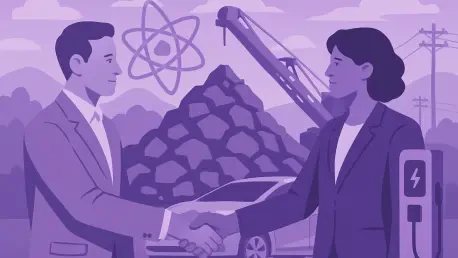

We are joined today by Kwame Zaire, a renowned manufacturing and production management expert with a keen focus on the rapidly evolving electronics supply chain. The conversation centers on a landmark agreement between Lilac Solutions and Traxys North America, a deal poised to significantly boost domestic lithium production in the United States. We will explore how innovative Direct Lithium Extraction technology is accelerating this shift, the deal’s structure that mitigates market risk, and what this all means for American electric vehicle manufacturing and the broader goal of supply chain independence.
Your 10-year, 50,000-tonne take-or-pay agreement is a major milestone. How does this structure specifically de-risk the project for Lilac amid market volatility, and what practical advantages does it offer Traxys for securing its long-term battery-grade material supply chain?
This is really the bedrock of the entire project’s viability. For Lilac, a take-or-pay agreement is like an insurance policy against the wild swings of the commodity market. They no longer have to worry about finding a buyer on the spot market day in and day out. Instead, they have a guaranteed revenue stream for 100% of their initial output for a decade. This provides the financial stability and certainty needed to confidently approach investors for that final push toward construction. For Traxys, the advantage is securing a predictable, long-term supply of battery-grade material from a domestic source. In a world where supply chains are constantly being disrupted, knowing you have 50,000 tonnes of lithium carbonate locked in allows you to plan with a level of confidence that is incredibly rare and valuable right now.
With Direct Lithium Extraction functioning in hours versus up to 24 months for evaporation ponds, what are the key operational differences? Could you walk us through how the Gen 5 ion exchange technology achieves such high efficiency, like the 87% recovery rate seen in pilot operations?
The difference is like night and day. You go from a massive, land-intensive, and slow process that relies on sun and time to a compact, controlled, and incredibly rapid technological one. Evaporation ponds can take two full years to yield lithium. With Direct Lithium Extraction, or DLE, we’re talking about a process that happens in mere hours. The Gen 5 ion exchange technology is the magic behind it. Think of it as a highly sophisticated filter specifically designed to attract and capture lithium ions. As the brine from the Great Salt Lake is pumped through the system, this ion exchange media selectively pulls the lithium out while letting the rest of the brine pass through. Achieving an 87% recovery rate in the pilot is a testament to its precision and efficiency, fundamentally changing the economics and speed of lithium production.
The Great Salt Lake facility’s Phase 1 could nearly double US lithium production, with Phase 2 potentially quadrupling it. What specific impact will this have on regional EV manufacturing loops, and how does it help US companies meet domestic sourcing requirements for tax credits?
This project is a linchpin for building a robust American EV ecosystem. When Phase 1 comes online with 5,000 tonnes per year, you’re not just adding a small amount of supply; you’re essentially on the verge of doubling the entire country’s current output from a single location. This makes it feasible for battery and EV manufacturers to create true regional manufacturing loops, sourcing critical materials from Utah instead of from halfway around the world. When the planned Phase 2 expansion brings total capacity to 20,000 tonnes, you could be looking at nearly four times the current domestic production. This scale is what allows U.S. companies to confidently meet the stringent domestic sourcing standards required for federal tax credits, making their vehicles more affordable for consumers and their supply chains far more secure.
The extraction process is described as non-consumptive, with lithium-depleted brine returned to the lake. What does this mean for the local ecosystem, and how does this design feature help streamline the process of securing final construction permits with state regulators in Utah?
The “non-consumptive” aspect is arguably one of the most elegant and critical features of this project. It means the process essentially borrows the brine, extracts the valuable lithium, and then returns the vast majority of the water back to the Great Salt Lake. This approach minimizes the project’s impact on the lake’s water levels and unique ecosystem, which is a major concern for the region. For state regulators in Utah, this is a huge step in the right direction. It demonstrates a forward-thinking, environmentally conscious design that makes the permitting process much smoother. It’s not about consuming a precious resource but about selectively harvesting an element from it, which is a much more sustainable model that regulators are keen to support.
Having completed FEL-3 engineering, what are the most critical remaining milestones before construction begins at the Great Salt Lake site? Please detail the key steps involved in moving from your current stage toward a Final Investment Decision, now that 100% of Phase 1 offtake is secured.
Completing FEL-3 engineering means the technical and design work is largely in place—the project is “shovel-ready” from an engineering perspective. The most significant remaining hurdles are on the regulatory and financial fronts. The immediate priority is working with Utah state regulators to finalize all the necessary construction permits, a process made easier by the project’s non-consumptive design. In parallel, securing 100% offtake with Traxys was the key that unlocks the final treasure chest. It allows Lilac to go to investors and say, “The engineering is done, and the entire initial product is already sold.” This dramatically reduces the project’s financial risk, making the path to a Final Investment Decision and securing the capital for construction much clearer and more direct.
What is your forecast for domestic lithium production and its role in the US manufacturing sector over the next decade?
I am incredibly optimistic. Over the next decade, I forecast that domestic lithium production, powered by technologies like DLE, will transition from a niche industry into a foundational pillar of the American manufacturing sector. Projects like this one at the Great Salt Lake are not just isolated wins; they are creating a replicable blueprint for responsible and efficient resource extraction. As more of these facilities come online, we will see a powerful ripple effect, attracting billions in investment for battery cell and EV manufacturing. The United States will shift from being a net importer to a significant producer, creating a resilient, domestic supply chain that enhances our economic security and accelerates our transition to a clean energy future.