
The sudden imposition of sweeping global tariffs last year served as a stark, final confirmation of a reality that had been building for years: the era of predictable, cost-optimized supply chains is definitively over. For decades, the guiding principle was efficiency above all, leading to complex, elongated networks vulnerable to the slightest tremor. Today, the landscape has been reshaped not by a single event, but by a continuous state of volatility. In this environment, the conversation has fundamentally changed from managing crises reactively to orchestrating resilience proactively. Success is no longer measured by the lowest cost-per-unit but by the ability to anticipate, adapt, and thrive amidst constant change, a capability now defined and driven by the comprehensive power of virtual twin technology.
Adapting to a New Era of Perpetual Disruption
The operational playbook of the past, characterized by reactive crisis management and siloed decision-making, has been rendered obsolete. Businesses are moving decisively beyond simply responding to disruptions after they occur. The new imperative is to build systems capable of predictive and proactive operations, where potential bottlenecks and risks are identified and mitigated before they can impact the flow of goods. This represents a fundamental shift in mindset, acknowledging that continuous disruption—from geopolitical tensions to climate events—is the new operational standard.
Consequently, the very metrics of success have evolved. While cost and speed remain important, they are now secondary to resilience. The ability of a supply chain to bend without breaking, to reconfigure itself in response to unforeseen variables, is the new benchmark of performance. This resilience is not an abstract concept; it is an orchestrated capability, enabled by digital technologies that provide the visibility and intelligence necessary to navigate a perpetually uncertain world. Virtual twins have become the cornerstone of this new paradigm, orchestrating the complex interplay of data and decisions that define a truly adaptable enterprise.
The Strategic Pivot from Cost Efficiency to Agile Control
The vulnerabilities inherent in hyper-efficient, long-distance supply chains were laid bare by a series of global events over the past few years. The pursuit of minimal cost led organizations to create brittle, opaque networks that shattered under pressure. This has catalyzed a widespread strategic realignment across industries. The focus has pivoted from a singular obsession with cost-efficiency toward a more balanced and robust model. This new model prioritizes end-to-end visibility, granular control over operations, and, most critically, the agility to pivot manufacturing and logistics plans “at the drop of a hat.”
This strategic pivot is most visibly demonstrated by the reshoring movement, which has transformed from an emerging trend into a mainstream and highly successful strategy. Companies are actively bringing manufacturing and sourcing closer to home to insulate themselves from geopolitical instability and logistical nightmares. This is not a retreat from global trade but a calculated move to build shorter, more transparent, and more controllable supply networks. The goal is to create an operational framework that ensures business continuity by reducing exposure to external shocks, making adaptability a core competitive advantage.
Anatomy of a Hyper-Resilient Digital Operation
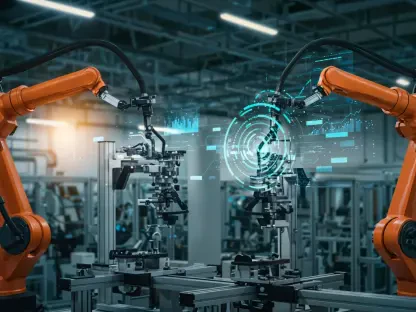
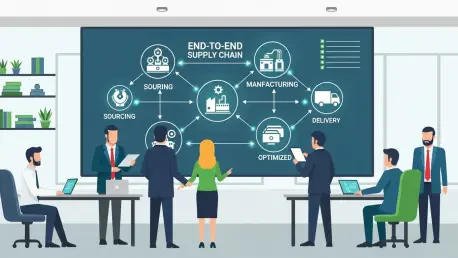
At the heart of this new operational model is the virtual twin, which functions as the central nervous system of the entire supply chain. It is far more than a simple digital model; it is a comprehensive, dynamic, and data-rich replica of the complete value chain, from raw material extraction and supplier networks to manufacturing processes and final customer delivery. This living digital replica acts as the undisputed single source of truth, synchronizing data from disparate systems to provide a holistic, real-time view of the entire ecosystem.
This technology provides the complete visibility needed to proactively manage exceptions, identify emerging constraints, and perform rapid root-cause analysis when issues arise. However, the virtual twin does not operate in a vacuum. Its power is amplified by the foundational role of artificial intelligence (AI) and machine learning (ML). AI algorithms are revolutionizing demand forecasting within Sales and Operations Planning (S&OP), leveraging vast datasets to drastically improve prediction accuracy and reduce operational downtime. Simultaneously, AI optimizes manufacturing by generating dynamic production schedules and maintaining precise inventory levels, effectively minimizing both costly stockouts and the financial drag of excess holding costs.
Data-Backed Performance of Modern Supply Chains
The tangible benefits of these strategic and technological shifts are validated by compelling performance data. The success of reshoring, for instance, is no longer anecdotal. A comprehensive Forbes study confirms its efficacy, revealing that an overwhelming 94 percent of U.S. manufacturers that have initiated reshoring initiatives report them as a success. This statistic underscores the strategic wisdom of prioritizing control and reduced risk over the often-illusory savings of distant sourcing.
Moreover, the competitive advantage conferred by enhanced visibility is equally clear. Research from 3DS identifies cross-operational collaboration—a direct outcome of the unified view provided by a virtual twin—as the single most important factor for top-performing businesses. This data-driven insight allows disparate teams to work in concert, breaking down silos and aligning their efforts toward common goals. Looking forward, the economic and environmental imperatives for adoption are monumental. Projections indicate that these integrated digital strategies are on track to unlock an estimated $1.3 trillion in additional value and achieve significant reductions in CO2 emissions globally by 2030, proving that resilience and responsibility are two sides of the same coin.
A Blueprint for Building the Future-Proof Supply Chain
The first step in constructing this resilient ecosystem is to model the end-to-end supply chain within a unified virtual twin. This involves creating a digital replica that is not static but continuously synchronized with live data from enterprise resource planning (ERP) systems, manufacturing execution systems (MES), and other shop floor sources. This creates an up-to-the-minute, holistic view of performance, risks, and opportunities across the entire network.
With a comprehensive model in place, the next critical step is to connect the virtual and physical worlds through a continuous feedback loop. The virtual twin serves as a sophisticated “sandbox” where planners can test various “what-if” scenarios—from simulating the impact of a supplier shutdown to modeling a sudden surge in demand. Once an optimal plan is chosen, it is translated into actionable directives for real-world operations. Performance data from the physical world is then fed back into the virtual twin in real time, allowing for constant refinement and optimization to close any gaps between planned and actual outcomes.
Finally, sustainability is embedded as a core pillar of the strategy, not an afterthought. The virtual universe provides the ideal environment to design, test, and validate new products and processes digitally, completely eliminating the material waste and energy consumption associated with physical prototyping. Furthermore, the virtual twin is used to track the carbon footprint across the entire value chain in real time. This capability enables more sustainable sourcing decisions, facilitates the recirculation of materials, and actively fosters the development of a circular economy, turning environmental stewardship into a measurable and strategic business advantage.
The journey toward this new operational standard has been one of necessity and innovation. The discussion has outlined how strategic realignments like reshoring, coupled with the deep integration of artificial intelligence, have laid the groundwork for a new era of supply chain management. Central to this transformation was the adoption of virtual twin technology, which provided the end-to-end visibility and dynamic planning capabilities required to navigate an environment of constant change. By embracing these principles, leading organizations built intelligent, agile, and sustainable business ecosystems that not only survived uncertainty but learned to thrive within it, securing their future while contributing to a more resilient and responsible global economy.