
A groundbreaking study led by researchers at the University of Southern California and partner institutions has introduced a novel 3D-printing technique that drastically shortens the timeline for discovering high-performance materials. This advanced methodology, termed combinatorial additive manufacturing, has already yielded a remarkable tungsten-based super-alloy capable of withstanding temperatures far beyond the limits of current industry standards. This breakthrough signals a transformative shift for sectors such as aerospace, energy, and space exploration, which have long been hampered by the thermal constraints of conventional materials, opening doors to innovations in hypersonic flight and fusion energy that were previously considered unattainable. The development not only provides a new material but also a revolutionary platform for creating future alloys tailored to the most extreme environments imaginable.
A Revolutionary Approach to Material Science
The central challenge that this research successfully addresses is the persistent issue of thermal failure in materials subjected to extreme heat. For many years, nickel-based alloys have been the material of choice for demanding applications like jet engine turbines, but they possess a critical weakness: their structural integrity begins to rapidly degrade at temperatures approaching 1000 °C. This thermal threshold has acted as a significant bottleneck, preventing advancements in technologies where components must operate reliably under much harsher conditions. The traditional, methodical process of developing new alloys through trial-and-error has been incredibly slow and resource-intensive, making the search for superior alternatives a long and arduous journey. This created an urgent demand not just for a new material, but for an entirely new, accelerated paradigm for material discovery that could keep pace with modern engineering ambitions.
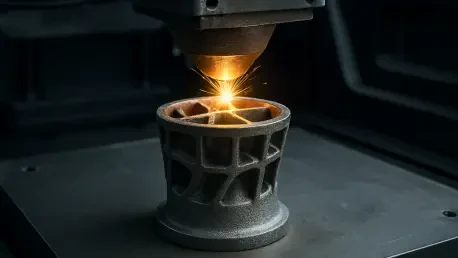
At the core of this innovation is a high-throughput system that completely redefines the materials science workflow, developed by a team spearheaded by USC Viterbi professor Wen Chen. The technique leverages a highly sophisticated, laser-based metal 3D-printing platform specifically engineered to control the feed rates of multiple elemental powders within a single, continuous operation. By systematically and dynamically varying the proportions of tungsten (W), rhenium (Re), and osmium (Os), the researchers were able to fabricate a single component that contained a vast gradient of chemical compositions. In just one afternoon, this method produced nearly 500 unique alloy variations. This achievement represents an extraordinary leap in efficiency, accomplishing a task that, using conventional fabrication and testing protocols, would have previously consumed months or even years of dedicated laboratory work, demonstrating the profound potential of this new approach.
Forging the Alloy of the Future
This rapid synthesis capability was intelligently paired with an equally innovative and efficient characterization technique, bypassing the need for slow, laborious mechanical tests on each individual sample. The research team employed automated indentation measurements, a process that utilizes microscopic probes to create thousands of tiny “pokes” across the surface of the printed gradient material. This allowed for the rapid and comprehensive mapping of crucial properties like hardness and structural strength. Critically, these tests were conducted at temperatures soaring as high as 1400 °C, enabling the team to screen hundreds of candidates in parallel and swiftly pinpoint the specific compositions that maintained their structural integrity under the most extreme thermal duress. This integration of high-speed fabrication with high-speed testing created a seamless and powerful discovery pipeline.
The investigation focused on a highly promising class of materials known as high-entropy alloys (HEAs). Unlike traditional alloys, which are typically based on a single primary element with minor additions of others, HEAs are formulated by combining several principal elements in roughly equal or comparable proportions. This unique compositional strategy opens up a vast and largely uncharted “design space” of potential material properties. The specific elements chosen for this study—tungsten, rhenium, and osmium—were meticulously selected for their exceptionally high melting points, all of which exceed 3000 °C. This inherent thermal resistance made them ideal foundational candidates for developing a new generation of alloys designed to perform reliably in the punishing environments found inside advanced gas turbines and future nuclear reactors.
Redefining the Limits of Engineering
The culmination of this systematic exploration was the identification of a standout performer: a super-alloy with the specific composition W₄₂Re₃₀Os₂₈. This newly discovered material exhibited exceptional resilience and strength at temperatures that far surpass the operational limits of conventional super-alloys. The performance metrics of W₄₂Re₃₀Os₂₈ serve as a powerful testament to the success of the discovery method. At room temperature, the alloy boasts a yield strength of approximately 1.8 gigapascals (GPa). More impressively, it sustains a yield strength of roughly 1.4 GPa even when heated to an intense 1400 °C. This means the material successfully retains about 78% of its room-temperature strength at this extreme temperature, a level of performance that firmly places it in a new and elite class of structural materials.
While the discovery of the W₄₂Re₃₀Os₂₈ alloy marked a significant achievement in its own right, the researchers emphasized that the most profound and lasting advance lay in the methodology itself. By successfully integrating high-throughput additive manufacturing, rapid material characterization, and data-driven screening, the team established a powerful and efficient pipeline for discovering bespoke materials tailored to specific and demanding performance targets. The potential applications for such advanced materials were extensive. In the aerospace industry, alloys that remain strong at higher temperatures could enable the design of more efficient jet engines and structural components requiring less cooling, thereby reducing system weight and improving overall performance. In the pursuit of nuclear fusion energy, where components must endure sustained and extreme thermal stresses, such materials were not just beneficial but absolutely essential for progress. This research ultimately demonstrated that through innovative techniques, the physical limits of engineering were poised for a dramatic expansion.