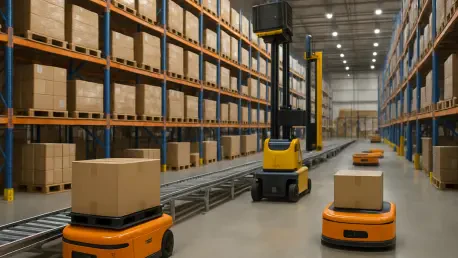

The global logistics landscape is undergoing a profound structural transformation as supply chains transition from traditional manual operations to fully integrated, intelligent ecosystems that prioritize speed and accuracy above all else. This shift is clearly reflected in the rapid expansion of the Automated Guided Vehicle market, which is currently on a trajectory to reach a staggering $11.17 billion by 2033. Beginning with a solid valuation of approximately $5.57 billion at the start of 2025, the sector is maintaining a steady compound annual growth rate of 9.08 percent throughout the middle of this decade. This momentum is largely fueled by the relentless demands of modern e-commerce and a global imperative to modernize warehouse facilities to meet consumer expectations. Today, these mobile units—ranging from autonomous forklifts to sophisticated tow vehicles—utilize advanced systems like LiDAR and vision-based guidance to navigate complex environments. These tools are no longer seen as optional upgrades but as foundational components of industrial infrastructure.
Innovations in Navigation: The AI Integration
The evolution of navigation technology has moved significantly past basic magnetic strips or floor-embedded wires to embrace Simultaneous Localization and Mapping, commonly known as SLAM. This advancement allows AGVs to build real-time maps of their surroundings, enabling them to navigate dynamic warehouse floors without the need for any extensive structural modifications to the building. Industry 4.0 principles now dictate that these vehicles must communicate fluently with wider warehouse management systems to ensure just-in-time delivery of components to the assembly line. By leveraging AI-driven optimization, facilities can now deploy flexible fleets that automatically scale their activity based on real-time order volume fluctuations. This technological sophistication ensures that material handling remains fluid, reducing the bottlenecks that once plagued traditional distribution centers. The integration of high-resolution sensors and IoT connectivity has essentially turned these robots into mobile data hubs that provide constant visibility into inventory movement.
Beyond the technical specifications, the current surge in AGV adoption addresses critical socioeconomic challenges, specifically the persistent labor shortages and rising operational costs in industrialized nations. These autonomous units excel at performing repetitive, high-volume tasks that often lead to physical strain or workplace injuries when handled manually by human workers. By reallocating human personnel to more complex, value-added roles, companies are creating a collaborative environment where robots handle the heavy lifting while employees focus on quality control and system oversight. This transition has significantly improved workplace safety records across the manufacturing sector by minimizing the presence of heavy machinery in pedestrian-heavy zones. Furthermore, the modular nature of modern AGV fleets allows for incremental implementation, meaning a facility can start with a few units and expand as demand grows. This scalability is vital for businesses looking to maintain agility in a market characterized by unpredictable consumer behavior and volatile global supply chains.
Strategic Implementation: Global Markets and Operational Evolution
Geographical trends indicate that the United States, Germany, China, and Saudi Arabia are leading the investment race, each launching strategic technological initiatives to secure their logistics dominance. In the United States and Germany, the focus remains heavily on precision and integrating AGVs into existing high-tech manufacturing pipelines with minimal disruption. Meanwhile, China and Saudi Arabia are building massive, ground-up smart cities and industrial hubs where autonomous logistics are baked into the architectural design from the very first day. Major industry players like ABB Ltd., BALYO, and FANUC Corporation are responding to this global demand by developing sustainable, electric-powered material handling solutions that align with modern environmental standards. These companies are pushing the boundaries of what is possible by creating vehicles that can operate outdoors in varying weather conditions or handle increasingly heavy payloads. This cross-border competition is accelerating the pace of innovation, leading to more cost-effective robotic solutions for a diverse range of applications.
The transition toward a fully automated logistics framework required leaders to prioritize interoperability between disparate robotic systems and legacy software platforms. Decision-makers found that the most successful implementations focused on thorough site assessments and the gradual integration of AI-driven navigation tools rather than immediate, total overhauls. It became clear that investing in robust cybersecurity measures was essential to protect the interconnected data streams generated by growing AGV fleets. Organizations also benefited from establishing clear protocols for human-robot interaction, ensuring that the workforce felt empowered by the new technology rather than displaced by it. As the market moved toward its eleven-billion-dollar milestone, the focus shifted toward long-term maintenance strategies and the use of predictive analytics to minimize downtime. Ultimately, those who embraced flexible, scalable automation solutions positioned themselves to navigate the complexities of a globalized economy with unprecedented efficiency and resilience, setting a new standard for excellence.