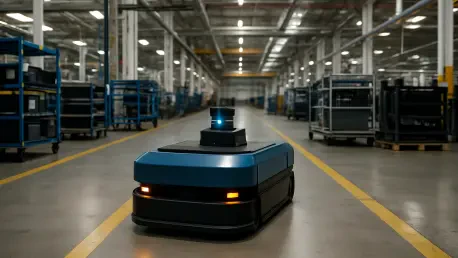

Siemens’ SIMOVE ANS+ navigation software represents a significant advancement in the industrial automation sector, offering a blueprint for the reconfigurable smart factories that are quickly becoming an industry necessity. This review will explore the evolution of this technology, its key features, performance metrics, and the impact it has had on various manufacturing applications. The purpose of this review is to provide a thorough understanding of the technology, its current capabilities, and its potential future development in creating flexible and efficient production environments.
An Introduction to Next-Generation Industrial Navigation
SIMOVE ANS+ is a sophisticated software platform designed to provide intelligent, infrastructure-free navigation for Automated Guided Vehicles (AGVs) and Autonomous Mobile Robots (AMRs). Its core principle is to leverage the existing facility environment for localization and pathfinding, marking a pivotal shift away from traditional, rigid methods like magnetic tape or guide wires. This approach directly addresses the modern factory’s need for greater agility and scalability in response to fluctuating consumer demands and rapid product cycles.
This technology has emerged as a critical component in the broader landscape of Industry 4.0, where digital transformation is paramount. By untethering mobile robots from fixed paths, manufacturers can reconfigure production lines and logistics flows with software commands rather than physical construction. This move from hardware-defined to software-defined logistics not only increases operational efficiency but also fundamentally changes how factory layouts are designed and managed over time.
Core Technologies and System Features
LiDAR-Based SLAM Navigation
The system functions as the “eyes and brain” for mobile robots using LiDAR-based Simultaneous Localization and Mapping (SLAM). This technology enables a vehicle to create a detailed digital map of its surroundings and subsequently navigate by recognizing permanent natural features like walls, pillars, and stationary machinery. This intrinsic ability to perceive and understand the environment is the cornerstone of its autonomy.
This core capability eliminates the need for costly and disruptive physical infrastructure installation on the factory floor. The removal of guide wires, magnetic strips, or painted lines not only reduces initial deployment costs and downtime but also lowers the total cost of ownership by simplifying maintenance and future modifications. The result is a cleaner, more adaptable, and safer production space.
Hybrid Navigation for High-Precision Tasks
For applications demanding greater accuracy than what natural feature navigation can provide, SIMOVE ANS+ supports a hybrid approach that integrates artificial reflectors into the environment. By referencing these precisely placed markers, the system can achieve a navigational precision of ±10mm, a level of accuracy critical for operations like docking at machinery or handling materials in congested production areas.
This dual-capability ensures the system is versatile enough for a wide range of industrial tasks. While SLAM provides the flexibility for general transit, the reflector-based enhancement delivers the pinpoint accuracy required for the final, critical steps of a process. This allows a single AGV or AMR fleet to handle both bulk transport and delicate, high-precision assignments without compromise.
Flexible and Dynamic Movement Modes
The software provides two distinct operational modes to maximize efficiency across different scenarios. The “Virtual Line Tracking” mode guides vehicles along exact, predefined digital paths, which is ideal for structured processes where consistency and predictability are key. This mode essentially digitizes the function of a traditional guide wire without its physical limitations.
In contrast, “Free Navigation” empowers vehicles to autonomously calculate the most efficient route between two points, including dynamically maneuvering around temporary obstacles. This mode is essential for navigating the unpredictable nature of a busy factory floor, allowing the robot to make intelligent decisions in real time to avoid delays and maintain workflow continuity.
Advanced Safety and Digital Zone Control
Safety is a cornerstone of the system, featuring dynamic obstacle avoidance that automatically slows, stops, or reroutes vehicles to prevent collisions with unforeseen objects or personnel. This proactive safety layer is crucial for enabling effective human-robot collaboration in shared workspaces.
Additionally, the “Zone Engineering” feature allows managers to digitally define and enforce specific traffic rules without physical barriers. Through the software interface, supervisors can designate speed limits in high-traffic areas, establish one-way corridors to manage flow, and create restricted keep-out zones around sensitive equipment. This digital control ensures a safe and orderly interaction between all moving elements on the shop floor.
Driving Innovation in Factory Agility
The latest developments embodied by SIMOVE ANS+ center on creating highly adaptable production environments. A significant innovation is the ability to wirelessly push map updates and new routes to an entire fleet of vehicles without halting production. When a new machine is installed or a workflow is changed, the master map can be updated and distributed seamlessly, allowing robots to adapt to the new layout instantly.
This shift from physical to digital reconfiguration allows manufacturers to modify assembly lines and logistics with unprecedented speed. This capability directly supports the industry’s move toward flexible, on-demand manufacturing, where the ability to quickly pivot production is a key competitive advantage. It transforms the factory floor from a static grid into a dynamic, responsive ecosystem.
Real-World Applications and Industry Impact
Automotive Manufacturing and Assembly
In a notable implementation, Tofaş, a major automotive manufacturer, deployed the system for the precise transport of heavy batteries into tight production cells. This use case successfully showcased the technology’s high-accuracy hybrid navigation capabilities, ensuring components were delivered safely and accurately in a constrained space.
In another landmark project, Porsche replaced inflexible conveyor systems with a fleet of AGVs at a multi-level urban production site. This strategic change not only reclaimed valuable floor space but also granted the company the ability to digitally redraw logistics paths as production needs evolved. This application stands as a powerful example of how autonomous navigation can redefine the limitations of factory design.
Mobile Quality Control and Human-Robot Collaboration
FFT Produktions successfully utilized SIMOVE ANS+ for mobile quality inspection workstations, bringing measurement tools directly to the component rather than the other way around. This use case highlights the system’s ability to enable safe and efficient operation in mixed environments where robots work in close proximity to human employees.
By creating mobile platforms for tasks traditionally performed at fixed stations, companies can enhance both productivity and workplace ergonomics. The system’s advanced safety features ensure that these collaborative applications do not compromise the well-being of the human workforce, proving that efficiency and safety can advance together.
Challenges and Integration Solutions
While the technology is advanced, its adoption faces challenges such as ensuring robust performance in highly dynamic or visually sparse environments where natural features for SLAM are limited. SIMOVE ANS+ mitigates these hurdles by operating on standard Siemens industrial PCs with a Linux OS, which ensures seamless integration for facilities already using Siemens’ programmable logic controllers (PLCs).
This approach significantly reduces the need for specialized IT expertise, lowering the barrier to implementation for many manufacturers. Furthermore, the software’s ability to reduce the total cost of ownership by eliminating the long-term expense and maintenance of physical navigation infrastructure helps overcome initial investment concerns, making a stronger business case for adoption.
The Future of Integrated Autonomous Systems
The outlook for this technology points toward deeper integration within the smart factory ecosystem. The trend is moving beyond isolated AGV fleets to a fully synchronized environment where autonomous robots, advanced machinery, and human workers operate as a collaborative and intelligent system. This future relies on powerful central control software to orchestrate all factory operations in perfect sync.
As envisioned by Siemens’ leadership, the future of manufacturing will involve advanced autonomous systems, including humanoid robots, working alongside people to perform complex tasks. The intelligence provided by navigation platforms like SIMOVE ANS+ is a foundational element for this vision, providing the spatial awareness and control needed for such sophisticated, integrated operations.
A New Standard in Industrial Autonomy
SIMOVE ANS+ established a new benchmark for autonomous industrial navigation by replacing rigid, infrastructure-dependent systems with an intelligent and adaptable software solution. Its core strengths—SLAM-based navigation, high-precision capabilities, and advanced digital safety features—provided a clear competitive advantage by increasing operational agility and reducing the total cost of ownership for its adopters. The successful deployments at leading companies like Porsche and Tofaş validated its performance and demonstrated its profound impact on creating the flexible, efficient, and reconfigurable factories that define modern manufacturing.