
Recent advancements in orbital hardware deployment have signaled a transformative shift in how aerospace components are conceived and manufactured for the unforgiving vacuum of space. While traditional manufacturing relied on assembling dozens of intricate parts with multiple potential failure points, NASA’s Jet Propulsion Laboratory has recently demonstrated that a single, 3D-printed titanium structure can perform the work of an entire mechanical assembly. This breakthrough was achieved through the successful deployment of the JPL Additive Compliant Canister, a device that effectively bridges the gap between laboratory experimentation and mission-critical hardware. By utilizing additive manufacturing to create a compliant mechanism, engineers managed to reduce mass and complexity without sacrificing structural integrity. This success suggests that the era of labor-intensive assembly might be giving way to a more streamlined, monolithic approach to spacecraft design, where the flexibility of titanium allows for innovative solutions that were previously impossible to forge through conventional means.
The Engineering Breakthrough: From Assemblies to Monolithic Structures
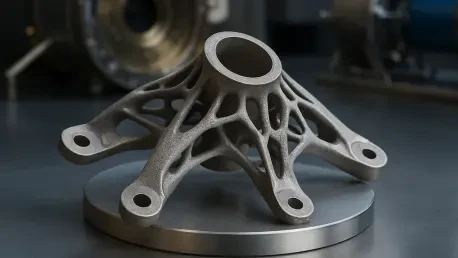
The core innovation of the canister lies in its radical consolidation of mechanical parts, turning what used to be a complex array of hardware into a unified component. Traditionally, a deployment mechanism would require five distinct elements including a hinge, a panel, a compression spring, and two torsion springs, all of which must be meticulously fitted together. By leveraging advanced 3D printing techniques, engineers integrated all these functions into a single titanium spring that measures roughly the size of a paperback book and weighs less than one pound. This design choice resulted in a mechanism with three times fewer parts than those constructed using traditional fabrication methods, which significantly lowered the risks associated with mechanical friction and assembly errors. Because the device functions as a single piece, the structural reliability increases while the manufacturing lead time decreases. This shift toward monolithic design represents a departure from decades of aerospace tradition, favoring geometric complexity over part quantity to ensure mission success.
Titanium was selected as the primary material for this endeavor because of its exceptional strength-to-weight ratio and its ability to withstand extreme thermal fluctuations without losing its elastic properties. In the context of the Additive Compliant Canister, the titanium structure acts as a compliant mechanism, meaning it achieves motion through the flexibility of its own geometry rather than through sliding joints or hinges. This lack of moving parts is particularly advantageous in space, where lubricants can evaporate or freeze, and mechanical wear can lead to catastrophic mission failure. By printing the device as a single unit, the internal stresses are distributed more evenly across the material, allowing the spring to be compressed to just one inch and then reliably expanded to six inches upon command. Furthermore, the use of additive manufacturing allows for internal geometries that are impossible to reach with traditional machining tools. This capability ensures that future spacecraft can be lighter and more resilient, directly contributing to the feasibility of long-duration missions.
Validating Performance: The Path to Rapid Flight Infusion
The operational validation of this technology took place during the Transporter-15 mission, which launched from Vandenberg Space Force Base in late 2025. The canister traveled aboard Mercury One, a commercial satellite developed by Proteus Space that gained industry attention for being the first satellite designed using artificial intelligence. This synergy between AI-driven architecture and 3D-printed hardware highlights a new frontier in aerospace engineering where software and manufacturing capabilities evolve in lockstep. The payload, which was part of the PANDORASBox initiative, underwent rigorous flight certification in less than a year, proving that the timeline from concept to orbital deployment can be dramatically shortened. The satellite’s AI-optimized frame provided the ideal platform to test the durability of the titanium spring, as the mission aimed to demonstrate how high-performance materials could be integrated into small-scale commercial platforms. This integration proves that even compact satellites can carry sophisticated hardware that meets the highest standards.
The success of the deployment over the Pacific Ocean confirmed that 3D-printed titanium structures were fully capable of surviving the intense vibrations of launch and the thermal cycling of low Earth orbit. This milestone provided a scalable solution for future satellite constellations and complex lunar infrastructure, such as the components required for the Artemis program. The industry responded by prioritizing rapid flight infusion, a strategy that moved advanced manufacturing from the fringe of research into the core of production cycles. Engineers determined that the ability to print flight-ready hardware on demand could reduce costs by nearly half compared to traditional machining. This approach allowed for a more iterative design process where improvements were implemented in months rather than years. Looking ahead, the focus shifted toward expanding these techniques to larger structural frames and pressurized vessels. The successful verification of this technology established a new standard for reliability, ensuring that future exploration missions would benefit from more efficient systems.