
A single one-hour annealing treatment at 1100 degrees Celsius has been shown to transform the brittle microstructures of 3D-printed steel into highly ductile and fracture-resistant configurations. This discovery, emerging from recent investigations at Northwestern Polytechnical University, challenges the long-standing assumption that the rapid thermal cycles of 3D printing are purely detrimental to metal integrity. Researchers focusing on 316L stainless steel produced via micro laser powder bed fusion (micro-LPBF) have successfully demonstrated that the intrinsic stresses and dislocations within printed parts can be strategically utilized. Instead of viewing these structural irregularities as flaws that must be minimized, the team used them as a stored energy source to drive grain boundary engineering (GBE). By integrating the printing stage as a functional precursor, scientists have unlocked a method to achieve superior mechanical properties without the traditional need for labor-intensive mechanical deformation, such as cold rolling.
Redefining Metallurgical Boundaries
Understanding Grain Boundaries: The Pursuit of Precision
Polycrystalline metals like 316L stainless steel consist of numerous individual crystals, or grains, meeting at interfaces known as grain boundaries. In conventional metallurgy, these boundaries often represent the material’s most vulnerable points, acting as conduits for crack propagation and corrosive infiltration. Random high-angle boundaries are particularly problematic because they lack the atomic alignment necessary to resist external pressures or chemical attacks. In 1984, the concept of grain boundary engineering was introduced with the hypothesis that if engineers could control the distribution of these interfaces, they could vastly improve a metal’s durability. The goal became to increase the proportion of “special” boundaries, particularly annealing twins. These twins possess a high degree of atomic coincidence between adjacent crystals, making them remarkably resistant to mechanical failure. However, creating these special boundaries has historically been a significant engineering hurdle.
Traditionally, the pursuit of specialized grain boundaries required an arduous cycle of plastic deformation followed by annealing. This process usually involved rolling or forging the metal to introduce strain before heating it to encourage structural reorganization. While effective for large, simple plates or bars, these mechanical steps are physically impossible for the intricate, miniature components often produced through additive manufacturing. Small medical implants or complex aerospace nozzles cannot be squeezed through a roller without destroying their functional geometry. This limitation created a persistent gap between the theoretical benefits of grain boundary engineering and the practical reality of high-precision 3D printing. The inability to mechanically work these parts meant they were often stuck with inferior microstructures. By finding a way to bypass external deformation, researchers have effectively bridged this technological divide, opening up GBE to a new class of complex industrial hardware.
Role of Micro-LPBF: The Deformation-Free Precursor
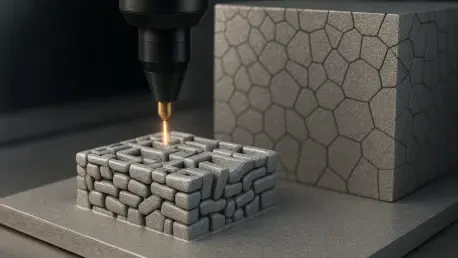
The micro laser powder bed fusion process serves as a unique metallurgical starting point due to its intense thermal dynamics. During the printing phase, a high-precision laser melts metal powder in a layer-by-layer sequence, creating extreme temperature gradients between the molten pool and the solidified base. This rapid heating and cooling cycle generates a dense network of dislocations throughout the material. In materials science, dislocations are line defects within the crystal lattice that are typically introduced by physical force, such as hammering or bending a cold metal. However, in the micro-LPBF environment, these defects are an inherent byproduct of the thermal stress experienced during the printing process itself. The result is a material that is internally “pre-strained” at the atomic level, despite having never touched a forge. This dense dislocation density acts as a massive reservoir of stored energy, which is critical for the next stage of structural transformation.
This concept of a “deformation-free precursor” represents a fundamental shift in how additive manufacturing is categorized within the industrial workflow. Rather than seeing the 3D-printed object as a finished product with unavoidable internal stress, researchers now treat it as a highly energized intermediate state. The dislocations packed within the 316L stainless steel lattice provide the necessary driving force for recrystallization, a process where the metal’s internal architecture essentially hits a “reset” button. Without this high initial energy, the subsequent heat treatment would fail to produce the desired grain boundary configuration. By leveraging the specific thermal history of the printing process, engineers can essentially “program” the metal to be ready for its final structural refinement. This innovative perspective turns a traditional manufacturing “bug”—internal thermal stress—into a powerful feature that enables the creation of high-performance components that were previously considered unreachable through 3D printing alone.
The Science of Structural Transformation
Triggering Recrystallization: The Effect of Targeted Annealing
To initiate the reorganization of the metal’s internal architecture, the research team subjected the as-printed steel to a specific annealing process at 1100 degrees Celsius for exactly one hour. This thermal intervention acted as a catalyst, triggering a phenomenon known as recrystallization. As the material reached the target temperature, the energy stored in the form of dislocations began to dissipate, fueling the nucleation and growth of entirely new, strain-free grains. This was not merely a matter of the metal softening; it was a total reconstruction of the material’s interior on a microscopic scale. The existing grain boundaries began to migrate through the crystal lattice, consuming the high-energy, dislocation-rich zones. As these boundaries moved, they naturally sought more stable, lower-energy configurations. The primary outcome of this migration was the formation of stable twin boundaries, which are characterized by their exceptional resistance to the standard modes of material degradation.
The statistical impact of this single-hour treatment was profound, marking a clear departure from standard “as-built” properties. Prior to the annealing step, the 316L stainless steel exhibited a standard, relatively random distribution of grain boundaries. Following the heat treatment, however, the fraction of special twin boundaries surged to a remarkable 55.6 percent. This massive increase was the result of what scientists call strain-induced grain boundary migration. Essentially, as the boundaries shifted to accommodate the heat, they left a “trail” of these durable twin-related domains in their wake. This specific microstructural signature is what gives the metal its newfound toughness. The transition from a random boundary network to one dominated by twins significantly reduces the paths available for fractures to travel. This streamlined approach proves that high-temperature annealing can perform the same heavy lifting as industrial forging, provided the starting material has the correct internal energy profile.
Identifying the Drivers: GNDs and Microstructural Change
A critical aspect of the Xi’an research involved distinguishing between the types of atomic defects responsible for this transformation. The team focused on two main categories: statistically stored dislocations (SSDs) and geometrically necessary dislocations (GNDs). While SSDs are essentially tangled networks of defects within individual grains, GNDs are specifically required to accommodate local strains and orientations between the fine cellular structures typical of 3D-printed alloys. Through detailed electron backscatter diffraction analysis, the researchers determined that GNDs were the primary drivers of the recrystallization process. These specific dislocations provided the necessary orientation gradients to kickstart the growth of new grains during the annealing stage. Understanding this distinction is vital because it moves the process from trial-and-error to a predictable science. It allows metallurgists to target specific defect types to achieve desired structural outcomes.
By identifying GNDs as the key contributors to grain boundary migration, the research provides a roadmap for future precision engineering. This knowledge implies that by fine-tuning the initial 3D-printing parameters—such as laser power, scanning speed, and hatch spacing—engineers can deliberately alter the density and distribution of GNDs. This essentially creates a “dislocation map” within the part that dictates exactly how the microstructure will evolve when it eventually enters the furnace. This level of control represents a significant advancement over traditional methods, where internal structures are often a secondary consideration to the overall shape of the part. The ability to predict and manipulate the final grain boundary configuration via the initial printing settings marks a transition into a more sophisticated era of metal fabrication. This proactive design philosophy ensures that the structural integrity is baked into the component from the very first layer of powder.
Measuring Performance and Potential
Balancing Strength: Enhancing Ductility and Reliability
The mechanical evaluation of the treated 316L stainless steel revealed a strategic trade-off that significantly improved the material’s overall reliability. In its initial, as-printed state, the steel was exceptionally strong but lacked the flexibility required for many critical applications. It recorded a yield strength of 620 megapascals, yet its elongation to failure—a key metric of ductility—was limited to approximately 30 percent. This high strength was largely the result of the “dislocation forest” within the metal, which acted as a barrier to deformation but also made the material prone to snapping under sudden stress. After the annealing process, the yield strength decreased to 322 megapascals as the internal stresses were relieved. While this reduction in pure strength might appear to be a setback, it was accompanied by a dramatic increase in ductility. The elongation to failure jumped to 48 percent, a 60 percent improvement that transformed the metal’s performance profile.
This enhanced ductility is a direct consequence of the high fraction of special twin boundaries created during the recrystallization process. In face-centered cubic metals like 316L, these boundaries serve as unique obstacles that balance the needs of strength and flexibility. They are robust enough to impede the movement of dislocations—which preserves a high ultimate tensile strength of 688 megapascals—while simultaneously allowing dislocations to glide through under extreme stress conditions. This dual functionality prevents “strain localization,” the phenomenon where deformation concentrates in one small area until the metal fails. Instead, the material deforms gracefully and uniformly across its entire structure, making it much safer for use in high-pressure or high-impact environments. This shift from a brittle, high-strength state to a tough, ductile configuration ensures that components are not just strong on paper but are also resilient in real-world service.
Implementation: Advancing the Reach of Digital Metallurgy
The success of the “Xi’an method” provided a clear path forward for industries requiring complex, high-performance metallic parts. This new workflow, termed additive grain boundary engineering, allowed for the production of miniature components that were previously excluded from the benefits of GBE due to their size or intricate geometries. In sectors like aerospace and medical device manufacturing, parts often feature internal channels or thin walls that cannot withstand the physical pressure of a rolling mill. By utilizing the 3D-printing process to generate internal energy and a simple furnace cycle to refine the microstructure, manufacturers bypassed the need for heavy deformation machinery. This shortcut reduced the time and energy required to produce specialized alloys while ensuring that the final products met the most rigorous standards for fracture resistance and longevity. The process demonstrated that even the smallest parts could benefit from advanced metallurgical design.
This research laid the groundwork for a future where metallurgical properties were programmed directly into the design phase of a component. By viewing the high dislocation density of micro-LPBF metals as a resource rather than a defect, scientists established a bridge between the rapid prototyping capabilities of 3D printing and the centuries-old principles of grain boundary engineering. The move toward digital metallurgy meant that the internal performance of a part became just as customizable as its outward appearance. This breakthrough encouraged a shift in industry standards, prioritizing the exploitation of internal thermal stress to create optimized microstructures. Engineers adopted new protocols to verify that the dislocation density in printed parts was sufficient to drive the desired structural evolution during post-processing. Ultimately, this approach ensured that the next generation of engineering materials was characterized by both extreme precision and unparalleled structural integrity.