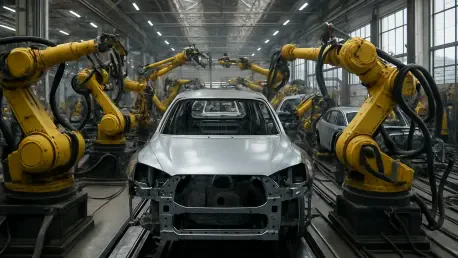

A profound industrial transformation is quietly unfolding as China pioneers the development of fully automated automotive “ghost plants,” facilities designed to operate entirely without direct human intervention. This ambitious leap beyond existing automation represents more than just an evolution in car manufacturing; it is the vanguard of a nationwide movement toward total autonomy that is poised to redefine public services, logistics, heavy industry, and the very nature of global economic competition. As these lights-out factories prepare to come online, they signal an impending shift in industrial paradigms, presenting a complex mix of unprecedented efficiency and significant societal challenges that will reverberate across the international stage. This initiative marks a decisive step toward a future where entire production ecosystems are managed by intelligent machines, forcing a global reevaluation of labor, productivity, and industrial strategy in the 21st century.
The Dawn of the Ghost Plant
The transition from partial to total automation lies at the heart of this industrial metamorphosis, moving far beyond the established role of robotics in manufacturing. For decades, robots have handled repetitive and hazardous jobs like welding and painting, but critical stages, especially final assembly, have remained the domain of skilled human workers due to their complexity and need for dexterity. China’s new generation of factories, slated to become fully operational before 2030, are engineered to eliminate this final human touchpoint. Every phase of production, from the initial stamping of metal sheets to the intricate installation of wiring harnesses and sensitive electronics, will be executed by a synchronized network of intelligent machines, advanced sensors, and sophisticated algorithms. The absence of a human workforce allows for a radical reinvention of the factory environment itself. These facilities will operate continuously in near-total darkness, devoid of the bright lighting, climate control, and ergonomic considerations essential for human comfort. This not only promises monumental savings in energy and operational costs but also heralds a new industrial epoch where manufacturing plants resemble self-contained, hyper-efficient alien landscapes more than traditional workshops.
A Nation Embracing Autonomy
The push for complete autonomy is not an isolated phenomenon but is part of a systemic, nationwide adoption of robotics and artificial intelligence that is reshaping the fabric of Chinese society. This strategic embrace reflects a willingness to fundamentally rethink the dynamics of labor, public management, and urban infrastructure. Across many of China’s major cities, robots have already become an integrated part of daily life, undertaking tasks such as monitoring busy traffic intersections, conducting public security patrols, and collecting real-time environmental data to optimize municipal functions. This technological integration is even more pronounced in the logistics and transportation sectors, where fleets of driverless cargo vehicles and swarms of autonomous delivery robots are becoming increasingly commonplace. By coupling these automated systems with powerful AI-driven analytics, logistics networks can now dynamically optimize freight routes and reconfigure supply chains on a scale previously unimaginable, leading to significant reductions in operational costs, enhanced delivery speeds, and a smaller carbon footprint. This holistic approach signals a future where automation streamlines not just production lines but entire societal systems.
Reshaping Heavy Industry and Infrastructure
The principles of total automation are also being applied with transformative effect in heavy industry and on large-scale infrastructure projects, domains traditionally characterized by intensive manual labor and complex logistical challenges. On modern construction sites, modular robotics are now utilized to precisely assemble prefabricated sections of bridges and high-rise buildings, accelerating construction timelines while improving structural integrity. Simultaneously, machine-learning software provides constant, real-time monitoring of heavy equipment health and on-site safety protocols, enabling predictive maintenance that prevents costly breakdowns and proactive risk management that averts accidents without direct human supervision. In these intricate environments, AI-led planning systems are steadily replacing the traditional role of human project managers in coordinating hundreds of workers. These intelligent systems dynamically reallocate resources, from machinery to materials, to maximize productivity and ensure compliance with safety standards, thereby streamlining complex scheduling and organizational workflows into a seamless, automated process.
The Human Cost of Progress
While this emerging industrial model promises undeniable gains in production speed, product consistency, and corporate profitability, it also casts a long shadow over the future of the global workforce. The widespread elimination of manufacturing jobs, which have historically served as the economic backbone for countless communities worldwide, raises fundamental questions about employment, regional stability, and social equity. Although these highly advanced facilities will still require specialized teams of engineers, data scientists, and maintenance technicians for programming and digital oversight, the steep and inevitable decline in routine operational positions is set to trigger a profound economic and social shift. This necessitates an urgent and massive investment in comprehensive retraining and education programs designed to prepare the workforce for a new reality. The transition will require workers to move away from hands-on operational roles toward those centered on remote system monitoring, software management, and the intricate maintenance of complex, interconnected automated systems, a transformation that presents a formidable challenge for governments and industries alike.
A New Front in Global Competition
China’s rapid advancement toward total automation was a development that intensified the competitive pressures on established Western manufacturers, particularly within the auto industry. While these legacy brands had long adopted partial automation, many of their critical production procedures still relied on the irreplaceable skill of human labor, an area where the new generation of Chinese robotics made significant and disruptive breakthroughs. The successful deployment of China’s ghost factories established new international benchmarks for productivity, cost-effectiveness, and industrial resilience, fundamentally altering the competitive landscape. This reality served as a clear call to action for other industrial nations, which were compelled to overhaul not only their technological strategies but also their fundamental social and economic policies related to workforce transitions. In the end, remaining a leader in the evolving global industrial arena required a holistic approach that balanced technological innovation with a robust plan for societal adaptation.