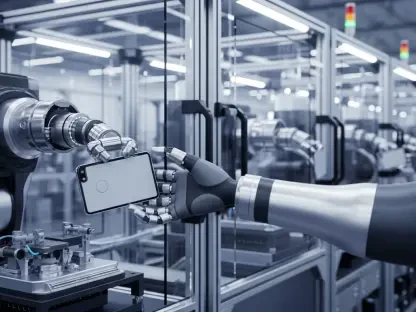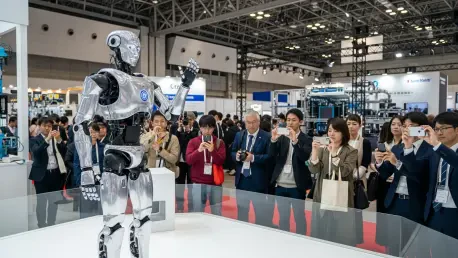

A startling new reality was on full display at the recent International Robot Exhibition in Tokyo, where the most advanced and captivating humanoid machines were not the product of Japanese innovation but were instead developed by Chinese firms. This tectonic shift in the global robotics landscape was powerfully symbolized by a Japanese company, GMO Internet Group, showcasing Chinese-made robots like Unitree Robotics’ “G1” to an astonished home crowd. The event served as a microcosm of a much larger trend: Japan, the nation long celebrated as the undisputed “Land of Robots,” is now grappling with being surpassed by the vigorous commercialization and AI-driven advancements of China and the United States, forcing a fundamental reassessment of its technological future.
The Changing of the Guard
A Tale of Two Exhibitions
The legacy of Japanese robotics, once personified by iconic achievements such as Honda’s groundbreaking ASIMO, now appears to be a fading memory in the rapidly evolving humanoid sector. During its own premier international exhibition, Japan’s leading robotics firms, including giants like Fanuc and Yaskawa Electric, remained firmly rooted in their traditional domain of industrial robotic arms. While these systems are critical for factory automation, their presence highlighted a conspicuous and concerning absence of Japanese contenders in the advanced humanoid space. This technological void stands in stark contrast to the nation’s pioneering past, signaling a critical failure to pivot from established, albeit successful, industrial automation to the new, more complex frontier of AI-integrated humanoid robotics. The exhibition floor inadvertently told a story not of leadership, but of a nation struggling to keep pace with a revolution it once seemed destined to lead.
This apparent stagnation points to deeper systemic challenges within Japan’s once-dominant tech industry. The transition from precisely programmed industrial machines to autonomous, AI-driven humanoids requires a different kind of innovation—one that embraces rapid software development cycles, massive data integration, and a higher tolerance for the trial-and-error process inherent in creating general-purpose intelligence. Established Japanese corporations, renowned for their meticulous hardware engineering and long-term product planning, may have found their structured approach less suited for the agile and software-centric nature of the modern robotics race. The paradigm has shifted from perfecting a single, complex machine to building a scalable platform where the AI “brain” is just as, if not more, important than the robotic “body.” This disconnect has created an opening that more nimble, software-focused competitors from China and the U.S. have aggressively exploited, leaving Japan to defend its legacy markets while the future of robotics unfolds elsewhere.
The New Contenders
While Japan’s presence in the humanoid sector has diminished, Chinese companies have surged forward to establish a commanding position in the market. Firms such as Unitree Robotics, Zhongqing Robotics, and Ubtech have moved beyond the research and development phase and are now leading the charge in commercialization. Their advanced humanoid robots, including the “G1” and “Walker E” models, are not mere prototypes confined to a lab; they are fully realized products available for mass production, complete with established sales and support systems. This critical advantage in manufacturing scale and market readiness has made them the primary, and in many cases the only, viable source for businesses seeking to acquire and deploy humanoid robot fleets today. Their ability to deliver functional, commercially available robots at scale represents a decisive strategic lead, transforming the theoretical potential of humanoid robotics into a tangible, accessible technology.
The shifting power dynamic was powerfully underscored by the strategic decision of Japan’s own GMO Internet Group to source its entire rental fleet of humanoid robots from these Chinese manufacturers. Acting as a distributor and service provider for foreign technology on its home soil, GMO’s move is a pragmatic acknowledgment of the current market reality. This business model signals a dramatic role reversal, where a Japanese tech company finds it more viable to import and integrate leading Chinese technology than to wait for a domestic equivalent. It is a testament to how quickly and effectively Chinese firms have captured the commercial high ground. This dependency highlights a significant strategic vulnerability for Japan but also demonstrates the compelling value proposition offered by the new contenders, whose commercially mature products are now setting the pace for the entire industry.
The Forces Driving the New Robot Era
AI as the Game-Changer
The fundamental catalyst behind this industrial upheaval is the profound fusion of advanced artificial intelligence with robotics, transforming machines from single-task tools into adaptable, intelligent agents. In this new paradigm, robots are increasingly viewed as the physical “bodies” for sophisticated AI, capable of perceiving, reasoning, and acting in complex, unstructured environments. The humanoid form, in particular, has emerged as uniquely valuable. Because it is designed to operate in a world built for people, it can seamlessly integrate into existing infrastructure—from factory floors and warehouses to retail stores and homes—without requiring expensive, purpose-built modifications. This inherent compatibility allows humanoid robots to perform a vast range of tasks, making them an ideal solution for augmenting human labor and addressing workforce shortages across numerous sectors of the economy.
This convergence of AI and a human-like form factor is unlocking a market of almost unimaginable scale. A forecast by Morgan Stanley projects that the global market for humanoid robots could surge to an astonishing $5 trillion by 2050, with over one billion units deployed worldwide. The potential applications are incredibly broad, spanning far beyond simple manufacturing and logistics. These robots are poised to become integral to disaster relief operations, where they can enter hazardous environments unsafe for humans. They also hold immense promise in the service industry, particularly in providing elder care and assistance, a critical need for nations with aging populations. This enormous economic potential is the prize fueling the intense global competition, as nations and corporations race to secure a leadership position in what is widely seen as the next major technological platform.
A New Global Order and Japan’s Crossroads
The race for humanoid robotics supremacy had effectively become a two-horse race between the United States and China, each leveraging distinct strategic strengths to pull ahead of the pack. China executed a formidable, state-supported national strategy that aggressively nurtured a domestic ecosystem for both robot development and the localization of critical components, attracting immense capital and talent. In parallel, the United States excelled in the domain of practical, real-world application. American firms like Agility Robotics demonstrated a mature progression from research to commercial integration by deploying dozens of robots in the warehouses of a major logistics company and collaborating directly with Amazon for continuous optimization. These efforts solidified a new bipolar global leadership structure, leaving other nations to adapt.
This new reality placed Japan in a precarious position, as its once-unquestioned leadership had waned to the point where its companies were rarely mentioned in expert discussions about the industry’s future. It became clear that a head-on competition to reclaim broad dominance against the sheer scale of China and the commercial integration of the U.S. was ill-advised. Consequently, Japan’s path forward required a strategic pivot. The nation’s most viable strategy was not to build another general-purpose humanoid but to leverage its inherent strengths in precision engineering and high-quality components, carving out a new, vital role as a key supplier within the global supply chain. By focusing on niche applications tailored to its specific domestic needs, such as advanced elder care, and doubling down on its technological expertise in core hardware, Japan identified a way to remain relevant in a new technological era it no longer defined.