
At the recent 3DExperience World conference, a landmark strategic partnership was announced between technological titans Dassault Systèmes and Nvidia, a move set to create a shared industrial AI platform that will redefine how complex systems are designed, simulated, and operated. This collaboration is poised to establish a new foundation for industrial artificial intelligence by integrating Dassault Systèmes’ profound leadership in virtual twin technology with Nvidia’s undisputed dominance in AI infrastructure and accelerated computing. The announcement, jointly delivered by Dassault CEO Pascal Daloz and Nvidia founder and CEO Jensen Huang, outlines an ambitious, long-term vision for how industrial AI will be developed, validated, and deployed at a massive scale across a multitude of sectors. The fusion of these two powerhouses promises not just an evolution of current practices but a fundamental revolution, aiming to ground artificial intelligence in the immutable laws of physics and science to unlock unprecedented levels of human ingenuity and industrial efficiency, marking a pivotal moment in the digital transformation of the global economy.
Forging the Future of Industrial AI
The Core Vision Virtual Twins Meet AI
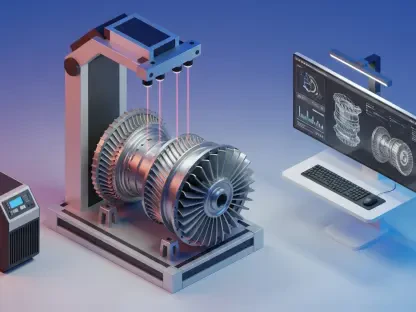
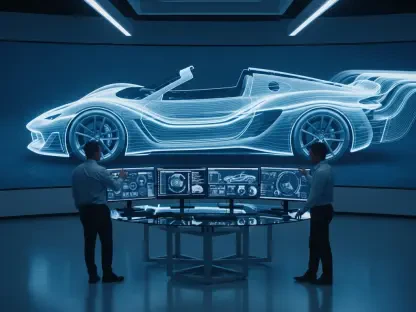
The central thesis of this transformative partnership is the intricate fusion of two immensely powerful technological concepts: Dassault Systèmes’ comprehensive virtual twin technologies and Nvidia’s robust, sprawling AI ecosystem. This integration will strategically leverage Nvidia’s advanced AI infrastructure, its growing library of open models, and its accelerated software libraries to power and significantly enhance the entire portfolio of the 3DExperience platform. The ultimate objective is the creation of what the companies term “science-validated industry World Models”—extraordinarily sophisticated digital representations that are fundamentally grounded in the laws of physics and core scientific principles. These high-fidelity models, running on the 3DExperience platform, are designed to enable new, more intelligent ways of working. A key innovation will be the deployment of skilled “virtual companions,” which are advanced AI agents capable of providing deep industrial context and immediately actionable intelligence to users, thereby streamlining complex workflows and elevating decision-making processes to a new level of precision and insight.
This collaboration is set to redefine the very nature of artificial intelligence in an industrial context, moving it from a tool of prediction and generation to one of deep, contextual understanding. As articulated by Dassault CEO Pascal Daloz, the industry is entering an era where AI doesn’t just process data but comprehends the real world in a meaningful way. He emphasized that when artificial intelligence is firmly grounded in science, physics, and validated industrial knowledge, it transcends its role as a simple tool and becomes a powerful “force multiplier for human ingenuity.” The overarching goal is not merely to automate legacy processes but to actively invent the future. Daloz positioned the collaboration as the definitive union of the “virtual twin factory with the AI factory,” a paradigm shift that will empower industries to design, simulate, and operate incredibly complex systems with a level of confidence never before possible, particularly in pioneering fields such as biology, advanced materials science, and next-generation manufacturing.
The Next Great Platform Reinvention
From Nvidia’s perspective, this alliance represents the dawn of the next great platform reinvention, a fundamental shift from a computer-aided design (CAD) paradigm to a fully AI-powered one. Nvidia founder and CEO Jensen Huang identified “physical AI”—artificial intelligence that can deeply comprehend and interact with the physical world—as the next major frontier for the technology. He framed the partnership as a powerful convergence of decades of industrial leadership, uniting Dassault’s unparalleled expertise in virtual representation with Nvidia’s cutting-edge AI and Omniverse platforms. This venture is not a new acquaintance but the culmination of a relationship that spans approximately 30 years, originating during the last major computing platform transition from Unix to Windows-based workstations. Huang views this new chapter as an equally significant inflection point, marking a generational leap in how industries will approach innovation, development, and operation, driven by the pervasive intelligence of AI.
Elaborating on this vision, Huang detailed the fundamental change in computing that this partnership represents. He drew a sharp contrast between the previous generation of design, which relied heavily on structured, specified representations of geometry and materials, and the emerging “generative computing model.” In this new world, he explained, the entire computing stack is being fundamentally reinvented from the ground up. He posited that AI is rapidly evolving from a specialized, niche tool into a foundational infrastructure, becoming as essential to modern society as electricity, water, and the internet. This impending “new industrialization,” he argued, will be a global phenomenon, powered by AI in every country and across every conceivable industry. This shift signifies a move away from deterministic instruction-based computing toward a model where AI generates solutions, designs, and insights, profoundly altering the landscape of industrial technology and global commerce.
A Synergistic and Strategic Implementation
Enhancing the Dassault Portfolio
The technical implementation of this partnership involves a series of deep and specific integrations across Dassault’s entire portfolio, colloquially referred to as “the -ias,” encompassing platforms like Catia, Delmia, Biovia, and Simulia. In the realms of biology and materials science, the collaboration will combine the powerful Nvidia BioNeMo platform for generative AI in drug discovery with Dassault’s Biovia science-validated world models. This synergy is expected to dramatically accelerate the discovery timeline for novel molecules and the development of next-generation materials with tailored properties. For AI-driven design and engineering, Dassault’s Simulia platform, which focuses on advanced simulation, will be significantly enhanced with AI-based Virtual Twin Physics Behavior. By leveraging Nvidia’s extensive CUDA-X libraries and specialized AI physics libraries, designers and engineers will be able to predict complex physical outcomes with far greater accuracy and unprecedented speed, reducing reliance on costly and time-consuming physical prototypes.
The impact of this integration extends deeply into the manufacturing and operational sectors. Nvidia’s Omniverse physical AI libraries are set to be integrated directly into Dassault’s Delmia, the platform for modeling and managing global production systems. This will enable the creation of truly autonomous, software-defined production systems and the development of highly realistic, operational virtual twins of entire factories, allowing for optimization and problem-solving in a risk-free digital environment. Furthermore, the 3DExperience platform itself will be transformed into an “agentic” platform. By combining Nvidia’s advanced AI technologies, including its Nemotron open models, with Dassault’s industry-specific World Models, the system will power sophisticated Virtual Companions. These AI assistants will provide users with trusted, context-aware intelligence, improving efficiency and decision-making on an industrial scale, and fundamentally changing the user experience from passive instruction to active collaboration with an intelligent system.
A Reciprocal and Powerful Alliance
This forward-thinking collaboration was designed with a reciprocal infrastructure strategy, ensuring that both partners benefit from each other’s core competencies. Dassault Systèmes announced plans to deploy its own AI factories through its sovereign cloud brand, Outscale, utilizing the very latest Nvidia AI infrastructure to enhance its platform’s capabilities and offer state-of-the-art performance to its customers. Concurrently, in a powerful demonstration of synergy, Nvidia will adopt Dassault’s model-based systems engineering (MBSE) methodologies to design and optimize its own increasingly complex AI factories. This initiative will begin with the design of the next-generation Nvidia Rubin platform and will be integrated with the Nvidia Omniverse DSX Blueprint for orchestrating large-scale deployments, creating a virtuous cycle of innovation where each company’s technology helps to advance the other’s. This strategic alignment underscored the partnership’s depth, moving beyond a simple technology integration to a co-development of foundational infrastructure.
Ultimately, the formation of this partnership represented a strategically astute move. Rather than engaging in costly competition in areas outside their primary domains, Dassault Systèmes and Nvidia chose to leverage their respective, formidable strengths to create something far greater than the sum of their individual parts. This collaboration exemplified the principle that “together we’re stronger,” establishing a new and powerful foundation for the future of industrial AI. The joint effort promised to accelerate innovation across countless industries by grounding artificial intelligence in the rigorous principles of science and physics, ensuring that the digital and physical worlds become more seamlessly and intelligently intertwined. The alliance was not just a business agreement; it was a clear signal to the industry that the next era of industrialization would be built on a bedrock of collaborative, science-driven artificial intelligence.