
For centuries, the art of glassmaking has been defined by the skilled hands of artisans and the intense heat of the furnace, a tradition largely unchanged, but now, a groundbreaking collaboration is challenging these ancient techniques by transforming a perceived imperfection of modern manufacturing into a celebrated design feature. In the world of additive manufacturing, the fine lines and layered textures that betray an object’s 3D-printed origin are often seen as flaws to be minimized or polished away in pursuit of a seamless finish that mimics traditional production. However, a pioneering project led by industrial designer Josh Owen, in partnership with the creative studio Evenline, boldly subverts this convention. By embracing the visible artifacts of the 3D printing process, this initiative redefines the very essence of ornamentation, suggesting that the story of an object’s creation can be its most beautiful and compelling attribute. This approach marks a significant maturation in design, moving beyond novelty to create objects of profound functional beauty and ushering in a new era where technology and artistry are inextricably linked.
A New Aesthetic Language for Glass
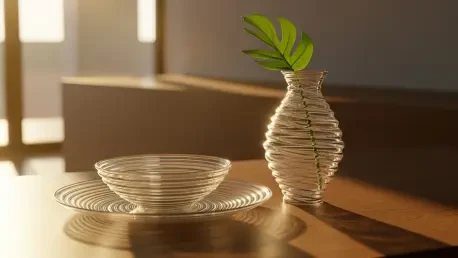
The core philosophy driving this innovative approach is the concept of “process as ornament,” a principle masterfully embodied in the Spiral Vessel Collection. Instead of striving to erase the evidence of manufacturing, Owen’s design intentionally highlights the concentric lines left by the molten glass extruder, transforming them into the object’s primary decorative and functional element. He envisioned the collection as a tangible narrative, where each vessel tells the visual story of its own formation through a single, continuous line traced in three-dimensional space. This deliberate choice elevates the spiraling layers from a technical byproduct to a sophisticated design feature. The resulting texture, composed of neatly bubbled layers of glass, creates a remarkable visual depth and a captivating interplay of light and shadow as light radiates through the translucent material. This method stands in stark contrast to the prevailing industry trend of achieving perfectly smooth surfaces, instead celebrating the inherent character and rhythm of the additive manufacturing process as a unique and valuable aesthetic in its own right.
Beyond its striking visual appeal, the design’s inherent texture serves a critical and practical purpose, seamlessly merging form with function in a way that exemplifies thoughtful engineering. The distinctive spiral pattern, which gives the collection its name and aesthetic signature, also creates a surprisingly ergonomic surface, providing a secure and comfortable grip that enhances the user’s interaction with each piece. Furthermore, the collaboration with Evenline, whose co-founder Michael Stern co-invented the glass 3D printing technology used, ensured that these intricate designs were not only beautiful but also technically sound. Each vessel is meticulously engineered to be completely watertight, a crucial feature that makes them fully functional for everyday use as plates, bowls, or vases. The collection includes three distinct height variations—a low plate, a medium bowl, and a high storage vessel—demonstrating the versatility and scalability of this design philosophy across a range of applications. This successful fusion of artistic intent and technical precision proves that celebrating the manufacturing process does not require a compromise on utility.
Redefining Value in Additive Manufacturing
This landmark project signals a pivotal moment of maturation for the broader additive manufacturing industry, illustrating a decisive shift away from its origins in rapid prototyping and the creation of novelty items. For years, 3D printing was often associated with experimental forms and one-off curiosities, but the Spiral Vessel Collection represents a confident step toward the production of high-end, intentional objects designed for longevity and daily use. This move toward creating items of “functional beauty” challenges the perception of 3D printing as merely a tool for speed or customization, repositioning it as a legitimate method for high-craft production. The partnership between a visionary designer like Josh Owen and a technology pioneer like Evenline is a testament to the powerful synergy that can be achieved when creative insight is paired with cutting-edge engineering. The resulting objects possess a unique character that is both historically informed by the legacy of glass art and undeniably advanced, forging a new category of products that are valued for their aesthetic, their utility, and the innovative story of their making.
The principle of purposeful design is further exemplified in another significant collaboration between Owen and Evenline: the creation of the 2025 Radical Innovation Award. Rather than producing a conventional, purely symbolic trophy destined to collect dust on a shelf, the team designed the award as a functional 3D-printed glass vessel, capable of serving as a vase or a distinctive container. This decision powerfully reinforces the core idea that an object’s value is magnified when its symbolic meaning is integrated with tangible utility. The award itself becomes a physical manifestation of the very principles it seeks to honor—innovation, functionality, and forward-thinking design. This year, the prestigious award was presented to James Lee, Levi Lu, and Theresa Lee of IA Interior Architects for their visionary project, “The Passage.” By bestowing a beautiful and useful object, the award not only celebrates the winners’ achievement but also provides them with a lasting piece of functional art that embodies the spirit of radical and practical innovation in the design world.
A Lasting Imprint on Design
Ultimately, the work of Josh Owen and Evenline did more than just introduce a new collection of glass objects; it fundamentally shifted the dialogue surrounding manufacturing and design. By transforming the layered lines of 3D printing into a celebrated ornamental feature, the project offered a compelling counter-narrative to the relentless pursuit of seamless perfection. This initiative established a powerful precedent, demonstrating that the visual artifacts of a production process could be harnessed as a core component of an object’s identity and beauty. The collaboration encouraged a new generation of designers and engineers to look for artistry within their tools and materials, finding value in the inherent textures and patterns of creation rather than working to conceal them. This paradigm shift questioned long-held assumptions about craftsmanship and perfection, suggesting that the story of how an object was made was as important as its final form, leaving an indelible mark on how future products would be conceived, crafted, and appreciated.