
The rhythmic hum of a CNC machine is no longer merely the sound of metal being cut; it is the sound of data being generated, analyzed, and acted upon in real time, creating an intelligent symphony of precision and efficiency. The manufacturing industry stands at a pivotal moment where the convergence of advanced digital technologies, shifting economic landscapes, and evolving corporate priorities has fundamentally transformed the factory floor. This is not a distant future but the current reality, compelling leaders to abandon traditional, siloed approaches to planning, programming, and production. The path to competitive advantage is now paved with interconnected systems and actionable insights, where five key trends are not just shaping the industry but defining its very essence. These forces are driving a holistic evolution from discrete mechanical processes to a fully integrated, data-driven manufacturing ecosystem where digital intelligence and physical execution are inextricably linked.
The Rise of the Intelligent Machine
AI-Native Machining Becomes Standard
Artificial intelligence has officially moved from the realm of experimental projects to become a core, embedded component of the machining process itself. This “AI-native” approach involves the deep integration of intelligent algorithms directly into the machine’s control loop, where they leverage a constant stream of real-time sensor data to autonomously adapt to the dynamic conditions of the cutting environment. The system dynamically adjusts critical parameters like feeds, speeds, and toolpaths in immediate response to live feedback on vibration, tool load, and thermal fluctuations. This capability for instantaneous, data-driven correction allows the machine to operate at its absolute peak efficiency, ensuring optimal performance from the beginning to the end of every cycle. The tangible benefits of this trend are profound, leading to a dramatic reduction in tool wear and catastrophic failures, alongside a marked improvement in the consistency and quality of the final part’s surface finish, all while minimizing unplanned production stoppages.
This fundamental shift toward intelligent self-correction has also catalyzed a deeper convergence between machine controllers, Computer-Aided Manufacturing (CAM) systems, and powerful data analytics platforms. This integration creates a closed-loop system where the AI continuously bridges the gap between the original design intent, the generated NC program, and the actual physical behavior of the machine on the factory floor. As a result, the role of the human operator has been significantly redefined. The machinist’s focus is transitioning away from reactive, manual adjustments toward more strategic, high-value activities. The operator in this new paradigm is a process optimizer, tasked with validating complex data patterns, fine-tuning the AI algorithms that govern the machines, and systematically working to improve the overall efficiency and reliability of the entire production system, thereby elevating their contribution from simple operation to sophisticated process management.
Digital Twins as the Production Nervous System
The concept of the digital twin has matured far beyond a simple visualization tool, evolving into a comprehensive and dynamic digital replica that mirrors the entire manufacturing lifecycle. It now functions as the central nervous system for production, integrating every facet of the process from initial design and process engineering to the physical machining operation and final post-process inspection. In an environment characterized by increasing part complexity and relentlessly shrinking lead times, this holistic virtual model enables manufacturers to achieve a “first-time-right” approach to production. By performing complete virtual commissioning, critical pre-production tasks such as clash detection between the tool, workpiece, and fixtures, as well as full machine kinematic validation, can be completed in the virtual world long before a single piece of raw material is touched. This preemptive validation effectively eliminates the costly setup errors and material waste traditionally associated with production trials.
Furthermore, the synergy between digital twins and mixed-reality (MR) technologies, including augmented and virtual reality, has unlocked new levels of operational efficiency and collaboration. This powerful pairing facilitates highly effective and safe virtual training for new operators, allowing them to gain experience without risking damage to expensive equipment. It also enables expert remote support, where specialists can guide on-site technicians through complex setup or maintenance procedures from anywhere in the world, mitigating the challenges posed by a shrinking pool of highly experienced machinists. The true power of the 2026 digital twin, however, lies in its capacity for creating a continuous feedback loop. Real-world performance data—such as measured tool wear, final part dimensions, and cycle times—is constantly fed back into the virtual model. This process continuously refines the model’s accuracy, making each subsequent simulation more predictive and reliable than the last.
Reshaping the Factory and Its Purpose
Hybrid Manufacturing Goes Mainstream
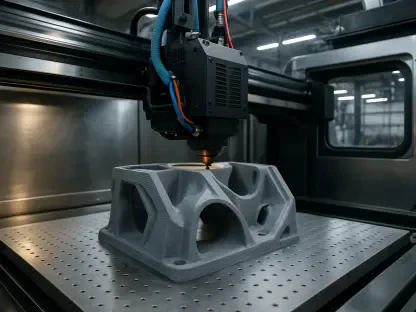
The convergence of additive manufacturing, such as 3D printing, and subtractive processes like CNC milling onto single, unified platforms has become a mainstream reality in demanding production environments. This hybrid manufacturing model directly and elegantly solves two of the most persistent challenges in conventional manufacturing. Firstly, it drastically reduces material waste by using additive processes to build a part to its near-net shape, requiring only minimal material removal by the subtractive CNC process to finish critical features and achieve tight dimensional tolerances. This is particularly impactful when working with expensive superalloys common in the aerospace and medical sectors. Secondly, this approach unlocks the ability to create highly complex and optimized geometries—including intricate internal channels for cooling, lightweight lattice structures for mass reduction, and conformal cooling paths that precisely follow a part’s contours—that are either impossible or prohibitively expensive to produce with subtractive methods alone.
The adoption of hybrid systems has resulted in a more agile and efficient production model characterized by fewer machine setups, the consolidation of multiple process steps into a single operation, and significantly shorter lead times from initial design to the finished part. For machinists and programmers, however, this trend introduces a new set of skills and challenges that require a deeper understanding of materials science and process interaction. They must now learn to manage the heat-affected zones resulting from the additive deposition process, develop strategies for machining novel alloys created in situ, and program complex toolpaths for the irregular, non-prismatic surfaces typical of near-net-shape parts. This evolution demands a more holistic approach to manufacturing, where the distinction between part creation and part finishing becomes blurred, requiring a new generation of highly skilled and adaptable technicians.
Sustainability as a Quantifiable KPI
Sustainability has officially transcended its traditional role within annual corporate social responsibility reports to become a core, quantifiable Key Performance Indicator (KPI) integral to daily operational management. Driven by escalating customer demand for complete supply chain transparency and a growing recognition of the economic benefits of resource efficiency, manufacturers are now required to track and report on the carbon footprint of each part they produce. This paradigm shift means that environmental performance metrics—such as energy consumption per part, coolant volume used, and material waste generated—are now treated with the same rigor and precision as critical dimensional tolerances. Environmental performance is no longer a secondary consideration but a primary driver of both operational excellence and customer value, directly influencing purchasing decisions and brand reputation in a competitive global market.
This focus on measurable environmental impact has accelerated the widespread adoption of specific technologies and practices designed to minimize the factory’s ecological footprint. The use of Minimum Quantity Lubrication (MQL) and advanced dry cutting techniques has become standard practice, drastically reducing coolant consumption and disposal costs. Machine tool designs now increasingly prioritize energy efficiency, with a particular focus on reducing idle power consumption, which can account for a significant portion of a machine’s total energy use. Furthermore, the systematic collection and recycling of valuable materials, especially high-cost titanium and nickel alloys, is a standard operating procedure, turning what was once a waste stream into a valuable resource. This data-driven approach to sustainability provides a clear competitive advantage, demonstrating a commitment to responsible manufacturing that resonates with customers and stakeholders alike.
Automation and Reshoring Fueling a New Economy
The confluence of macroeconomic forces, including persistent labor shortages, ongoing geopolitical instability, and the fragility of global supply chains, has accelerated a significant move toward reshoring—bringing manufacturing production closer to domestic markets. To remain competitive while navigating the higher labor costs associated with this strategic shift, manufacturers have made substantial investments in advanced automation and digital coordination. This has led to the proliferation of fully integrated, robot-tended CNC cells, automated pallet changers, and self-calibrating tool presetters, all designed to enable “lights-out machining.” This concept, which refers to the ability to run continuous and reliable unmanned production shifts, is no longer a novelty but a necessity for maximizing asset utilization and productivity in a high-cost environment, supported by intelligent scheduling software and remote monitoring capabilities.
The lynchpin for making this high level of automation viable is seamless data integration across the entire production ecosystem. All components—from the CNC machines and robotic loaders to enterprise resource planning (ERP) systems and coordinate measuring machines (CMMs)—must communicate fluently using a common data language. This interoperability allows for the automatic and real-time tracking of critical variables such as part quality, machine utilization, and remaining tool life, enabling the system to make autonomous decisions to maintain production flow. This new wave of automation is not primarily about replacing human workers but rather about amplifying the capabilities of skilled labor. It frees technicians from repetitive, low-value tasks like loading and unloading parts, allowing one person to effectively oversee the operation of multiple machines, interpret advanced analytics, and focus on managing exceptions and optimizing the overall production system.
An Integrated Future Realized
The evolution of precision manufacturing was no longer a question of incremental improvement but one of fundamental integration. The factories that thrived were those that had successfully treated every machine cycle not just as a physical act but as a data-generating event to be captured, analyzed, and leveraged for continuous improvement. The companies that built connected, AI-aware production workflows, utilized simulation to eliminate errors before they occurred, and embraced sustainable practices as a source of competitive strength ultimately defined the industry standard. They cultivated a workforce trained to think in terms of data-driven feedback loops rather than discrete, isolated tasks. The cutting edge of manufacturing became as much digital as it was physical, blurring the lines between programming and machining, and between planning and production, until the pursuit of perfection was powerfully augmented by the seamless fusion of data, algorithms, and human ingenuity.