
The factory floor of today is becoming almost unrecognizable from its recent past, rapidly evolving from a place of manual labor into a sophisticated ecosystem of intelligent, interconnected machines. At the core of this monumental shift is the Computer Numerical Control (CNC) machine, a technology that is not just automating tasks but is fundamentally redefining the limits of precision and efficiency in modern industry. As the global precision manufacturing market accelerates toward a projected valuation well beyond its current $78.4 billion, sectors from automotive and electronics to aerospace are becoming increasingly reliant on these advanced systems. This industrial metamorphosis is a direct answer to a confluence of powerful forces: the persistent rise of labor costs in key manufacturing regions and a relentless global demand for products that are more complex, more precise, and produced faster than ever before. Manufacturers are now making unprecedented investments to expand their production capacity and integrate these smart technologies, setting the stage for the next industrial revolution.
The New Geography of Production
The proliferation of smart machines has effectively redrawn the world’s manufacturing map, concentrating industrial power in new global hubs. The center of CNC machine production has decisively shifted, with China now commanding the market by accounting for approximately 35% of all global output. While established leaders like Japan and Germany remain significant players, this realignment underscores a new paradigm where manufacturing leadership is intrinsically linked to regional technological expertise and, crucially, direct access to vital component supply chains. This new geography is not just a matter of location; it represents the formation of powerful, self-reinforcing industrial ecosystems that are poised to define global production for decades. The Pearl River Delta, for instance, has transformed from a region of basic manufacturing into a high-precision powerhouse, hosting thousands of enterprises that exemplify this trend.
This massive consolidation of production, combined with an unprecedented surge in global demand, has introduced significant logistical complexities that ripple across the supply chain. The average lead time for new equipment has nearly doubled in just a few years, stretching from a manageable 8-10 weeks to a protracted 14-16 weeks. This delay is a direct consequence of both overwhelming order volumes and ongoing adjustments in global logistics networks. In response to this volatility, astute manufacturers are fundamentally rethinking their operational strategies to build resilience. To safeguard against crippling disruptions and delays, a key trend has emerged: the strategic bolstering of critical component inventories and the proactive establishment of redundant supplier relationships. This approach is creating a more adaptable and responsive global production network, capable of weathering future shocks.
The Evolution of Intelligent Hardware
Today’s smart machines bear little resemblance to their predecessors, as the industry rapidly moves toward more sophisticated and complex hardware as the new standard. A prime example of this evolution is the five-axis machining center. Once a niche technology reserved for highly specialized, cost-prohibitive applications, these advanced systems now account for an impressive 28% of all new CNC machine installations. This widespread adoption is a direct response to the escalating demand for parts with intricate geometries, particularly from high-tech sectors like the medical device and aerospace industries. What was once a theoretical design possibility is now a mass-producible reality, thanks to the accessibility of this advanced hardware. This shift signifies a fundamental change in manufacturing capabilities, where complexity is no longer a primary barrier to production.
This technological evolution extends well beyond the machines themselves to encompass the cutting-edge tools they employ. The market for high-performance consumables, such as carbide end mills, has blossomed into a multi-billion dollar industry, reflecting the relentless pursuit of greater efficiency and precision. Modern cutting tools are marvels of material science, featuring advanced coatings and proprietary carbide formulations that extend their operational life by as much as 40% compared to those available just five years ago. This longevity directly translates into reduced operational costs and increased machine uptime. Furthermore, the precision of these tools has reached new heights, with manufacturing tolerances now routinely measured in micrometers and runout specifications held to within an astonishing 0.005mm for high-performance applications. These advanced tools are a critical, often overlooked, component in the smart manufacturing equation.
Software and DatThe Unseen Revolution
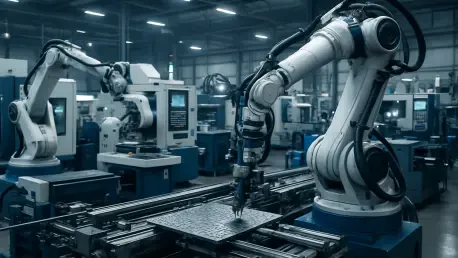
What truly elevates modern manufacturing to the level of “smart” is the deep, seamless integration of automation and sophisticated software. Physical automation is no longer an optional add-on but a core, expected feature of new equipment. Approximately 45% of new CNC machines valued over $100,000 are now installed with integrated automation systems, such as robotic loading arms and automated tool changers, that can run for hours without human intervention. Specialized applications, like the Glue Dispenser systems used in electronics manufacturing, work in tandem with CNC positioning to achieve adhesive application accuracy within 0.1mm—a level of precision that is physically impossible to replicate manually. These systems are not just replacing labor; they are enabling new levels of quality and consistency that were previously unattainable.
This advanced hardware is animated by an equally sophisticated digital backbone that serves as the central nervous system of the modern factory. Today’s machine controls no longer operate in isolation; they communicate fluently with factory-wide Enterprise Resource Planning (ERP) systems. This connectivity enables real-time production monitoring and automated job scheduling, which in turn optimizes machine utilization rates, boosting them from an industry average of 68% to upwards of 85% in highly efficient facilities. The data generated by these machines is another cornerstone of this revolution. Modern CNCs are powerful data-gathering hubs, collecting information on hundreds of operational parameters like cutting forces and spindle temperature. This constant stream of data is the fuel for predictive maintenance programs and advanced quality assurance systems that have successfully driven scrap rates to below 1% in many operations.
The Human and Economic Equation
The powerful push for smarter manufacturing is fundamentally reshaping the underlying economics of the industry, with a new emphasis on long-term operational efficiency. Energy consumption, once an accepted cost of doing business, has moved to the forefront of machine design and selection. Modern CNC machines are 20-30% more energy-efficient than their decade-old counterparts, a result of significant improvements in motor efficiency and intelligent power management systems. Analysis has revealed that idle time can account for a staggering 35-40% of a machine’s total energy consumption, prompting the development of quick-response sleep modes and automated shutdown protocols. This focus on efficiency also extends to consumables, where innovations like Minimum Quantity Lubrication (MQL) systems are replacing traditional flood coolant methods, reducing fluid consumption by as much as 90%. These sustainability features are now central to investment decisions.
Ultimately, the successful transformation of manufacturing hinges not just on technology, but on its people. The industry is currently facing a persistent and critical shortage of skilled labor, with 67% of machine shops reporting significant difficulty in finding qualified operators and programmers. This challenge has become a powerful catalyst for two key developments: the adoption of more user-friendly, intuitive control interfaces that lower the barrier to entry, and a necessary evolution in workforce training programs. Cutting-edge technologies like virtual reality (VR) simulation systems are now being used to reduce initial training time by about 30% without risking damage to expensive equipment. Concurrently, industry-standard certification programs have gained prominence, providing a clear pathway for skills development. This dual approach of making technology more accessible while simultaneously cultivating the next generation of talent is essential for realizing the full potential of the smart factories of tomorrow.