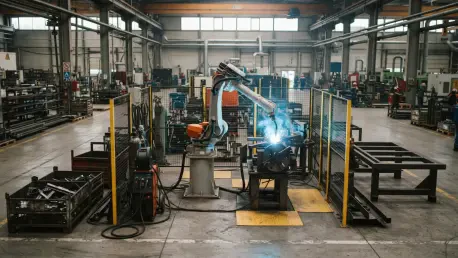

Current research indicates that geometry-based local adjustments can effectively prevent collisions during the critical approach and retreat phases of a welding operation. In the high-stakes world of heavy industrial manufacturing, where structural components like crane booms and vehicle chassis are fabricated, the precision of robotic systems is non-negotiable. While automation has dominated mass production for decades, the industry is currently grappling with a persistent bottleneck: the programming of robots for complex, non-standard, or multi-planar workpieces. Historically, this has required a tedious “teach-in” method, where human operators manually guide the robot arm through every coordinate point. This manual intervention is not only labor-intensive but frequently accounts for more than 30% of the total time allocated to a welding project. To eliminate this inefficiency, contemporary engineers are turning toward sophisticated offline programming (OLP) frameworks that can automatically generate safe trajectories directly from digital models, paving the way for a more agile and responsive production environment.
The transition toward automated path generation is more than a simple upgrade in software; it represents a fundamental shift in how manufacturing intelligence is applied. Rather than relying on human trial and error, modern OLP systems utilize hierarchical path planning to bridge the gap between abstract CAD designs and the physical reality of the factory floor. This methodology is specifically designed to handle spatially distributed welding tasks that involve multiple seams across a single large structure. By moving away from rigid, pre-recorded sequences and embracing a dynamic digital workflow, companies can ensure that their robotic assets are working as efficiently as possible. This approach balances the need for high-quality material deposition with the critical requirement of navigating through environments cluttered with fixtures and obstacles. The ultimate goal is a system that can take a 3D model and, with minimal human guidance, produce a collision-free, optimized movement plan that meets or exceeds the rigorous standards of modern structural engineering.
Defining the Structured Path Meta-Model
To manage the inherent complexity of multi-seam welding, the framework utilizes a structured meta-model that categorizes every movement the robot makes based on its specific function. Rather than viewing a path as a long, undifferentiated list of X, Y, and Z coordinates, the system identifies specific path nodes as either primary or auxiliary. Primary nodes are the critical points where the welding torch actually engages with the material, marking the precise start and end of a seam. Auxiliary nodes, on the other hand, are the intermediate waypoints that guide the robot through the space between welds. This classification allows the planner to apply different logic and safety constraints depending on what the robot is currently doing. By imbuing the motion data with this kind of semantic meaning, the system creates a high-level roadmap that is much easier for automated algorithms to optimize than a raw stream of geometric data.
Building on this classification, the framework divides the entire welding cycle into four distinct types of segments: weld, retreat, approach, and inter-seam transition. The weld segment is the most rigid, requiring absolute adherence to torch angles and speeds to ensure a high-quality bond. The retreat and approach segments are short maneuvers performed immediately before and after welding, designed to get the torch safely away from the workpiece without bumping into the freshly finished seam or its surrounding fixtures. Finally, the inter-seam transition segments handle long-distance travel across the workpiece to reach the next task. By breaking the process down into these logical chunks, the planning algorithm can prioritize accuracy during the actual welding phase while focusing on speed and obstacle clearance during transitions. This hierarchical structure ensures that the robot is always operating under the most appropriate set of rules for its current task.
Extracting Geometry and CAD Integration
The success of any offline programming system depends on its ability to accurately interpret the physical world from a digital representation. In this framework, data extraction is handled via the OpenCASCADE geometry kernel, which allows for a high degree of interaction with standard CAD files. Instead of relying on fully automated feature recognition—a technology that frequently fails when confronted with the unique, one-off geometries common in heavy machinery—the system employs a semi-automated approach. Engineers use a graphical interface to select the target seams and adjacent planes. Once the user provides this high-level guidance, the system automatically calculates the necessary coordinates and identifies the ideal torch pose for each point along the seam. This hybrid method leverages human intuition for complex spatial reasoning while letting the computer handle the thousands of precise calculations required for a professional welding trajectory.
Once the geometric data is extracted, it is encapsulated into a unified data structure that serves as the foundation for all subsequent planning. This structure includes not just the location of the weld but also the process-specific requirements, such as the tilt and lead angles of the welding torch. By integrating this manufacturing intelligence directly into the geometric model, the system ensures that the resulting paths are not just collision-free but also capable of producing high-quality welds. This digital foundation replaces the legacy method of manual coordinate entry, which was prone to human error and required extensive physical verification. By 2026, the integration of these sophisticated geometric kernels into OLP workflows has become the standard for companies looking to reduce lead times and improve the consistency of their structural welding operations without sacrificing the flexibility needed for custom manufacturing.
Implementing Local Attitude Adjustment Strategies
Collisions in robotic environments typically manifest in two distinct ways: near-field interference and far-field obstacles. Near-field collisions are particularly dangerous because they occur when the welding torch is only millimeters away from the workpiece or its mounting fixtures during the start and end of a weld. To solve this, the hierarchical framework implements a computationally lightweight strategy known as local attitude adjustment. When the system detects a potential collision during the approach or retreat phase, it does not attempt to reroute the entire robot arm immediately. Instead, it tries to solve the problem by slightly rotating the torch around the surface normal of the interfering face. This iterative process continues in small increments until the torch clears the obstacle while staying as close as possible to the ideal welding angle dictated by the process requirements.
This local adjustment strategy is essential for maneuvering in the tight, constrained spaces often found in box-type structures or complex chassis. By focusing on the orientation of the torch rather than the position of the entire arm, the system can find solutions that a more generic path planner might miss. This approach is specifically tailored to the geometry of the welding process, where maintaining a certain angle is vital for the integrity of the joint but where small deviations are often permissible to avoid a catastrophic collision. These adjustments are performed in a fraction of a second, allowing the system to refine the path locally without the need for heavy global recalculations. It ensures that the robot can “snake” into position or pull back from a completed weld with high reliability, even in environments where fixtures are positioned dangerously close to the seams.
Global Planning With Adaptive Optimization
While local adjustments handle the fine details near the weld seam, long-range movements across the workpiece require a more robust global planning approach. The system employs the Adaptive Batch Informed Trees (ABIT*) algorithm, which is highly efficient at finding optimal paths in the high-dimensional space of a six-axis robot. To make this algorithm even more effective for welding, researchers have enhanced it with a three-stage adaptive cost function. This cost function changes its priorities based on the robot’s progress along its path. In the initial phase of a transition, the priority is simply to move away from the current location in a direction that aligns with the ultimate goal. This directional guidance prevents the robot from getting stuck in local minima or taking awkward, roundabout routes out of a confined workspace.
As the robot enters the middle phase of its transition across the workpiece, the adaptive cost function shifts its focus entirely toward safety. A dual-zone logic is applied here: an “inner danger zone” within five centimeters of any obstacle triggers a massive penalty, while an “outer warning zone” extending to fifteen centimeters applies a decaying penalty. This encourages the algorithm to find a trajectory that gives the workpiece a wide berth, significantly reducing the risk of a high-speed collision during transit. Finally, as the robot nears its destination, the focus shifts to convergence. The influence of obstacle penalties is lowered to allow the robot to move precisely into the target pose for the next weld. This sophisticated shifting of priorities ensures that the robot moves with both speed and safety, adapting its behavior to match the specific constraints of the environment at every stage of the journey.
Validating Results Through Simulation Testing
Before any digital path is sent to a multi-million dollar industrial robot, it must undergo rigorous validation in a simulated environment. Using the Fast Collision Library (FCL) to detect interferences, researchers have put this hierarchical planning method through a battery of tests against traditional, non-hierarchical planners. The data revealed that the adaptive, three-stage optimization method reduced the average path length by a significant 20%, bringing the typical transition down from 2.45 meters to just 1.95 meters. This reduction is a clear indicator that the directional guidance terms in the global planner are successfully preventing the robot from taking unnecessary detours. In a high-volume manufacturing setting, these saved centimeters and seconds quickly add up to improved throughput and reduced wear on the robot’s mechanical components.
Beyond simple efficiency, simulation testing also highlighted a notable improvement in the safety margin of the generated paths. The average minimum clearance between the welding torch and the workpiece increased by 8%, proving that the dual-zone cost function was effective at “pushing” the robot away from potential collision points. Interestingly, the testing also identified a trade-off: the complex nature of the adaptive cost function meant that the planner was less likely to find a solution on the very first try compared to simpler algorithms. However, when the system was allowed up to three retries, the success rate surged to over 90%. In the context of offline programming in 2026, where a few extra seconds of background computation is functionally irrelevant, this trade-off is widely considered acceptable in exchange for the vastly superior safety and efficiency of the final path.
Evaluating Success in Real-World Implementation
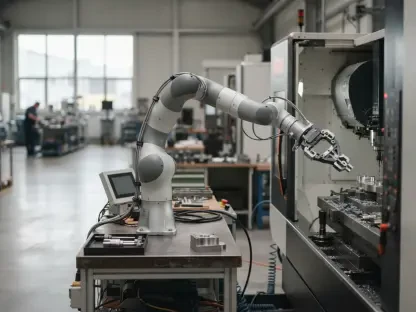
The ultimate test for any robotic planning framework is its performance on the factory floor, where physical variables like vibration and mechanical backlash come into play. To validate the research, the generated trajectories were exported and executed on a physical FANUC M-10iD industrial robot tasked with welding a complex box-type structure. The results were highly positive, as the robot successfully navigated the workpiece without a single collision. This physical validation confirms that the hierarchical approach is robust enough to handle the transition from a perfect digital model to a real-world manufacturing environment. The system’s ability to automatically generate these paths saved hours of manual labor, proving that the digital twin approach is a viable replacement for traditional teaching methods.
Perhaps the most critical metric for the success of this implementation was the precision of the final movement. Measurement data showed that the deviation between the planned digital path and the actual physical path was less than two millimeters. For large-scale structural welding, industrial standards typically allow for a tolerance of plus or minus three millimeters, meaning the accuracy of the hierarchical planner is well within the requirements for high-quality production. This level of precision ensures that the weld metal is deposited exactly where it needs to be, maintaining the structural integrity of the component. The success of this physical trial demonstrates that the framework is ready for immediate integration into industrial workflows, offering a practical solution for manufacturers looking to automate the production of complex, high-value components.
Analyzing Trends in Industrial Automation
The move toward hierarchical, process-informed path planning is part of a larger trend in industrial automation toward smarter and more autonomous systems. By 2026, the industry has largely accepted that generic motion planning is no longer sufficient for specialized tasks like welding. Instead, the focus has shifted toward systems that understand the semantic meaning of their actions. By treating each part of a path differently—recognizing that a weld segment has different requirements than a transit segment—engineers can create more reliable and efficient automation. This shift is empowered by the increasing capability of multi-objective optimization functions, which allow a single algorithm to simultaneously prioritize safety, speed, and process accuracy. This research serves as a clear example of how these complex objectives can be balanced to solve real-world industrial problems.
Looking ahead, the logical next step for this technology involves the integration of machine learning to further refine the path planning parameters. Currently, certain weights in the cost functions must be tuned by engineers to match the specific geometry of a workpiece. Future systems will likely use neural networks to analyze a CAD model and automatically determine the optimal settings for the global planner, further reducing the need for human intervention. Additionally, the principles of hierarchical planning are likely to be expanded to multi-robot collaboration, where multiple arms must coordinate their movements to weld a single large structure without colliding with each other. This continuous evolution of digital planning tools is essential for maintaining the competitiveness of heavy manufacturing, ensuring that even the most complex structures can be built with the speed and precision of a fully automated production line.
1. What is the Main Benefit of Hierarchical Path Planning?
The primary advantage of a hierarchical approach is its ability to drastically reduce the time and effort required to program robots for non-standard, complex workpieces. By automating the generation of collision-free trajectories, manufacturers can bypass the manual “teach-in” phase, which often consumes nearly a third of the total time in a welding project. This automation is made possible by segmenting the robot’s movement into logical phases, such as welding, approaching, and transitioning. Each phase is then optimized using specific rules—ensuring high precision when the torch is active and maximum safety when the robot is moving between seams. This results in a system that is not only faster to set up but also produces shorter, safer, and more efficient paths than a human operator could design manually.
2. How Does the System Avoid Collisions in Tight Spaces?
To handle the challenges of maneuvering in confined areas, the system employs a two-pronged strategy that separates local adjustments from global movement. For near-field situations where the torch is very close to the workpiece, the framework uses local attitude adjustment. This technique avoids collisions by incrementally rotating the torch’s orientation around the surface normal of the interfering object until clearance is achieved. This allows the robot to reach deep into structures or maneuver around fixtures without needing to reposition the entire arm. For larger movements across the workpiece, an adaptive global planner is used. This planner applies high penalties to any path that enters a predefined danger zone near the workpiece, effectively pushing the robot’s trajectory away from potential obstacles and ensuring a safe clearance at all times.