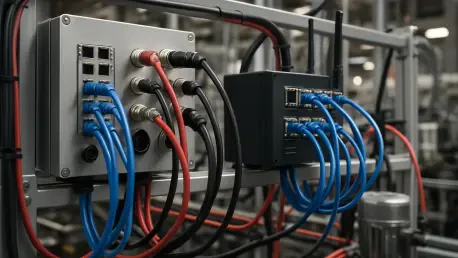

The relentless pressure of maintaining uptime in critical infrastructure has reached a point where even a minor networking glitch can ripple through a supply chain, costing thousands of dollars per minute in lost productivity. For years, engineers managed these risks by cobbling together various switches, modems, and security appliances, resulting in a cluttered “spaghetti cabling” mess inside field cabinets. The Digi IX25 marks a departure from this fragmented history, emerging as a consolidated industrial hub that replaces a rack of gear with a single, hardened point of intelligence.
The Shift From Simple Routing to Consolidated Industrial Hubs
By merging high-speed networking with edge intelligence, the IX25 challenges the traditional separation between enterprise IT and operational technology. It functions as a singular gateway that simplifies the physical architecture of remote sites, moving beyond the limitations of basic connectivity. This integration allows teams to eliminate external switches and redundant wiring, which reduces the surface area for hardware failure.
The transition to this centralized model reflects a broader movement toward efficiency in the field. Instead of managing a fleet of disparate components, operators can now deploy a unified platform that handles everything from data routing to local application hosting. This consolidation is not merely about saving space; it is about establishing a more reliable foundation for the complex automation tasks that define modern industrial sites.
Navigating the Convergence of IT and OT Requirements
Modern industrial landscapes require equipment that satisfies the conflicting demands of extreme physical durability and sophisticated digital security. While traditional data center equipment would fail instantly in the dust and heat of a remote utility site, the IX25 thrives in these environments. It bridges the gap by offering the ruggedness of industrial hardware alongside the advanced software protocols required by corporate security audits.
Organizations migrating to private cellular networks or 5G must also navigate a complex web of certifications. Whether dealing with hazardous locations requiring ATEX or C1D2 compliance or satisfying strict supply chain transparency mandates, the hardware is built to meet these rigorous standards. This alignment of physical and digital resilience ensures that critical infrastructure remains both connected and protected against evolving threats.
A Multifaceted Approach to Hardware Resilience and Network Agility
The architecture of the Digi IX25 rests on four pillars designed to ensure long-term viability in the field. First, physical consolidation is achieved via four integrated Gigabit Ethernet ports, allowing the device to serve as both a router and a switch. Second, environmental hardening enables operation in temperatures from -40 °C to +75 °C, supported by MIL-STD-810H ratings for shock and vibration.
Beyond the physical shell, the device offers unparalleled spectrum versatility, supporting LTE, 5G RedCap, and eMBB alongside private frequencies like CBRS and Anterix. To streamline logistics, the inclusion of GSMA-compliant eSIM technology permits remote carrier switching. This removes the logistical nightmare of sending technicians to remote locations for manual SIM card swaps, significantly lowering the total cost of ownership.
Security Standards and the New Era of AI-Driven Management
The demand for “Western-made” components has become a priority for operators looking to mitigate geopolitical supply chain risks. The IX25 addresses this through TAA compliance and the use of Western cellular modules, ensuring it meets the procurement standards of government and utility sectors. This focus on trust is paired with a revolutionary management layer that moves beyond traditional dashboards.
The platform utilizes a specialized MCP server that integrates large language models, allowing network administrators to interact with their fleet using natural language. This shift enables users to troubleshoot complex connectivity issues or automate large-scale configuration updates through intuitive queries. It effectively transforms a standard management interface into an intelligent assistant capable of distilling massive amounts of telemetry into actionable insights.
Strategies for Deploying Edge Intelligence in Critical Infrastructure
To extract maximum value from the Digi IX25, organizations moved toward decentralized computing strategies that process data at its source. By utilizing the quad-core processor to run Linux containers or AWS IoT Greengrass, teams reduced the latency and bandwidth costs associated with traditional cloud-only models. This allowed SCADA data to be filtered locally, ensuring only vital telemetry reached the central servers.
Standardizing on a single hardware platform for both public and private networks simplified inventory management for large-scale utility projects. Furthermore, the transition to 5G RedCap provided a future-proof path that balanced the longevity of 5G networks with the power efficiency needed for industrial IoT. These strategic deployments ensured that infrastructure was not just connected, but also capable of adapting to the shifting technological requirements of the coming decade.