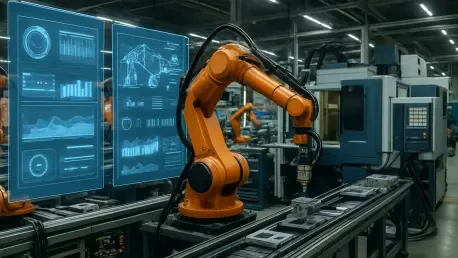

The global industrial landscape is currently undergoing a radical transformation that effectively blurs the lines between the physical, digital, and biological spheres through an unprecedented level of connectivity. This paradigm shift, widely recognized as the Fourth Industrial Revolution, moves far beyond the isolated automation of previous decades to establish a comprehensive ecosystem where every component of the production chain is intelligently linked. By integrating Artificial Intelligence, the Internet of Things, and high-performance robotics, contemporary enterprises have unlocked a capacity for operational efficiency and granular product customization that was once considered purely theoretical. Today, the reliance on real-time data streams allows for the creation of incredibly resilient and flexible production models capable of pivoting instantly in response to the fluctuations of a volatile global market. This evolution marks a departure from rigid manufacturing toward a fluid, data-driven environment that prioritizes speed, accuracy, and sustainability.
The Historical Foundations of Mechanization and Mass Production
The long journey of industrial evolution began in the United Kingdom during the late 18th century with the First Industrial Revolution, which fundamentally altered the course of human history. This transformative period marked a decisive transition from rural, manual labor to sophisticated mechanization, powered largely by the perfection of the steam engine by James Watt. This specific innovation did more than just automate textile factories; it completely revolutionized rail and maritime transport, drastically lowering the cost of goods and expanding international trade routes. By replacing muscle power with mechanical energy, this era provided the fundamental groundwork for structured industrial environments, moving society away from artisanal production toward a more organized, mechanical economy. The societal shift from agrarian lifestyles to urban industrial centers created the first true blue-collar workforce, establishing the basic organizational hierarchies and labor structures that would persist for over a century as the world modernized.
As the late 19th century approached, the Second Industrial Revolution introduced new energy sources like electricity and oil, which gradually replaced coal as the primary driver of progress. This era is most notable for the birth of the assembly line, a production method championed by pioneers like Henry Ford that allowed for the mass manufacturing of complex machines such as automobiles. Innovations in materials like steel and aluminum, combined with the groundbreaking invention of the telephone and radio, created a more interconnected global market than had ever existed before. During this time, the United States and Germany emerged as dominant industrial leaders, setting the stage for modern global connectivity through standardized parts and synchronized workflows. This period proved that scale and speed were the primary metrics for success, leading to the rise of massive corporations and a global supply chain that relied on the rapid movement of raw materials and finished products across vast distances.
The Transition Into Digital Systems and Early Automation
The Third Industrial Revolution, which emerged in the 1970s and 1980s, shifted the primary focus of development from purely mechanical systems to electronic and digital technologies. Known as the Digital Revolution, this period saw the birth of the internet and the widespread use of information technology in manufacturing through programmable logic controllers and early robotics. Automation became significantly more sophisticated as electronics allowed for higher productivity and the rise of a truly globalized world where information could be shared instantly. This phase served as a vital bridge, turning specialized knowledge into a highly accessible digital resource and paving the way for the data-centric landscape seen today. While the Second Revolution focused on moving parts, the Third Revolution focused on moving bits of data, enabling factories to achieve a level of precision that human operators could not match, while also reducing the physical burden on the workforce through computerized control systems.
The official concept of Industry 4.0 was introduced at the Hanover Fair, highlighting a new era where data and communication take center stage in every industrial process. While it builds on the computerization of the previous revolution, Industry 4.0 emphasizes smart systems capable of making autonomous decisions without direct human intervention. By integrating Big Data, cybersecurity, and Augmented Reality, this revolution allows machines to communicate with one another and optimize complex processes in real time. This shift represents a transition from basic digital tools to a fully interconnected, intelligent industrial framework where the factory itself can predict maintenance needs and adjust production schedules based on live consumer demand. In the current era, the distinction between a software company and a manufacturing firm is becoming increasingly thin, as digital fluency is now the most critical asset for any organization seeking to remain competitive in a rapidly evolving technological landscape.
Modern Implementation and Strategic Technological Integration
In the current landscape, the successful implementation of Industry 4.0 requires a sophisticated and seamless integration of Information Technology and Operational Technology. This ensures that the software governing business logic and financial planning communicates effectively with the hardware performing physical tasks on the factory floor. Companies now rely on high-speed connectivity, mobile robotics, and hybrid cloud computing to maintain operational continuity across multiple geographic locations simultaneously. By bridging these technological gaps, businesses can protect their critical assets through robust industrial cybersecurity while remaining agile enough to meet the demands of a fast-paced market. This integration allows for a “digital twin” approach, where every physical asset has a virtual counterpart that can be tested and optimized in a simulated environment before any physical changes are made, thereby reducing waste and preventing costly downtime during production shifts.
The successful adoption of these technologies depended on a fundamental shift in how organizations viewed their data and their workforce. Companies that thrived were those that moved away from siloed departments and instead embraced a unified data architecture where information flowed freely between engineers, managers, and autonomous systems. This transition required a heavy investment in upskilling employees to work alongside collaborative robots and AI-driven analytical tools, ensuring that human creativity remained at the center of the technological surge. Leaders in the field discovered that the true value of the Fourth Industrial Revolution lay not just in the hardware itself, but in the ability to derive actionable insights from the massive volumes of data generated every second. By prioritizing cybersecurity as a core business function rather than a secondary IT concern, these organizations secured their supply chains and built the necessary trust to operate in an increasingly interconnected and transparent global economy.