
Kwame Zaire is a seasoned industrial operations leader with a profound interest in the intersection of electronics, equipment reliability, and production management. As a thought leader in predictive maintenance, quality, and safety, he advocates for a future where technology amplifies human potential rather than replacing it. In this conversation, we explore how digital knowledge capture, signal-to-action judgment, and AI-driven diagnostics are reshaping the manufacturing landscape, turning the traditional maintenance role into a sophisticated, data-driven profession that bridges the gap between veteran expertise and the next generation of technicians.
Many industrial facilities lose decades of expertise when veteran technicians retire without documenting their unique insights. How can digital knowledge capture transform this “tribal knowledge” into repeatable procedures, and what specific steps should teams take to ensure this information remains accessible across different shifts and experience levels?
The loss of tribal knowledge is a critical inflection point for modern factories, as veteran technicians often hold the undocumented “secrets” of machine behavior in their heads. Digital knowledge capture transforms these private insights into public assets by allowing frontline teams to author digital standard operating procedures and annotate photos or videos directly within their workflow. To make this information accessible, teams must move away from paper binders and toward mobile-first platforms where a technician can pull up torque specifications or specific repair nuances at the machine itself. By structuring this data so it can be reused across different shifts and sites, companies ensure that the wisdom of a 30-year veteran is available to a new hire on their first day, effectively preventing the “brain drain” that typically accompanies retirement.
While most facilities aim for preventive maintenance, reactive firefighting often dominates daily operations due to a lack of actionable data. In what ways does signal-to-action judgment allow technicians to move beyond manual troubleshooting, and how does this shift fundamentally change the day-to-day metrics of a plant floor?
Currently, fewer than 35 percent of facilities spend most of their time on planned work, meaning the majority are stuck in a cycle of reactive firefighting. Signal-to-action judgment shifts the technician’s role from guessing to validating, as they use AI-generated anomaly alerts to identify a specific root cause—like a misaligned coupling—before a total breakdown occurs. This data-driven decision-making replaces the manual lookup of old manuals with real-time diagnostics that suggest the best corrective path immediately. Consequently, day-to-day metrics shift from “how fast did we fix it?” to “how effectively did we prevent it?”, significantly reducing the frequency of equipment failure, which remains the leading cause of unplanned downtime.
Imagine a junior technician identifying a potential equipment failure, such as a compressor vibration, using AI-driven diagnostics. How does this technology accelerate the learning curve for entry-level workers, and what is the practical process for escalating complex issues to supervisors without halting the entire production line?
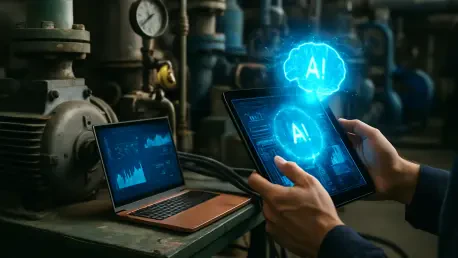
AI-driven diagnostics act as a digital mentor, allowing a junior technician to perform at a senior level by providing step-by-step repair guidance drawn from OEM manuals and historical data. When a compressor shows subtle vibration changes, the system can automatically surface the likely cause, reserve the necessary parts from inventory, and generate a work order with precise safety checks. For escalation, the process becomes streamlined: the junior worker handles the physical labor and data validation, while the supervisor is only alerted for a final approval step via the digital platform. This prevents unnecessary production halts because the technician has the confidence and the data to proceed with the repair safely, effectively bypassing the hours spent waiting for an expert’s manual diagnosis.
Scalable AI implementation requires robust infrastructure, including low-latency connectivity and edge computing. Why is maintaining the “data pipeline” now a core responsibility for maintenance teams, and what specific security or governance standards must be met to ensure these systems remain safe and resilient during active production?
The maintenance role has expanded to include IT-OT data stewardship because if the data pipeline fails, the AI cannot provide the timely alerts needed to keep the factory running. Technicians are now responsible for ensuring that edge analytics and sensors stay synchronized with physical systems through robust industrial Ethernet or 5G networks. To keep these systems resilient, we are adopting high standards like FedRAMP and focusing on OT cybersecurity, role-based access, and detailed audit trails. This governance ensures that while the AI provides recommendations, there are always human-in-the-loop controls to prevent unauthorized changes or security breaches during active production cycles.
Some manufacturers have seen a 90% reduction in mean time to repair by centralizing knowledge. Beyond direct cost savings, how does AI-augmented maintenance reshape the broader hiring pool for industrial roles, and what specific metrics should leadership track to measure the success of these workforce transformations?
By digitizing procedures, companies like Redimix have been able to expand their hiring pool to include people who may lack decades of mechanical experience but possess high data literacy and judgment. This shift makes industrial roles more attractive to a younger, tech-savvy workforce that views maintenance as a sophisticated, data-driven career rather than just “wrench-turning.” To measure success, leadership should look beyond the 34 percent reduction in downtime costs and track metrics like the speed of onboarding for new hires and the ratio of planned versus reactive work. Ultimately, the goal is to transform the role into one that delivers high economic value through a combination of human adaptability and technological precision.
What is your forecast for AI in the industrial workforce?
My forecast is that AI will become the foundational “operating system” for the frontline worker, where the distinction between a manual laborer and a data analyst completely disappears. We will see a shift where every technician is an “augmented technician,” empowered by real-time insights to perform complex repairs that were once the sole domain of specialized engineers. This transformation will lead to a more resilient manufacturing sector that is no longer paralyzed by the skills gap or aging workforces. Instead of a “tsunami” of job losses, AI will facilitate a renaissance of American manufacturing, creating safer, more stable, and more valuable jobs that prioritize human judgment and responsibility for the physical systems that power our world.