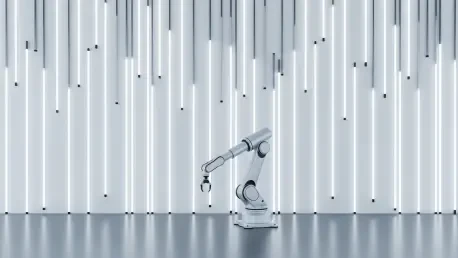

The global industrial landscape is undergoing a radical transformation as companies struggle to maintain production levels while facing an unprecedented scarcity of skilled workers. Traditional assembly lines that once relied heavily on human endurance are evolving into automated ecosystems where output is no longer tethered to a physical headcount. This shift represents a critical turning point for economic stability, as manufacturers seek to decouple their growth potential from the availability of local labor.
The urgency of this transition is driven by a widening gap between market demand and the dwindling number of individuals willing to enter manual trade sectors. Industry analysts suggest that the integration of AI-driven hardware and flexible financial frameworks will define industrial competitiveness for the next decade. By moving toward a model where machines handle the brunt of physical labor, organizations can safeguard their operations against demographic shifts and fluctuating migration patterns.
Orchestrating a Digital Response to a Physical Gap
Bridging the Productivity Chasm Through Smart Automation
Recent data indicates a significant surge in automation, with over 542,000 new robotic installations recorded annually. This aggressive adoption serves as a direct countermeasure to the reality that nearly half of all manufacturers are currently unable to fill open positions. When smart systems are deployed to fill these vacant human roles, facilities often see an immediate productivity increase ranging from 10% to 20%.
While the initial capital investment for high-end systems from providers like FANUC or Yaskawa Electric remains substantial, the risk of operational paralysis poses a much greater threat. Manufacturers are increasingly viewing the cost of robotics not as a luxury, but as an essential insurance policy. Those who hesitate to automate face the long-term danger of being unable to meet contractual obligations as the pool of available workers continues to contract.
The Democratization of Robotics via RaaS and Lowered Entry Barriers
The rise of Robotics-as-a-Service (RaaS) and the decreasing cost of sensor technology have significantly lowered the barrier to entry for small and medium enterprises. Rather than requiring massive upfront expenditures, flexible subscription models allow smaller shops to treat automation as a predictable operational expense. This democratization ensures that the benefits of high-tech production are not reserved solely for industry giants.
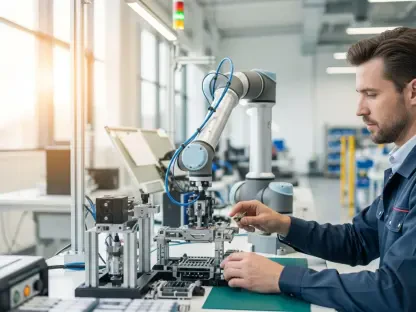
Companies like Teradyne, through its subsidiary Universal Robots, have pioneered no-code solutions that allow non-technical staff to program complex tasks. This shift empowers existing employees to manage sophisticated machinery without needing a degree in robotics. By simplifying the interface between human and machine, organizations can redeploy their current workforce into higher-value roles while automated cobots handle repetitive and strenuous duties.
Regional Disparities and the Geopolitics of Automation
The global rollout of automation is far from uniform, with Asian markets currently holding a massive lead. China alone accounts for approximately 54% of global installations, reinforcing its position as a manufacturing powerhouse. In contrast, Western regions have seen more volatile trends. For instance, the United Kingdom experienced a sharp decline in adoption following the termination of specific tax credit programs, illustrating how policy shifts can impact technological progress.
Geopolitically, the race for automation is creating new industrial hubs. India is witnessing a significant boom in its automotive sector, mirroring the rapid growth seen in Japan and Korea. Meanwhile, parts of Europe face industrial stagnation, highlighting the need for consistent government support to remain competitive. These regional differences suggest that the future of global trade will be heavily influenced by how quickly nations can integrate robots into their core infrastructure.
Human-Centric Design and the 24/7 Autonomous Lifecycle
Innovations in human-centric design are pushing the boundaries of what machines can achieve without human intervention. The UBTECH Walker S2, for example, demonstrates the ability to manage its own maintenance tasks, such as battery swapping, ensuring continuous operation. This level of autonomy is vital for “lights-out” manufacturing, where factories can operate through the night with human staff restricted to high-level oversight and strategic planning.
The strategic acquisition of ABB’s robotics division by SoftBank signals a deeper fusion between AI software and heavy hardware. This convergence allows for more intuitive machines that can adapt to changing environments in real time. Industry experts believe that as hardware becomes more self-sustaining, the role of human labor will continue to shift toward creative problem-solving and system management, effectively ending the era of grueling manual labor.
Strategic Integration: Best Practices for Navigating the Automation Shift
Successful automation requires the implementation of interoperable systems that can scale alongside legacy workflows without causing disruption. Manufacturers should prioritize platforms that allow different machines to communicate seamlessly, ensuring that a robotic arm from one vendor can work in tandem with a conveyor system from another. This cohesion is essential for creating a truly responsive and flexible production floor.
The most effective strategy involves using collaborative robots, or cobots, to augment the existing staff rather than attempting a total replacement overnight. By focusing on low-code platforms, companies can reduce the burden on their IT departments and allow production managers to make adjustments on the fly. This incremental approach builds internal confidence and allows the workforce to adapt to a digital-first environment at a manageable pace.
Solidifying the Foundation of a Post-Labor Industrial Economy
Automation transitioned from a optional competitive advantage to a fundamental requirement for industrial survival. Leaders recognized that the synergy of advanced software and hardware was the only way to stabilize supply chains in an era of demographic decline. By embracing AI-powered systems, factories achieved a level of self-sufficiency that protected them from regional labor shortages and economic volatility.
The trajectory toward fully autonomous manufacturing centers became the standard for global trade operations. Manufacturers that prioritized low-code integration and flexible financial models were the ones that thrived during the workforce crisis. Ultimately, the successful stabilization of the global economy depended on the seamless fusion of human ingenuity and robotic precision, creating a more resilient industrial base for the future.