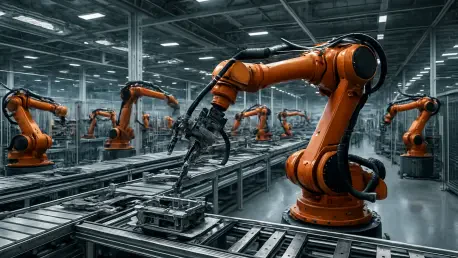

The rapid integration of sophisticated robotics into the global manufacturing landscape has reached an unprecedented scale, driven by the persistent challenge of shrinking labor markets and the rising demand for operational efficiency. In the current industrial environment, automation is no longer viewed as an optional upgrade but as a fundamental necessity for companies aiming to decouple their production volumes from the availability of human personnel. Recent data highlights this shift, showing a significant influx of over 542,000 new robotic installations worldwide as manufacturers race to fill gaps left by an aging workforce and shifting migration patterns. This transition is further accelerated by the emergence of smart manufacturing technologies, which allow firms to leverage artificial intelligence and advanced sensors to optimize workflows. By adopting these systems, facilities are reporting production improvements ranging from 10% to 20%, proving that the marriage of mechanical precision and digital intelligence is the primary driver of industrial growth in 2026.
Regional Dynamics of Industrial Automation
The Asian Dominance: Leading the Global Charge
The center of gravity for industrial robotics remains firmly rooted in Asia, where the region continues to account for approximately 75% of all new global installations. China stands as the undisputed leader in this sector, holding more than half of the total market share and maintaining an operational stock of robots that has recently surpassed the two million unit mark. This aggressive expansion is largely fueled by state-led initiatives and a massive push to modernize the country’s manufacturing base in the face of rising domestic costs. Meanwhile, Japan and South Korea continue to leverage their established robotics ecosystems to maintain high density in automotive and electronic assembly lines. Interestingly, India has emerged as a significant growth engine within the region, with its automotive sector driving a steady increase in robotic adoption. This regional momentum underscores a strategic focus on high-volume production and the rapid scaling of infrastructure to meet international demand through 2027 and beyond.
Western Market Realities: Adapting to Economic Shifts
In contrast to the rapid growth observed across Asia, Western markets have recently encountered a period of adjustment characterized by a slight downturn in robotic installations. European manufacturing centers reported an 8% decrease in new deployments, while the United States, Mexico, and Canada also saw a reduction in activity. This cooling period is largely attributed to the conclusion of specific tax incentive programs and a more cautious approach to capital expenditure amidst fluctuating interest rates and energy costs. However, this dip is widely regarded as a temporary stabilization rather than a long-term decline, as companies shift their focus toward optimizing existing hardware and exploring standardized integration protocols. The emphasis in these regions has moved toward lowering the total cost of ownership through cheaper, high-performance sensors and interoperable software platforms. As economic conditions stabilize, Western manufacturers are expected to pivot toward more specialized, high-margin automation projects to remain competitive.
Technological Evolution and Market Leadership
The Evolution of Collaborative and Precision Systems
Leading manufacturers such as FANUC and Yaskawa are currently redefining the capabilities of heavy-duty assembly through the advancement of mechatronics and high-precision collaborative robots, or cobots. These systems are designed to bridge the gap between human dexterity and machine endurance, allowing for safer and more flexible production environments. Simultaneously, firms like Teradyne are simplifying the user experience by offering low-code or no-code platforms that enable smaller manufacturers to deploy robotics without requiring extensive programming expertise. This democratization of technology ensures that automation is accessible to more than just the industry giants, fostering a more resilient manufacturing ecosystem. Furthermore, the structural landscape of the industry is evolving, as evidenced by significant moves such as ABB’s strategic sale of its robotics division to the SoftBank Group. These shifts indicate a broader trend toward consolidation and the integration of robotics into larger digital service portfolios to provide comprehensive solutions.
Humanoid Robotics and Integrated Execution Systems
The emergence of humanoid robotics represents one of the most significant technological leaps in the current era, with companies like UBTECH leading the way. Their Walker S2 model has demonstrated the ability to autonomously perform complex tasks such as swapping its own batteries, ensuring that production lines can operate 24/7 without human intervention. This move toward humanoid forms is driven by the need for robots that can navigate environments originally designed for people, thereby reducing the cost of facility redesign. Beyond the physical hardware, the integration of robotics with Manufacturing Execution Systems is unlocking an additional 15% in operational capacity by aligning physical workflows with real-time data analytics. This holistic approach allows for predictive maintenance and dynamic scheduling, ensuring that every robotic movement contributes to maximum throughput. As these digital and physical layers continue to merge, the industry is moving toward a highly autonomous future where robotics serve as the backbone of sustainable industrial development.
Strategic Implementation for Future Growth
The transition toward a fully automated industrial framework necessitated a comprehensive reevaluation of how organizations approached their long-term production strategies. Manufacturers that successfully navigated this shift focused on the seamless integration of physical hardware with advanced software analytics to ensure that every robotic unit contributed to overall facility performance. This involved prioritizing the adoption of standardized protocols, which reduced the complexity of managing diverse equipment fleets and lowered the barriers to entry for smaller operational roles. Moving forward, stakeholders should consider investing in low-code platforms and modular robotics to maintain flexibility in a rapidly changing market. By focusing on these scalable solutions, companies ensured they remained resilient against labor shortages and economic fluctuations. The focus turned toward creating a digital thread that connected every stage of the lifecycle, ultimately proving that those who embraced automation early were the best positioned to lead the global manufacturing sector into a new era of productivity.