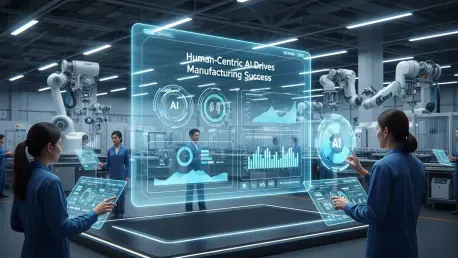

With a deep background in production management and a keen focus on the intersection of electronics, equipment, and predictive technologies, Kwame Zaire has become a leading voice in the strategic application of AI on the factory floor. He champions a human-centric approach, guiding manufacturers through the complexities of digital transformation to enhance quality, safety, and operational resilience. In our conversation, we explored the critical missteps in AI adoption, the practicalities of building a successful human-AI partnership, and the future evolution from predictive to prescriptive maintenance.
Many companies struggle with AI implementation, often because their models lack a comprehensive data picture. What specific risks do businesses face from this incomplete analysis, and can you outline the initial steps for building a unified data strategy across the entire production chain?
The single biggest mistake I see is companies deploying AI in isolated pockets rather than across their entire operation. When your AI model doesn’t have a complete, comprehensive picture of the data, the analysis it produces is fundamentally flawed. It’s not just unhelpful; it’s actively misleading. This inevitably leads to larger complications down the road, forcing leaders to waste precious time and capital trying to figure out why their expensive new AI system isn’t delivering. The initial step isn’t about the algorithm; it’s about strategy. You must begin by looking for solutions that can unify data across the entire production chain, ensuring the AI has a holistic view from start to finish.
To counter the fear of job replacement, leaders are often advised to frame AI as an assistant. Beyond just communication, what practical, day-to-day changes can a maintenance manager implement to demonstrate this partnership? Please share a scenario where AI empowers a technician to be more proactive.
It’s crucial to move beyond just words and demonstrate that AI is a tool, not a replacement. A maintenance manager can practically show this by shifting the team’s entire focus from reactive repairs to proactive strategy. For example, instead of a technician spending their day on routine inspections of perfectly healthy equipment, AI-driven predictive maintenance can flag a specific bearing that shows early signs of wear. The system doesn’t just send an alert; it provides the data. The technician is then empowered to investigate a real issue, schedule a repair during planned downtime, and prevent a catastrophic failure. This transforms their role from a reactive firefighter to a proactive problem-solver, allowing a leaner team to operate with incredible precision and confidence.
The “human-in-the-loop” approach is a central principle for effective AI. How does this model concretely ensure that AI enhances, rather than undermines, the quality of human work? Could you walk us through a real-world example of this principle in action within a manufacturing workflow?
The “human-in-the-loop” approach is the guiding force that keeps technology in service of people. It’s about ensuring AI is a tool used by humans, not on them. This model concretely protects work quality by keeping the final judgment and expertise in human hands, preventing a scenario where employees feel their skills are devalued or are encouraged to produce lower-quality work. Imagine a quality control workflow where an AI vision system flags potential defects on a production line. Instead of automatically discarding the part, the system routes the flagged image and its analysis to an experienced operator. The operator then uses their expertise to make the final call, confirming if it’s a true defect or a false positive. In this way, the AI does the heavy lifting of monitoring, but the human provides the critical thinking and final validation, enhancing their capability without undermining their role.
With so many vendors available, selecting the right AI partner is critical. What key criteria should a manufacturer use to evaluate a potential partner’s ability to support their entire chain, and what are the tell-tale signs of a solution that will not scale sustainably with their operations?
The most essential criterion is whether a potential partner offers tools that can support your entire manufacturing chain, from end to end. Because AI thrives on comprehensive data, having a fragmented system from multiple vendors creates data silos that cripple its effectiveness. You need a partner who can help unify maintenance and operations across every facility. A tell-tale sign of a non-scalable solution is one that requires massive, disruptive infrastructure changes or has a long, complicated learning curve. The right partner makes implementation feel seamless, not like a complete overhaul. If a vendor’s solution only works for one type of machine or one part of the process, it’s a red flag that it won’t grow with you and will become a bottleneck later on.
While predictive maintenance is now common, prescriptive maintenance is emerging as the next step. Can you explain the practical difference between the two and provide a specific example of how a prescriptive recommendation leads to a better ROI than a simple predictive alert?
The difference is about moving from awareness to action. Predictive maintenance tells you what might fail and when. It’s incredibly valuable, but it stops there. Prescriptive maintenance takes it a step further—it tells you why it might fail and precisely what to do about it. For instance, a predictive alert might say, “Motor B has an 80% chance of failing in the next 15 days due to high vibration.” A prescriptive system would say, “Motor B’s vibration indicates a bearing flaw. We recommend replacing bearing part #74B within the next 10 days during the scheduled line changeover to avoid 36 hours of unscheduled downtime, saving an estimated $50,000.” This provides a clear, actionable treatment plan and even projects the outcome, which directly improves ROI by giving teams a data-driven path to make the most efficient and cost-effective decision.
What is your forecast for AI in manufacturing?
AI in manufacturing is really just getting started. If companies implement it correctly, with human collaboration at the core, we will see it become a foundational element of sustainable business practices. The key is to start small, focusing on workflows where AI can act as a support system for employees, and then scale those successes. Rather than a bubble popping, I forecast a steady, impactful integration where AI becomes an indispensable tool for optimizing operations, driving efficiency, and ultimately empowering the human workforce to be more strategic and resilient than ever before.