
The long-held vision of humanoid robots working alongside humans on factory floors is rapidly transitioning from a distant technological ambition into a tangible operational reality. The emergence of these advanced systems marks a significant leap in industrial automation, moving beyond the confines of caged robotic arms to embrace flexible, adaptable solutions designed for human-centric environments. This review explores the technology’s evolution from concept to practical application, using a pivotal proof-of-concept trial as a central case study. It examines the core technological components, validated performance metrics, and the real-world impact on manufacturing, providing a thorough analysis of the technology’s current capabilities and future potential.
An Introduction to Applied Humanoid Robotics
The migration of humanoid robots from controlled laboratory settings into the dynamic, unpredictable environments of industrial facilities is driven by a convergence of technological maturity and pressing industry needs. For years, automation was limited to highly structured tasks, but the maturation of artificial intelligence, sophisticated sensory inputs, and advanced hardware now enables robots to perform complex duties in spaces designed for people. This shift addresses a critical demand for flexible automation solutions that can be integrated into existing workflows without requiring costly infrastructure overhauls.
This technological evolution is powerfully illustrated by the collaboration between Siemens and Humanoid, a UK-based AI and robotics firm. By deploying humanoid robots in a live production environment, this partnership serves as an industry benchmark, showcasing how these systems can tackle modern manufacturing and logistics challenges. The trial moves the conversation from theoretical possibility to demonstrated value, providing a practical blueprint for integrating advanced robotics into the industrial ecosystem.
A Deep Dive into the Technology and Performance
Core Robot Design and Onboard Intelligence
The technical foundation of this successful deployment is the HMND 01 ALPHA BIPEDAL model, a robot engineered for dexterity and autonomous operation. Its design features 29 degrees of freedom, a specification that grants it a range of motion comparable to a human, enabling it to manipulate objects and navigate cluttered spaces with remarkable agility. This mechanical sophistication is complemented by an array of advanced sensors that provide a rich stream of data about its surroundings, which is crucial for safe and effective operation on a busy factory floor.
This sensory data is processed by high-performance NVIDIA hardware, which powers the robot’s onboard intelligence. This combination of advanced mechanics and powerful computation allows the machine to perform complex tasks that require both physical coordination and cognitive decision-making. It can identify and handle different objects, plot efficient paths through dynamic environments, and adapt its actions in real-time, demonstrating a level of autonomy that is essential for practical industrial use.
The Two-Phase Validation Methodology
A structured, two-phase approach was instrumental in ensuring the project’s success and mitigating deployment risks. The initial phase was conducted in-house by Humanoid, where a “physical twin”—a real-world replica of the factory environment—was used for extensive simulation and optimization. This pre-deployment stage allowed for the refinement of the robot’s software and hardware in a controlled setting, ensuring that the system was fully prepared for the complexities of the live production line before it ever left the lab.
The subsequent phase involved a two-week operational trial at the Siemens electronics factory in Erlangen, Germany. This live deployment served as the ultimate validation of the technology’s readiness, testing its performance, reliability, and integration capabilities under real-world conditions. This methodical progression from simulation to live operation represents a best-practice model for integrating novel automation technologies, proving their value and ensuring a seamless transition into existing workflows.
Validated Performance in an Industrial Task
During the operational trial, the humanoid robot’s performance was measured against a set of demanding targets, all of which were successfully met or exceeded. The robot achieved a throughput of 60 tote moves per hour, demonstrating an efficiency level suitable for industrial logistics. It also proved its adaptability by successfully handling two different tote sizes and maintaining continuous autonomous operation for over 30 minutes at a time, a key indicator of its reliability for sustained work cycles.
Furthermore, the system’s precision was validated by pick-and-place success rates that surpassed 90%, both overall and in fully autonomous mode. This high degree of accuracy is critical in manufacturing environments where errors can lead to costly disruptions. These validated metrics confirm that the technology is not only functional but also robust and efficient enough to deliver tangible value in a demanding industrial setting.
Emerging Trends in Real-World Implementation
The Siemens-Humanoid project highlights a critical industry trend: the shift from theoretical research to value-driven, practical proof-of-concept trials. Companies are increasingly moving beyond the laboratory to test advanced robotics in live production environments, focusing on tangible outcomes and a measurable return on investment. This hands-on approach is essential for bridging the gap between technological potential and commercial viability.
Partnerships between technology developers like Humanoid and industry leaders such as Siemens and Schaeffler are accelerating this trend. Such collaborations ensure that robotic solutions are developed to address specific operational needs rather than being engineered in a vacuum. This focus on real-world validation and iterative development is rapidly advancing the commercialization of humanoid robotics, grounding innovation in the practical realities of the modern factory.
Real-World Application: Automating Factory Logistics
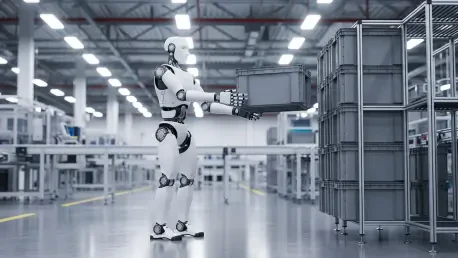
The proof-of-concept trial focused on a specific yet crucial task within the Siemens electronics factory: tote destacking. The robot was responsible for autonomously picking totes from a storage stack, transporting them a short distance, and precisely placing them onto a conveyor belt for the next stage of the production process. This type of task—repetitive, monotonous, and physically undemanding for a machine—is an ideal candidate for automation, freeing human workers to focus on more complex, value-added responsibilities.
A key success of the trial was the robot’s seamless integration into an existing workflow alongside human operators. Its bipedal, human-like form allowed it to navigate the same spaces as its human counterparts without requiring any modification to the factory layout. This ability to fit into environments built for people is a core advantage of humanoid robotics, offering a path to automation that is less disruptive and more flexible than traditional, fixed machinery.
Overcoming Deployment Challenges
Deploying advanced robotics into established industrial settings presents inherent challenges, including ensuring system reliability, achieving smooth integration with existing processes, and proving tangible value to stakeholders. The success of any new automation technology hinges on its ability to overcome these hurdles and demonstrate that it is not only innovative but also practical and beneficial.
The strategic methodology employed in this trial effectively mitigated these risks. The use of a physical twin for pre-deployment simulation allowed for extensive testing and refinement, minimizing the chances of failure in the live environment. Moreover, the phased POC approach provided a structured framework for validating the technology’s readiness, building confidence among stakeholders, and proving its value through demonstrated performance, thereby creating a clear path for broader adoption.
Future Outlook for Humanoids in Industry
The successful trial at Siemens provides a strong indicator of the future trajectory for industrial humanoid robotics. With its viability now proven in a real-world setting, the potential for broader adoption across factory networks is significant. As the technology matures, these robots are expected to take on an expanding range of tasks, particularly those that are hazardous, monotonous, or ergonomically challenging for human workers.
The long-term impact of this technology extends beyond mere task replacement; it centers on augmenting human capabilities. By delegating repetitive and physically strenuous duties to robots, companies can improve workplace safety, reduce the risk of injury, and reallocate human talent to roles that require creativity, critical thinking, and complex problem-solving. This collaborative model, where humans and robots work in tandem, promises a new era of enhanced productivity and operational efficiency.
Conclusion: A New Era of Industrial Automation
The collaboration between Siemens and Humanoid has confirmed that industrial humanoid robotics is no longer a concept confined to the future. The trial’s success in a live manufacturing environment demonstrated that these machines are a practical solution capable of delivering measurable value today. The meticulous two-phase validation process, culminating in the achievement of demanding performance metrics, proved the technology’s reliability, adaptability, and readiness for real-world industrial tasks. This milestone signifies a pivotal shift, establishing humanoid robots as a viable and valuable component in the ongoing evolution of industrial automation.