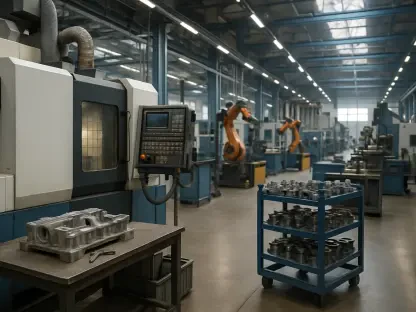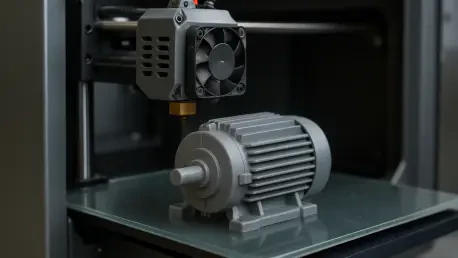

The traditional industrial paradigm has long relied on specialized assembly lines and global logistics to produce the electromagnetic components that power modern technology, yet this centralized model is increasingly vulnerable to delays and high overhead costs. Engineers at the Massachusetts Institute of Technology have recently challenged this status quo by unveiling a multimaterial additive manufacturing platform capable of printing entire electric machines in a single, streamlined process. This breakthrough represents a fundamental shift in how complex hardware is conceived and constructed, moving away from the labor-intensive assembly of discrete parts toward a cohesive, integrated fabrication method. By combining structural, conductive, and magnetic materials into a single print job, the team has demonstrated that the intricate internal geometries of a motor can be realized without the need for manual winding or external housing assembly. This shift toward consolidated manufacturing suggests a future where the distance between a digital design and a physical, working device is measured in hours rather than weeks or months of industrial lead time.
Multi-Material Extrusion and Precision Control
At the core of this technological leap is a sophisticated extrusion-based system that utilizes four independent tools to deposit a variety of functional materials with extreme precision. The printer must handle the unique rheological properties of electrically conductive filaments alongside hard magnetic substances, ensuring that each material retains its specific physical characteristics during the deposition process. A primary engineering challenge in such a system is the seamless transition between materials, as any misalignment or contamination between layers could compromise the motor’s electromagnetic performance. To solve this, the researchers developed a custom control framework integrated with high-resolution sensors that allow the robotic gantry to swap nozzles with micron-level accuracy. This level of mechanical precision ensures that the conductive pathways and magnetic cores are perfectly aligned within the structural matrix, maintaining the functional integrity necessary for high-efficiency operation.
Beyond the mechanical hardware, the software governing the toolpaths plays a critical role in managing the complex transitions required for multimaterial builds. Traditional 3D printing often struggles with the interface between disparate materials, but this new platform utilizes an advanced feedback loop to calibrate the flow rate and pressure for each specific filament type in real time. This adaptability allows the system to print complex internal architectures, such as helical coils and custom flux barriers, which would be nearly impossible to manufacture using conventional stamping or casting techniques. By optimizing the interaction between the conductive copper-analog filaments and the magnetic composite layers, the system produces a component that is functionally ready for use almost immediately after leaving the build plate. This level of automation reduces the reliance on skilled manual labor for tasks like motor winding, which has traditionally been one of the most time-consuming steps in the production of electric machines.
Accelerating Production and Supply Chain Resilience
The practical implications of this technology were recently demonstrated when the engineering team fabricated a fully functional linear motor in just three hours, a timeline that is unheard of in traditional manufacturing. This process requires only a single post-processing step, involving the magnetization of the printed material, to transform the raw structure into a working electromagnetic device. Benchmarking tests have indicated that these printed motors possess performance characteristics that rival, and in some instances exceed, those of components produced via traditional industrial methods. This efficiency is not merely a matter of speed; it represents a drastic reduction in the energy and resources required to bring a product to market. By eliminating the need for complex tooling and specialized molds, manufacturers can prototype and iterate on designs at a fraction of the cost, allowing for rapid experimentation that was previously prohibited by the high price of custom fabrication.
Building on this operational efficiency, the technology offers a robust solution to the persistent vulnerabilities of global supply chains and the high costs of industrial downtime. In contemporary factory environments, a single motor failure in a critical piece of equipment can stop production for extended periods while a replacement is sourced from a distant supplier. An onsite additive manufacturing platform allows a facility to print a custom, exact-specification replacement part the moment it is needed, effectively bypassing the logistical hurdles of shipping and inventory management. This capability for on-demand production transforms the concept of spare parts from a physical stock to a digital library, where designs can be updated and printed locally. Such a shift significantly lowers the carbon footprint associated with industrial logistics and empowers companies to maintain higher levels of operational continuity by localizing their manufacturing capabilities directly at the point of need.
Future Developments in Autonomous Fabrication
As the technology continues to mature, the next phase of research focuses on integrating the magnetization process directly into the printing cycle to create a truly one-step manufacturing solution. Currently, the magnetic materials require an external field to become active after the print is finished, but future iterations of the platform aim to utilize localized electromagnetic pulses during deposition to align the magnetic domains in real time. This advancement would further reduce the complexity of the manufacturing chain and allow for the creation of more intricate magnetic geometries that are not feasible with post-print magnetization. Furthermore, expanding the material library to include high-temperature superconductors and advanced thermal management polymers will enable the fabrication of high-performance rotary motors suitable for aerospace and heavy industry. These developments are poised to push additive manufacturing beyond simple prototyping into the realm of high-stakes, end-use hardware production.
To fully realize the potential of on-demand motor manufacturing, organizations should begin by auditing their existing supply chains for high-risk, long-lead-time components that could be transitioned to a digital inventory model. Investing in the development of standardized digital twins for electromagnetic hardware will be a critical step for companies looking to adopt these additive platforms, as it ensures that printed parts meet rigorous performance benchmarks. Furthermore, collaboration between material scientists and electrical engineers will be necessary to refine the conductivity and magnetic density of 3D-printable filaments. As these systems become more autonomous and capable of handling a wider range of materials, the focus will shift from “how” a motor is built to “where” it is built, favoring decentralized hubs that prioritize flexibility and rapid response. Adopting this technology now will provide a competitive advantage by shortening innovation cycles and insulating operations against future disruptions in the global manufacturing landscape.