
Amid a persistent shortage of skilled labor that challenges the industrial backbone of Germany, agricultural machinery and commercial vehicle manufacturer Krone Group is pioneering a forward-thinking strategy that redefines the relationship between humans and machines on the factory floor. Rather than viewing automation as a tool for outright replacement, the company has embarked on a large-scale integration of advanced robotics to augment its existing workforce, enhancing productivity, improving workplace safety, and securing its long-term manufacturing viability within the country. This strategic pivot addresses immediate operational needs while simultaneously creating a more attractive and sustainable manufacturing environment for the next generation of workers. By transforming both its legacy and state-of-the-art facilities, Krone is demonstrating how collaborative robotics can be the key to overcoming demographic headwinds and elevating human capital to more complex and value-adding roles, proving that the future of industry lies not in a battle between people and robots, but in their sophisticated and synergistic partnership.
Modernizing Legacy and Smart Factories
Revitalizing the Werlte Plant
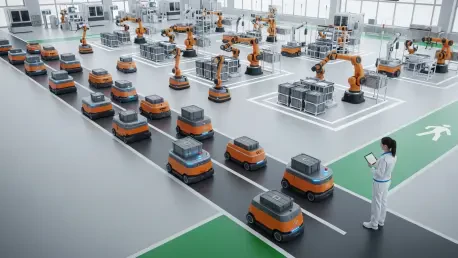
At its long-established truck trailer production plant in Werlte, Krone initiated a comprehensive modernization aimed at streamlining intralogistics and eliminating physically strenuous tasks. A key achievement has been the near-total removal of forklifts from the production floor, a move that significantly enhances safety and operational efficiency. This transformation was made possible by the deployment of a fleet of KMP 1500P autonomous mobile robots (AMRs). These intelligent vehicles navigate the facility independently, delivering necessary parts and supplies directly to designated welding cells with precision timing. The AMRs are part of a larger, digitally networked ecosystem that includes six-axis robots responsible for material handling and complex welding operations. This integrated system ensures a continuous and optimized flow of materials, relieving human employees of repetitive transport duties and the physically demanding work of heavy lifting. The result is a production environment where workers can focus on oversight, quality control, and other higher-skill functions, supported by a robotic infrastructure that handles the monotonous and laborious aspects of the manufacturing process, thereby increasing overall plant throughput.
The Ibbenbüren Smart Factory Blueprint
The company’s vision for a fully integrated production environment is most clearly realized at its newer smart factory in Ibbenbüren, a facility designed from the ground up for digital connectivity. Here, every machine, sensor, transport vehicle, and robot operates within a single, cohesive network, creating an intelligent system capable of real-time communication and autonomous decision-making. This digital backbone allows the factory to adapt instantly to production fluctuations or potential disruptions, re-routing materials or adjusting machine parameters to maintain optimal performance. A single production cell serves as a microcosm of this advanced philosophy, where nine KUKA robots work in perfect synchrony with multiple machining centers and an automated measuring cell. This high degree of automation has virtually eliminated unplanned downtime and provides the flexibility to scale production up or down with remarkable agility. The seamless coordination between robotic arms, processing units, and quality assurance systems represents a significant leap forward in manufacturing, enabling a level of precision and efficiency that would be unattainable through conventional methods alone.
Furthering the smart factory’s capabilities, the transport of large and heavy assemblies is managed by a fleet of KMP 3000P heavy-duty AMRs. These robust platforms, capable of moving payloads of up to three tons, are essential for maintaining the dynamic flow of production in a facility that manufactures large-scale agricultural machinery. Unlike fixed conveyor systems, these AMRs provide unparalleled flexibility, able to navigate complex routes and deliver massive components to various assembly stations as needed. Their integration into the factory’s central control system ensures that transport logistics are perfectly aligned with the real-time demands of the production schedule. This ability to autonomously manage the movement of substantial components not only frees human workers from dangerous and physically taxing roles but also optimizes the use of floor space and reduces the risk of bottlenecks. The successful deployment of these heavy-duty robots underscores Krone’s commitment to leveraging automation for every facet of the production process, from intricate welding to large-scale material handling.
A Strategic Shift in Workforce Dynamics
Overcoming the Skilled Labor Scarcity
The comprehensive push toward automation at Krone is fundamentally a strategic response to one of the most pressing challenges facing German industry: a shrinking pool of skilled labor. Volker Perk, the company’s production director, has emphasized that robotics are not a luxury but a necessity for sustaining manufacturing operations and remaining competitive on a global scale. By automating repetitive, predictable, and physically demanding tasks, the company can effectively bridge the labor gap without compromising on output or quality. This approach allows Krone to reallocate its most valuable resource—its human employees—to roles that demand creativity, problem-solving, and intricate decision-making. Workers who were once occupied with manual transport or welding are now being upskilled to supervise robotic cells, perform complex quality assurance checks, and manage the sophisticated digital systems that underpin the modern factory. This strategic reassignment not only maximizes the potential of each employee but also enriches their job roles, fostering a more engaged and highly skilled workforce.
Cultivating the Next Generation of Manufacturing Talent
Beyond addressing immediate labor needs, Krone’s investment in robotics and smart factory technology serves as a powerful tool for attracting and retaining new talent. The modernization of its facilities has transformed the traditional image of manufacturing, replacing it with a vision of a high-tech, innovative, and safe work environment. The significant improvements in workplace ergonomics, achieved by eliminating heavy lifting and repetitive strain, make careers in manufacturing more sustainable and appealing. For younger generations who have grown up with digital technology, a factory floor populated by collaborating robots and managed through sophisticated software is a far more compelling prospect than a conventional industrial setting. By positioning itself at the forefront of Industry 4.0, Krone is not only future-proofing its production capabilities but also building a corporate culture that values technological advancement and employee well-being. This, in turn, helps secure a pipeline of talent eager to contribute to the next chapter of advanced manufacturing.
A Blueprint for Industrial Symbiosis
Krone’s strategic integration of robotics served as a definitive answer to the escalating skilled labor crisis. The company successfully established a symbiotic operational model where human intellect and machine efficiency worked in concert, securing its manufacturing base in Germany for the foreseeable future. This initiative did more than just enhance productivity; it fundamentally redefined the value and nature of human work within an automated landscape. By reassigning employees to more complex and fulfilling roles, the company not only improved its operational resilience but also created a more engaging and safer work environment. This transformation provided a compelling blueprint for other industrial firms, demonstrating that augmenting, rather than replacing, the human workforce with robotic technology was a viable and powerful strategy for navigating the challenges of the modern economy.