
The challenge of rapidly deploying essential infrastructure in resource-scarce environments, such as disaster zones or extraterrestrial settlements, has long been a significant barrier to effective response and exploration. A team of researchers at the Massachusetts Institute of Technology has introduced a groundbreaking method that transforms this complex logistical problem into a remarkably simple action. Their system enables the on-site fabrication of intricate three-dimensional objects, from medical equipment to full-scale shelters, which can be assembled from a flat, two-dimensional state with the mere pull of a single string. This innovative approach, detailed in the paper “One String to Pull Them All: Fast Assembly of Curved Structures from Flat Auxetic Linkages,” represents a paradigm shift in deployable design, offering a powerful tool for providing critical equipment exactly when and where it is needed most, bridging the gap between urgent demand and the practical constraints of transportation and assembly.
The Kirigami-Inspired Mechanism
From Flat Patterns to 3D Forms
The foundational principle of this technology draws its inspiration not from the simple folding art of origami, but from the more versatile practice of kirigami, which incorporates both cutting and joining. This allows for the creation of unique materials known as “auxetic” structures, which exhibit the counter-intuitive property of expanding laterally when stretched. The researchers have engineered these structures into what they call “kirigamoids,” which consist of a network of small, interconnected rigid tiles linked at their corners by flexible hinges. This intricate arrangement allows a completely flat sheet to morph into a complex, pre-programmed three-dimensional shape. The entire transformation is orchestrated by a single, continuous cable that is carefully woven through the network of tiles. A gentle tug on this cable provides the necessary tensile force to pull the tiles into their final positions, effectively “inflating” the flat pattern into a stable, functional, and load-bearing structure. This method allows for a level of geometric complexity that was previously unattainable with conventional pop-up or folding designs.
Automated Design with a Powerful Algorithm
What truly elevates this research beyond previous efforts in deployable structures is the development of a sophisticated and robust algorithm that fully automates the design pipeline. This computational tool makes the technology exceptionally accessible and user-friendly, removing barriers that once required deep expertise in mechanical engineering and geometry. A user simply provides a standard digital 3D model of the desired object, whether it’s a piece of furniture, a robot chassis, or a protective helmet. The algorithm then performs all the complex calculations required to translate that three-dimensional form into a flat, manufacturable pattern of auxetic tiles and flexible hinges. Crucially, the software also intelligently determines the most efficient path for the actuating string, calculating the minimal number of anchor points and the shortest, lowest-friction route to guarantee a smooth, reliable, and complete deployment. This automated process democratizes the creation of complex deployable systems, which had previously been limited to simpler geometric forms.
Advantages and Real-World Potential
Reusable, Reversible, and Accessible
The new methodology presents several significant practical advantages over existing deployable technologies, primarily centered on its sustainability and adaptability. A key benefit is the complete reversibility of the deployment process. Unlike many pop-up structures that, once assembled, are difficult or impossible to collapse without damage, these kirigamoids can be easily “popped-down” back into their compact, flat state. This feature is invaluable for applications where storage space is at a premium and resources are scarce, as it facilitates easy transportation, low-cost storage, and repeated use, thereby minimizing material waste and overall cost. Furthermore, the system demonstrates remarkable compatibility with a wide array of common fabrication techniques. The flat tile patterns can be produced using standard methods like 3D printing, plastic molding, or computer numerical control (CNC) milling of materials such as wood or metal composites. While a multi-material 3D printer is ideal for creating the integrated rigid tiles and flexible hinges in a single pass, the inherent flexibility of the design makes it highly accessible for diverse manufacturing environments.
Scalable Applications from Helmets to Habitats
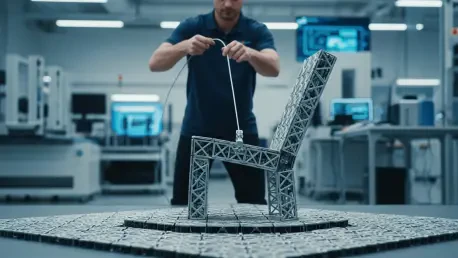
The potential applications for this technology are exceptionally broad and scalable, spanning from everyday consumer products to massive infrastructure for extreme environments. In disaster relief scenarios, medical personnel could rapidly 3D-print and deploy custom-fit splints for injuries directly on-site. For urban commuters, the inconvenience of a bulky bicycle helmet is elegantly solved by a version that can be folded flat and stowed in a backpack. The research team has already demonstrated the system’s viability by creating a functional, human-scale chair that a single person can assemble and disassemble in moments. In the field of robotics, the technology can be used to create foldable bodyshells for drones or rovers that must be transported compactly before deployment. Looking toward more ambitious futures, the applications scale up to human shelters like igloos and even massive architectural structures for bases on Mars, which would require a construction crane to actuate the deployment cable. At the opposite end of the spectrum, the technology could be miniaturized to create injectable medical devices that deploy safely within the human body.
Pathways to Automated Deployment
The research team, which included Jacqueline Aslarus, Jiaji Li, Associate Professor Stefanie Mueller, and Assistant Professor Mina Konaković Luković, had set out to refine the system for even greater utility. Their future work was planned to involve extensive experimentation with optimal hinge strengths and varying cable thicknesses to tailor the structures for specific applications and scales. A primary long-term objective that was established was the development of self-inflating kirigamoids. This advancement was envisioned to eliminate the need for any manual or robotic pulling of the actuating string, thereby enabling fully automated and instantaneous deployment in environments that are dangerous, remote, or otherwise inconvenient for human intervention. This forward-thinking trajectory promised a future where complex, life-saving, and essential structures could be stored in a highly compact form and deployed instantly, fundamentally changing how humanity prepared for and responded to the most demanding situations on Earth and in the cosmos.