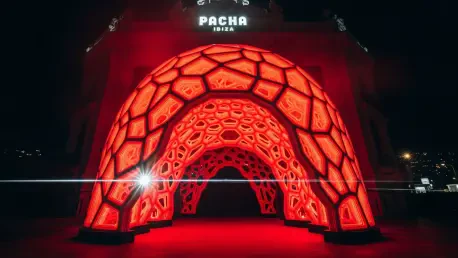

In the fiercely competitive world of Ibiza nightlife, where innovation is the currency of relevance, the world-renowned Pacha nightclub is making a bold architectural statement by blending its historic charm with futuristic technology. The iconic venue has unveiled a series of large-scale, 3D printed facades for its entrance, a groundbreaking project that represents a powerful convergence of branding, advanced manufacturing, and architectural design. This venture, timed for the 2025 summer season, introduces three distinct, interchangeable polymer exteriors that allow the club to dynamically transform its appearance, showcasing a novel and visually stunning application for additive manufacturing within the high-stakes entertainment industry. The first design, a pristine white structure titled “Wave White,” has already been installed, heralding a new, adaptable era for the celebrated institution.
A New Face for an Iconic Brand
For a globally recognized institution founded in 1973, the primary challenge lies in evolving to captivate a modern audience without sacrificing the cherished, “finca-like” identity that has defined it for decades. This project offers a brilliant solution by focusing on the building’s exterior. Rather than undertaking drastic and potentially alienating changes to the famous interior or DJ booth, the implementation of interchangeable facades provides a low-risk, high-impact strategy to keep the brand fresh and exciting. This adaptability serves as a powerful marketing tool in the cutthroat Ibiza scene, enabling the club to tailor its visual identity for specific events, such as its legendary “Flower Power” parties, or to align with the unique brand of a resident DJ. The result is a constantly evolving visual experience that creates a compelling spectacle for passersby, reinforcing Pacha’s image as a cutting-edge venue.
Beyond the initial spectacle, the project’s success hinged on practical design considerations meticulously tailored to the facade’s intended use throughout a busy season. The engineering team designed the hundreds of individual components for frequent and straightforward assembly and disassembly. Consequently, the key criteria included making the elements lightweight for ease of handling, modular for simple and secure mounting, and durable enough to withstand repeated use and exposure to the elements. Storability and ease of transport between installations were also paramount to ensure operational efficiency. To provide compelling visual variety, three distinct facade sets were created. In addition to the inaugural “Wave White” facade made from PLA, the club now possesses two other sets fabricated from transparent PET-G, one in a vibrant red and the other in a striking blue, ensuring both structural integrity and a stunning, ever-changing aesthetic.
The Technology and Business Model Driving Innovation
This ambitious venture was a multi-faceted collaboration between Pacha’s in-house creative team, Gola Studio, and the pioneering Italian 3D printing company WASP. In a crucial shift from its traditional role, WASP operated not just as a technology developer but as a “systems integrator,” a term describing an organization that manages the entire project lifecycle, from initial design support and engineering to final fabrication and execution. This comprehensive, end-to-end service model is proving vital for the additive manufacturing sector, as it significantly de-risks the adoption of complex technologies for clients like Pacha. By providing a holistic solution, such integrators make advanced manufacturing more accessible and practical for companies that may lack the specialized in-house expertise to manage such a technologically intensive undertaking, thereby accelerating project timelines and ensuring successful outcomes.
The intricate project was brought to life through WASP’s unique business structure, which leverages a global network of “WASP Hubs.” The Pacha project was specifically executed by WASP Hub Mantova in Lombardy, Italy, which is operated by a highly capable partner company named Arche. Possessing a formidable arsenal of 3D printing technologies—ranging from desktop extrusion and SLA to syringe extrusion for pastes, large-format delta systems, and robotic arm-mounted extruders—Arche was perfectly equipped for the task. The firm’s prior experience on high-profile, architectural-scale projects, including a notable collaboration with luxury brand Dior, had already established it as a reliable entity for delivering marquee projects with demanding aesthetic and structural requirements. This partnership underscores the power of a distributed yet integrated network in executing complex, large-scale additive manufacturing jobs with precision and expertise.
The Advanced Manufacturing Process in Detail
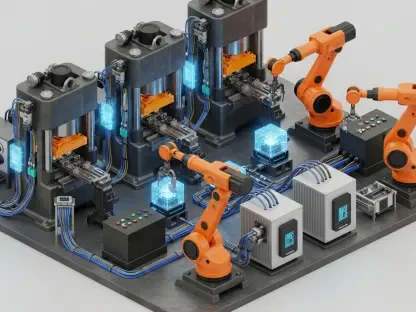
The technical execution and fabrication of the hundreds of individual facade elements relied on two key systems from WASP’s advanced portfolio: the WASP 3MT HDP printer and the CEREBRO robotics kit. The WASP 3MT HDP is a formidable large-scale delta printer, an imposing 350 kg machine boasting a substantial build volume of 1000 x 1000 mm. Its standout feature is the innovative FIRECAP SYSTEM, a mobile mini-chamber that selectively heats the area immediately around the extrusion point to 150°C. This targeted heating method is significantly more energy-efficient than heating an entire build chamber and, more critically, it expands the range of usable materials. It enables the successful printing of advanced polymers that might otherwise warp or fail in an open-air system, including more sustainable and cost-effective unfilled materials, which aligns with WASP’s core mission to develop 3D printing solutions for sustainable housing.
Complementing the large-scale delta printer was the CEREBRO system, a highly versatile control unit that allows various WASP extruder heads to be seamlessly mounted onto a standard KUKA robotic arm. For the Pacha project, a WASPExtruder HDP XL was integrated, providing an even larger and more flexible manufacturing platform that transcended the geometric constraints of a traditional gantry-based system. This hybrid manufacturing approach, which skillfully combined the speed and precision of a large delta printer with the reach and versatility of a robotic arm, demonstrated a sophisticated and remarkably adaptable production workflow. This powerful combination proved capable of handling the immense scale and intricate complexity of the architectural components, ensuring each piece was fabricated to exact specifications while optimizing the production timeline for the entire project.
A Landmark Achievement and Future Outlook
The 3D printed facades at Pacha Ibiza stood as a landmark project that effectively demonstrated the application of large-format additive manufacturing in the realms of architecture and branding. The primary finding was that this technology offered a viable and highly effective solution for creating temporary, customizable, and visually impactful architectural elements on a grand scale. The project successfully showed how a historic brand could leverage modern technology to innovate its public image without compromising its core identity. Furthermore, it highlighted the crucial importance of a new business model for the 3D printing industry: the systems integrator, a partner that provides a holistic service that lowers the barrier to entry for clients. The technical capabilities showcased by WASP and Arche pointed toward a future where sustainable, recycled, and cost-effective materials could become more commonplace in large-scale printing. This achievement has likely inspired a new wave of interest in 3D printed temporary structures for a variety of commercial uses, including retail pop-ups, event marketing, and other seasonal installations.