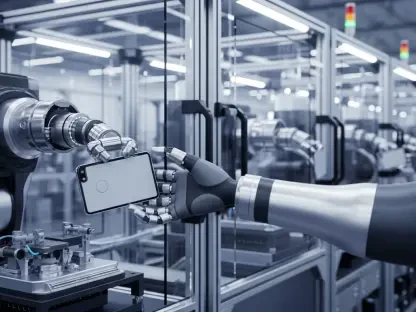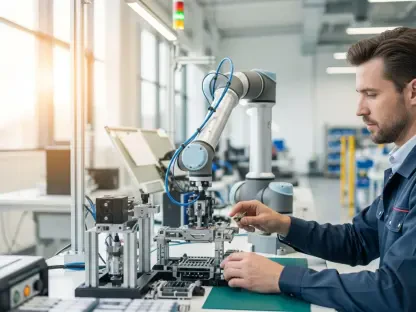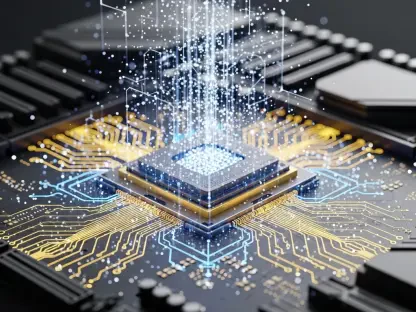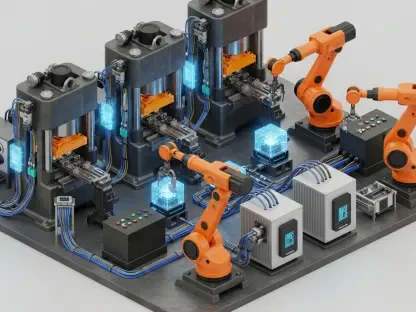

The long-imagined future where intelligent robots work alongside humans in dynamic, unstructured environments is no longer a concept confined to research labs and science fiction, as it has become a tangible and rapidly expanding commercial reality. A new technological paradigm known as Physical AI is driving this transformation, marking a profound departure from the rigid, pre-programmed automation that has defined industrial machinery for decades. This evolution involves the deep integration of advanced artificial intelligence models into physical systems, endowing machines with the ability to perceive their surroundings, reason about complex situations, and adapt their actions in real time. This capability is not just a theoretical improvement; it is actively generating revenue and reshaping industries. In logistics centers, bipedal humanoid robots now handle packages for e-commerce orders, while in advanced manufacturing plants, similar machines are inserting components into vehicle chassis, demonstrating significant gains in speed and efficiency. This shift extends far beyond the factory floor, with applications emerging in autonomous transportation, smart infrastructure, and intelligent agriculture. As Tye Brady, Chief Technologist for Amazon Robotics, aptly stated, the industry has become proficient at building the robotic “body,” and the current focus is on “bringing the mind to the body through generative AI,” unlocking a new frontier of smart machine capabilities.
The Economic Engine Capital and Confidence Converge
Reaching the Inflection Point
A strong consensus among industry leaders and analysts is that Physical AI has reached a crucial “critical inflection point,” a moment where technological maturity has finally converged with significant and demonstrable market demand. According to James Davidson, Chief Artificial Intelligence Officer at Teradyne Robotics, this represents a fundamental shift in the industry’s lifecycle. The long phase of widespread skepticism, where the potential of intelligent robotics was often questioned, has given way to a period of tangible proof. Early adopters are no longer just experimenting; they are reporting concrete efficiency improvements, cost savings, and revenue gains directly attributable to their Physical AI deployments. This wave of successful case studies has served as a powerful catalyst, propelling the market out of the early adopter phase and into what Davidson characterizes as the “early-majority phase of adoption.” This new stage is defined by a dramatic and accelerating scaling of investment and implementation as businesses across a spectrum of industries recognize the competitive necessity of integrating these intelligent systems into their operations. The conversation has moved from “if” to “how fast,” as companies race to leverage the capabilities of a technology that has proven its value in the real world.
The transition to this early-majority phase signifies more than just increased adoption; it reflects a foundational change in business strategy and operational philosophy. Where traditional automation was seen as a tool for optimizing repetitive, predictable tasks in controlled environments, Physical AI is viewed as a solution for tackling variability and complexity, which are inherent in most real-world operations. This has opened up automation possibilities in sectors previously considered too dynamic or unpredictable for machines, such as last-mile delivery, complex assembly, and personalized healthcare. The success of initial deployments has created a feedback loop: proven results attract more investment, which in turn fuels further research and development, leading to even more capable and reliable systems. This virtuous cycle is rapidly lowering barriers to entry, making sophisticated robotics accessible to a wider range of companies. The market is now characterized by a palpable sense of urgency, as the strategic advantage gained by early movers becomes increasingly clear, forcing competitors to either adopt the new technology or risk being left behind in a new era of intelligent industrial operations.
The Venture Capital Gold Rush
The technological momentum behind Physical AI is being supercharged by an unprecedented flood of investment capital, signaling immense confidence from the financial community. A recent analysis from Mind The Bridge reveals a near-total pivot in Silicon Valley’s investment thesis, with an astonishing 93% of all venture capital now flowing into startups and companies centered on artificial intelligence. This overwhelming focus underscores the belief that AI, and particularly its physical manifestation, represents the next major wave of technological and economic disruption. The financial landscape is being reshaped by this gold rush, with venture capitalists and corporate investors alike placing massive bets on the companies building the hardware and software for this new generation of smart machines. The scale of this investment is not incremental; it is transformative, providing the fuel needed to move groundbreaking technologies from prototype to mass production and widespread commercial deployment in a remarkably short period.
This trend is vividly illustrated by a series of massive funding rounds that have made headlines. In 2024 alone, companies specializing in Physical AI attracted over $7.5 billion in funding, a figure that highlights the sector’s explosive growth. This included mega-rounds for pioneers like the Jeff Bezos-backed Physical Intelligence, which raised $400 million, and Figure AI Inc., which secured a formidable $675 million. The momentum has only intensified since, with Figure AI raising an additional $1 billion in 2025 and Physical Intelligence securing another $600 million. Perhaps most indicative of the scale of ambition is Project Prometheus, a venture co-led by Jeff Bezos with the goal of developing “AI for the physical economy,” which raised a colossal $6.2 billion. Financial research firm Crunchbase further confirmed this sustained growth, reporting that over $6 billion in capital had already flowed into robotics companies in the first seven months of 2025, a pace projected to easily eclipse the record-breaking levels of the previous year. This massive influx of capital is not just funding research; it is building the infrastructure, supply chains, and talent pools necessary for a full-scale industrial revolution.
The Core Technology Building the Minds for Machines
Foundation Models for Robotics
At the heart of this technological revolution lies a new class of artificial intelligence known as Robotics Foundation Models (RFMs). These sophisticated AI software systems serve as the “brains” that power intelligent robots and machines, enabling them to move beyond rigid programming. Built upon powerful Vision-Language-Action (VLA) models, RFMs can ingest and interpret a rich stream of multimodal sensory information—including video feeds, audio cues, and tactile data—and use advanced reasoning to determine and execute a sequence of physical actions. Prominent examples of these models include Physical Intelligence’s general-purpose π0 model and Nvidia Corp.’s GR00T, a universal foundation model designed specifically for humanoid robots. These RFMs represent a paradigm shift because they are not trained for a single, specific task but are designed to be general-purpose, capable of learning and adapting to a wide range of activities and environments.
The core technical innovation that makes RFMs possible is the VLA model architecture. These models are trained on immense and diverse datasets that contain not just images and text, but also the corresponding robotic actions performed in response to them. This tripartite training data allows the model to build a deep, contextual understanding that links language commands and visual perception directly to physical manipulation. Google DeepMind’s Robotics Transformer 2 (RT-2), developed in 2023, is widely considered the paradigm-setting VLA. Its capabilities illustrate the monumental leap from old automation to true Physical AI. For example, a user can issue a natural language command like, “Please pick up the trash and throw it away.” A robot powered by a VLA model can understand this abstract prompt, visually identify objects it classifies as “trash” within its environment, determine the precise motor controls required to grasp them, locate a suitable receptacle like a trash can, and execute the entire disposal task. Crucially, it accomplishes this without ever having been explicitly programmed for that specific sequence of actions, demonstrating an ability to generalize its knowledge to perform novel, complex tasks.
Simulating Reality with World Foundation Models
A new, highly specialized class of AI has emerged to train and validate the increasingly complex foundation models for robotics. Known as World Foundation Models (WFMs), these systems serve two critical functions that are essential for accelerating the development and deployment of Physical AI. First, they enable the rapid generation of vast quantities of synthetic, physics-accurate data. This addresses one of the biggest bottlenecks in robotics: the immense cost, danger, and time required for real-world data collection. By using WFMs, developers can train robots on millions of diverse and challenging scenarios within a simulation, exposing them to a breadth of experience that would be impractical, if not impossible, to gather in the physical world. This massive-scale simulated training is crucial for building robust and reliable systems that can handle the unpredictability of real-world environments.
The second critical function of WFMs is the creation of highly realistic virtual environments, often referred to as “digital twins.” These sophisticated simulations serve as safe and controlled sandboxes where robotic systems can be rigorously tested, validated, and refined before they are ever deployed in a physical setting. This process is vital for addressing the “sim-to-real” challenge—the subtle yet critical discrepancies that often exist between a simulation and physical reality. Companies like Waabi Innovation Inc. have leveraged this approach for autonomous trucks, with its Waabi World platform achieving an incredible 99.7% simulation realism. Key examples of these powerful platforms include Nvidia’s Cosmos and Google DeepMind’s Genie 3. The strategic importance of this technology is so profound that AI pioneer Yann LeCun recently decided to found a startup focused exclusively on WFMs, believing they will advance AI more significantly than language models alone. Furthermore, the application of WFMs is expanding beyond traditional robotics, as seen with Archetype AI Inc.’s Newton model, which creates digital twins of any real-world environment to optimize systems like IoT networks, smart buildings, and intelligent city infrastructure.
Physical AI in Action From Warehouses to Highways
Transforming Modern Industry
While humanoid robots often capture the public imagination and media headlines, the current workhorses driving the Physical AI revolution in industry are collaborative robots, specialized robotic arms, and autonomous mobile robots (AMRs). These systems are already deployed at a massive scale and are delivering substantial economic value today. Amazon.com Inc. stands as the foremost example of this trend, having integrated over 750,000 robots into its vast network of warehouses. These machines range from systems like Vulcan, a robotic arm equipped with a sense of touch for delicate handling, to Proteus, an AMR designed to safely navigate and move carts through facilities shared with human workers. The impact of this large-scale automation is significant, with Morgan Stanley analysts projecting that these robotics initiatives could save the e-commerce giant up to $10 billion annually by 2030 through enhanced efficiency and productivity.
The broader market for AI in robotics is experiencing a period of explosive growth, reflecting the widespread adoption of these technologies across various sectors. According to projections by Grand View Research, the market is set to expand from $12.8 billion in 2023 to an astonishing $124.8 billion by 2030. Currently, industrial robots used in manufacturing and logistics dominate the market share, as these sectors were early to recognize and capitalize on the benefits of intelligent automation. However, the report also identifies the medical and healthcare sector as the fastest-growing segment. In this field, Physical AI is poised to revolutionize everything from robotic surgery and patient care to laboratory automation and diagnostics, promising improvements in precision, safety, and accessibility. This diversification of applications indicates that Physical AI is becoming a foundational technology with the potential to transform the operational landscape of nearly every major industry.
The Autonomous Revolution
The autonomous vehicle sector is another major beneficiary of the rapid advancements in Physical AI, with breakthroughs in perception, prediction, and decision-making enabling a new generation of self-driving systems. In the commercial trucking space, companies are on the verge of deploying fully driverless trucks on public roads, a milestone that promises to reshape the logistics industry. Waabi is planning to launch its first driverless routes by the end of this year, while competitors like Aurora Innovation Inc. and Torc Robotics Inc. are already running extensive commercial pilots, hauling freight for major clients such as FedEx and Uber Freight. The economic case for this technology is incredibly compelling. A report from McKinsey & Co. projects that the market for autonomous trucks could reach $600 billion by 2035, driven by massive cost savings in labor and fuel, as well as dramatic improvements in asset utilization. As Raquel Urtasun of Waabi notes, an autonomous truck can operate nearly 24 hours a day, a stark contrast to the 6.5-hour average driving time of a human driver constrained by service regulations.
This revolution is not limited to commercial freight. In the passenger vehicle market, powerful AI platforms are accelerating the development and adoption of advanced driver-assistance systems and fully autonomous capabilities. Nvidia’s Drive Thor platform, a centralized computer designed for autonomous vehicles, is set to become a key enabler of this trend. Major global automakers, including Mercedes-Benz and Volvo, have already announced that they will be adopting this platform for their 2025 production vehicles. The integration of such powerful AI hardware and software directly into consumer cars will bring sophisticated perception and reasoning capabilities to a mass market, paving the way for safer roads and a gradual transition toward fully autonomous mobility. This widespread adoption across both commercial and consumer segments signals that the era of autonomous transportation, powered by Physical AI, is rapidly moving from a distant vision to an everyday reality.
Navigating the Road Ahead Challenges and Opportunities
A Dose of Reality
Despite the rapid progress and palpable excitement surrounding Physical AI, industry veterans offer a balanced and sobering perspective, acknowledging the significant gap that still exists between impressive demonstrations and widespread, reliable deployment. Cedric Vincent of Tria Technologies GmbH noted that while online videos of humanoid robots performing complex tasks are compelling, they often do not show the frequent failures that occur during development, and that real commercial demand remains firmly with more established industrial robots. Echoing this sentiment, Igor Pedan from Amazon’s robotics unit stated that general-purpose robots still lack the nuanced judgment required to consistently and delicately “pack products” in a variable environment, which is why specialized robotic arms, not humanoids, remain the state of the art in their fulfillment centers. These expert opinions highlight a critical challenge: achieving human-level reliability and contextual understanding in dynamic settings is an incredibly difficult problem that has not yet been fully solved.
Further tempering the hype is the recognition of a significant “data gap.” Research from TheCUBE Research pointed out that Physical AI models are likely two to three years behind their large language model (LLM) counterparts in terms of analogous capabilities. This lag is primarily because they lack the equivalent of the internet—an enormous, pre-existing corpus of structured data detailing physical interactions with the world. While LLMs could be trained on trillions of words from digitized books and websites, robotics models must be trained on physical data that is far more difficult and expensive to acquire. This reality led to the practical advice from James Davidson to “focus on what’s available today versus what’s still emerging.” This pragmatic approach suggests that while the long-term vision of general-purpose robots is the ultimate goal, current business strategies should be grounded in the proven capabilities of today’s more specialized systems, gradually integrating more advanced AI as the technology matures and overcomes its current limitations.
Charting the Future Course
Looking forward, the evolution of the workplace was expected to be shaped by collaboration rather than outright replacement. The prevailing narrative shifted from “human replacement” to one of “augmented operations.” By 2027, AI-powered physical systems were increasingly seen as powerful tools designed to enhance human expertise and productivity. In this model, human labor transitioned away from repetitive, physically demanding tasks and toward higher-level roles that involved the supervision, management, and maintenance of fleets of intelligent robots. The key competitive differentiator for businesses became their ability to “quickly teach, manage, and trust the robotic components of their workforce,” fostering a symbiotic relationship between human and machine. This vision suggested a future where human cognitive strengths—creativity, critical thinking, and complex problem-solving—were amplified by the tireless precision and strength of their robotic counterparts.
This technological shift prompted important discussions about its impact on the labor market, with data suggesting a more nuanced outcome than simple job displacement. Projections from the World Economic Forum indicated a potential net gain of 78 million jobs globally by 2030, while a Goldman Sachs estimate suggested a “transitory” displacement risk for about 6-7% of the U.S. workforce. The historical lesson from past waves of automation was that while technological displacement often occurred slower than initially predicted, it frequently happened faster than workers could retrain without robust institutional support. A clear roadmap for value creation within the industry emerged from these trends. In the short term of two to three years, value was driven by companies building targeted applications for high-impact use cases, such as warehouse logistics and advanced manufacturing. Over the longer term of five or more years, value was expected to shift toward the platform providers and the creators of the dominant foundation models that would underpin the entire robotics ecosystem. Ultimately, success in this burgeoning field was determined by four critical factors identified by Teradyne’s Davidson: ease-of-use, reliability, versatility, and performance. These principles guided the industry’s transition from promising early deployments to a future where intelligent machines were seamlessly integrated into the fabric of the physical economy.