
The immense potential of 3D printing for creating complex structures, from custom medical implants to engineered human tissues, is often hampered by an invisible and ever-present force: gravity. When dealing with soft, fluid-like materials such as bio-inks, Earth’s gravitational pull can mask subtle yet critical internal stresses that develop during the printing process. These minuscule forces, though seemingly insignificant, become permanently embedded within the material as it solidifies, creating microscopic weak points that can lead to catastrophic structural failure down the line. For applications in regenerative medicine or advanced cosmetics, where precision and reliability are paramount, such defects are unacceptable. Understanding and mitigating these hidden stresses has been a significant hurdle for material scientists, prompting a bold new approach that temporarily escapes Earth’s grasp to reveal the fundamental physics at play in a way that is impossible to observe on the ground.
A Six-Minute Window in Weightlessness
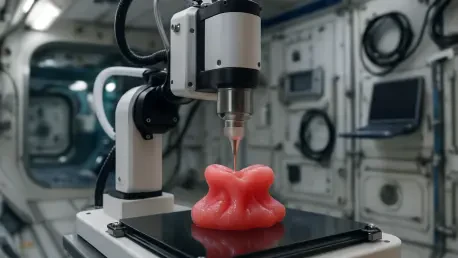
To overcome the limitations of terrestrial laboratories, a team of physicists orchestrated the COLORS experiment, a mission designed to study fluid dynamics in a microgravity environment. The project involved launching a suborbital sounding rocket that soared to an altitude of 267 kilometers, providing researchers with a brief but invaluable six-minute period of weightlessness. During this fleeting window, an automated system 3D-printed large droplets of a specialized soft material known as a micellar solution. This substance was chosen for its similarity to the bio-inks currently used in cutting-edge fields like tissue engineering and bioprinting. By removing the overwhelming influence of gravity, the experiment allowed the weak, intrinsic forces governing how the material spreads, merges, and settles to become the dominant and observable phenomena. This unique experimental setup provided an unprecedented opportunity to capture data on the behavior of soft matter during the additive manufacturing process, a crucial step toward perfecting its application in demanding environments.
Visualizing the Invisible Stresses
A key innovation of the COLORS experiment was the use of a sophisticated optical system designed to make the internal stresses within the printed material visible to the naked eye. As the micellar solution droplets were deposited and began to coalesce in zero gravity, this specialized equipment detected and translated the internal forces into a visual spectrum, with highly stressed regions appearing as bright, distinct colors. This direct visualization is critical because these are the exact forces that, once the material solidifies, become “frozen” structural flaws. On Earth, these subtle imperfections are incredibly difficult to isolate and study, but in the microgravity environment, they became the primary focus. By mapping these stress patterns in real-time, the researchers gathered crucial data that explains why some 3D-printed soft materials fail unexpectedly. This insight is fundamental to developing new printing techniques and material formulations that can actively prevent the formation of these internal weak points from the outset.
Forging a Digital Future for Manufacturing
The insights gained from this brief journey into space offered more than just a confirmation of theoretical principles; they provided a foundational dataset that is poised to revolutionize the additive manufacturing of soft materials. The ultimate goal of this research was to construct highly accurate predictive models that can simulate the fluid deposition process with unparalleled precision. These models will form the basis of a “digital twin,” a virtual replica of the 3D printing process that can forecast how a material will behave under various conditions, including the formation of internal stresses. By running countless simulations with this digital twin, engineers and scientists could refine printing parameters and material compositions to ensure the final product possessed maximum structural integrity and reliability. The successful flight and data collection from the COLORS experiment thus marked a pivotal moment, laying the groundwork for more dependable 3D printing technologies for critical applications both in space and on Earth.