
The familiar hum of the automotive assembly line is increasingly being orchestrated by a new generation of sophisticated robotic workers, moving far beyond the simple mechanical arms that once defined industrial automation. This review explores the evolution of this technology at Ford Motor Company, its key features, performance metrics, and the impact it has had on diverse applications, from production to logistics. The purpose is to provide a thorough understanding of Ford’s multifaceted robotics strategy, its current capabilities, and its potential for future development.
The Strategic Integration of Robotics at Ford
Ford’s adoption of robotics has transformed from a reliance on traditional, caged industrial arms into a dynamic and diverse ecosystem of advanced automated solutions. The core principle of this strategy is to leverage specialized robots to enhance efficiency, improve worker safety, and drive innovation across all operational facets. This approach positions the company at the forefront of the automotive industry’s technological transformation.
This multifaceted integration extends beyond the factory floor, incorporating robotics into facility management, logistics, and direct employee support. Rather than seeking a one-size-fits-all solution, Ford tailors its robotic deployments to specific tasks, creating a collaborative environment where technology augments human skill rather than simply replacing it.
Key Robotic Technologies in Ford’s Operations
Humanoid Robots in Complex Factory Roles
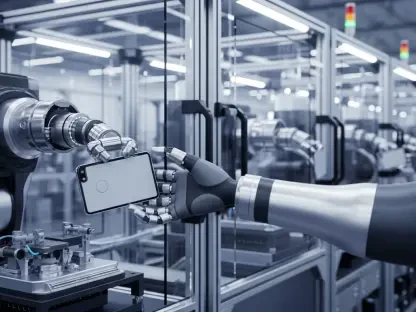
Ford is actively testing advanced, AI-powered humanoid robots for intricate manufacturing tasks previously reserved for human operators. A prime example is the successful proof-of-concept trials involving Humanoid’s HMND 01 Alpha, a wheeled humanoid designed to manipulate large car body parts and manage totes within a factory setting. These trials highlighted the robot’s high reliability in autonomous pick-and-place operations.
The successful testing signals that these advanced machines are ready for integration into real-world production environments. Their ability to handle complex duties autonomously represents a significant step toward a more flexible and intelligent manufacturing floor, where robots can adapt to dynamic operational needs.
Collaborative Robots on the Assembly Line
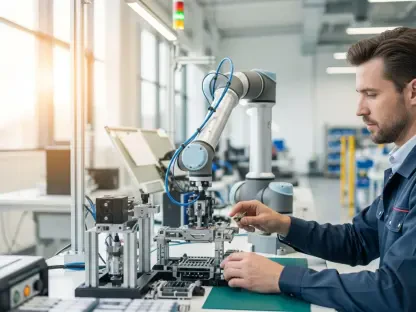
At its Cologne plant, Ford has seamlessly integrated collaborative robots, or “cobots,” to work directly alongside human employees on the assembly line. Models like the UR10 from Universal Robots are assigned physically demanding and highly repetitive tasks, such as sanding the entire body surface of a vehicle in under a minute. This application of human-robot collaboration significantly optimizes workflows.
By delegating these strenuous jobs to cobots, human workers are freed to concentrate on final quality control and other more nuanced responsibilities that require critical thinking and dexterity. This synergistic relationship enhances both productivity and the quality of the final product while improving the ergonomic conditions for the workforce.
Quadrupedal Robots for Facility Management
To modernize and streamline plant maintenance, Ford utilizes four-legged robots from Boston Dynamics, affectionately nicknamed “Fluffy” and “Spot.” These agile robots navigate and scan sprawling facilities like the Van Dyke Transmission Plant, accessing hard-to-reach areas to create precise, up-to-date digital models of the environment.
This innovative approach to facility mapping has cut scanning time by half, providing engineers with critical data for retooling and optimizing plant layouts for new vehicle production lines. The use of these quadrupeds demonstrates a proactive strategy to maintain and upgrade infrastructure with unprecedented speed and accuracy.
Bipedal Robots for Last-Mile Delivery
Looking toward the future of logistics, Ford is exploring the use of the bipedal robot, Digit, to solve the complex challenge of last-mile delivery. In a forward-thinking partnership with Agility Robotics, this two-legged robot, capable of carrying packages up to 40 pounds, is envisioned to work in concert with self-driving vehicles.
The concept involves Digit autonomously transporting goods from a parked autonomous vehicle directly to a customer’s doorstep. This initiative aims to create a completely seamless end-to-end logistics solution, bridging the final gap in automated delivery services.
Wearable Exoskeletons for Worker Support
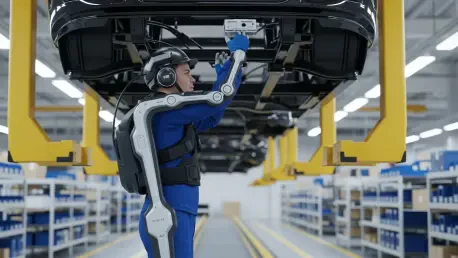
To enhance employee well-being and mitigate the risk of workplace injuries, Ford has implemented the EksoVest, an upper-body exoskeleton developed with Ekso Bionics. This wearable device has been deployed across 15 plants globally to provide lift assistance for workers performing repetitive overhead tasks.
The EksoVest lessens physical strain by supporting a worker’s arms, demonstrating a commitment to augmenting human capabilities and fostering a safer, more sustainable work environment. This technology directly addresses the physical toll of manufacturing jobs and represents a crucial investment in the health of the company’s workforce.
Emerging Trends and Strategic Partnerships
A primary trend shaping Ford’s robotics strategy is the formation of strategic partnerships with specialized technology firms like Humanoid, Universal Robots, Boston Dynamics, and Agility Robotics. Instead of attempting to develop all solutions in-house, Ford effectively leverages external expertise to address specific operational challenges, accelerating innovation and deployment.
This partnership-driven approach is complemented by significant investment in future research, highlighted by the $75 million Ford Robotics Building at the University of Michigan. This facility serves as a dedicated hub for developing, testing, and refining next-generation robotic technologies, ensuring a continuous pipeline of innovation.
Applications Across the Automotive Value Chain
Ford’s implementation of robotics extends far beyond the traditional assembly line to encompass the entire operational value chain. Humanoids and cobots are applied directly to vehicle manufacturing and finishing, fundamentally changing how cars are built. Simultaneously, quadrupedal robots are proving crucial for facility management and the complex process of retooling plants for future models.
This holistic application demonstrates a comprehensive strategy to integrate automation at every possible touchpoint. Bipedal robots are being tested for future logistics and delivery services, while wearable exoskeletons are deployed to directly support employee health and safety, creating a fully connected and technologically advanced ecosystem.
Challenges and Future Development Efforts
The primary challenge in deploying such a diverse range of robotics lies in integration, interoperability, and ensuring the reliability of advanced AI systems in dynamic factory environments. Technical hurdles include programming robots for complex, non-repetitive tasks and ensuring seamless, safe collaboration between machines and human workers.
Ford addresses these limitations through a methodical approach involving targeted proof-of-concept trials and iterative testing in controlled settings like its Advanced Manufacturing Center. Furthermore, long-term research collaborations with academic institutions help refine the technology for widespread, reliable adoption, turning experimental concepts into dependable industrial tools.
The Future of Automation in Automotive Manufacturing
The trajectory of robotics at Ford points toward a hyper-automated, interconnected, and highly collaborative manufacturing ecosystem. Continued advancements in artificial intelligence and machine learning will enable robots to perform increasingly complex and cognitive tasks, moving far beyond simple, repetitive automation to handle roles requiring judgment and adaptation.
Potential breakthroughs on the horizon include the full-scale deployment of humanoid robots on production lines and the commercial launch of autonomous delivery services powered by bipedal bots. The long-term impact will be a more agile, efficient, and safer production model that fundamentally reshapes the nature of work in the automotive industry.
A Blueprint for Next-Generation Manufacturing
Ford’s robotics strategy provides a comprehensive blueprint for the future of automotive manufacturing. By embracing a diverse portfolio of robotic solutions—from humanoids and cobots to quadrupeds and exoskeletons—the company addresses critical needs in production, logistics, maintenance, and worker well-being. This forward-thinking, partnership-driven approach not only enhances current operational efficiency but also positions Ford as a leader in the ongoing technological revolution, setting a new standard for the industry. This holistic integration of advanced automation creates a robust framework for innovation and resilience in a rapidly evolving market.